
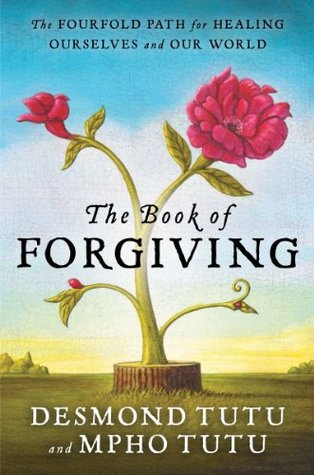
More on this book
Community


Kindle Notes & Highlights
by
Desmond Tutu
Read between
May 9 - May 21, 2021

I forgive, so that it is not the main plot of our life story, and so that we can go on to write new stories, better stories, happier stories.
butterfly struggles against the cocoon that surrounds it, and it is this very struggling that makes it resilient enough to survive when it breaks free.
Like the butterfly, we must become stronger and more resilient, and we will transform. We cannot remain frozen in a chrysalis.
Many people will carry grudges and resentments for years, believing this will somehow hurt the other person. In truth, it often only hurts the one who carries the grudge or resentment.
Forgiving is the only thing that can transform the aching wounds and the searing pain of loss.
Summary Granting Forgiveness • Forgiveness is a choice. • We grow through forgiving. • Forgiving is how we move from victim to hero in our story. • We know we are healing when we are able to tell a new story.
This place of peace lives within you always and belongs to you. You can step into this place whenever you wish. It is yours, and no one can take it from you.
write your story again but this time not as the victim but as the hero.
Once you have been able to forgive, the final step is to either renew or release the relationship you have with the one who has harmed you. Indeed, even if you never speak to the person again, even if you never see them again, even if they are dead, they live on in ways that affect your life profoundly. To finish the forgiveness journey and create the wholeness and peace you crave, you must choose whether to renew or release the relationship.
The decision to renew or release is a personal choice that only you can make. Obviously it is easier to choose to renew a relationship when it is a close connection, such as a spouse, parent, sibling, or close friend. With these intimates it is much harder to release the relationship completely, as the threads of memory and intimacy that bind you are strong. It is easier to release a relationship with an acquaintance, neighbor, or stranger, because these people often do not hold as much of your heart.
Renewing our relationships is how we harvest the fruits that forgiveness has planted. Renewal is not an act of restoration.
Renewing a relationship is a creative act. We make a new relationship. It is possible to build a new relationship regardless of the realities of the old relationship.
each of us does have a role in the society we have created. We can take responsibility for our part in a way that frees us from being a victim and allows us to open our hearts.
Renewing a relationship is not restoring a relationship. We do not go back to where we were before the hurt happened and pretend it never happened. We create a new relationship out of our suffering, one that is often stronger for what we have experienced together.
We make choices that affect others even when we do not mean to hurt them.
Only when we can speak the secrets can we hope to banish our shame and live with truth and integrity.
Ubuntu places the highest value on whole and healthy relationships. If someone is hurt, Ubuntu enjoins us to try to understand that person’s pain. Ubuntu invites us to see from the other person’s perspective. We have perhaps all heard the question “Do you want to be right or do you want to be happy?”
Witnessing the Anguish • Do not argue. • Do not cross-examine. • Listen and acknowledge the harm you have caused. • Do not justify your actions or your motivations. • Answer all questions honestly and thoroughly.
A whole world can be built on the very foundation laid out in these three simple words: “I am sorry.” If we neglect this important step, we can create cracks in the foundation of our forgiving. We may need to utter those magical words many times before they are heard and felt. We may have to say them many times before they are believed. What is important is that we are courageous enough to say them, vulnerable enough to mean them, and humble enough to repeat them as many times as necessary.
You can also participate in a number of online anonymous apology websites or even call an apology hotline phone number and leave your apology as an anonymous voicemail message.
That these outlets for apology exist is a testament to the healing power of an apology offered.
Anonymous Apology Websites www.perfectapology.com www.imsorry.com www.joeapology.com Apology Hotline Number (in the United States) (347) 201-2446
We ask for forgiveness because none of us can live in the past. The victim cannot live in the past. The perpetrator cannot live in the past. When we ask for forgiveness, we ask for permission to begin again.
And most days I believe I have forgiven me. It’s been a long, hard process, though. If this had happened to a friend, I would have told them, “Accidents happen. Forgive yourself. Move on.” I guess we are hardest on ourselves. I know I am. I try to help others.
Self-Forgiveness Is Not a Free Pass When we forgive someone, we let go of any demand that he or she should suffer as we have suffered.
When we forgive ourselves, we also free ourselves from a cycle of punishment and retribution directed at ourselves.
Why Should I Forgive Myself and Why Is It So Difficult? Lack of self-forgiveness can affect every area of our lives—our health, careers, relationships, parenting, and our general happiness and well-being.
Learning from the past is not the same as being held hostage by what we have done. At some stage we must let go of the past and begin again. We have said repeatedly that no one is undeserving of forgiveness, and this includes you.
None of us is constantly our best self. None of us is perfect. Sometimes the failures for which we must forgive ourselves are not willful failures. We did the best we knew to do at the time.
None of us is perfect, but we can perfect the art of learning from our past mistakes, and we can perfect the art of self-forgiveness. This is how we grow and change and, ultimately, begin anew.
I also read spiritual books and twelve-step workbooks, and in one workbook on healing and forgiving yourself, it said to look at yourself in the mirror and say, “I love you.”
First and foremost, self-forgiveness requires absolute truth. We need truth before we can reconcile with others, and we need truth before we can reconcile with ourselves.
As we’ve said throughout the book, we forgive for ourselves, not for others.
When we feel a profound sense of shame, we feel a profound disconnection from ourselves and the world. We feel, at our core, that we are not worthy of forgiveness from others or from ourselves.
This is why twelve-step groups are so successful the world over—people are able to come together and identify with each other in a place where they feel they belong, regardless of who they are or what they’ve done. When you share your experiences with others, you create new meaning out of a painful past.
a new sense of value and purpose in the world. We feel shame in isolation. It can only be healed in a community and in connection with others.
Resolving Shame Share your feelings with others. Be of service and help others, and this will strengthen your sense of self-worth and value. Remember, you can heal shame only in connection with others, and when you connect with others, your compassion for others and for yourself increases. When you feel compassion for yourself, you are more easily forgiving of yourself and your past behavior.
We all want to live in peace and harmony. But living in peace with others requires having peace and harmony within ourselves.
When we place ourselves and our stories in the service of others, we can more easily forgive ourselves for our failings.
The new story admits that “yes, I have caused pain and suffering.” The new story also recognizes that “the harm I have caused in the past is not who I am today.” Self-forgiveness is truly at the core of peacemaking, and we cannot build peace with others if we are not at peace with ourselves.
we can create a world of peace by making a world of forgiveness.
Forgiving Yourself • We become imprisoned in the past when we do not forgive ourselves for past mistakes. • If you have not sought forgiveness from your victim, do so. Forgiving yourself will be easier after you have sought forgiveness from your victim. • We do not heal in isolation. Connecting with others is how we develop compassion for others and for ourselves. Meditation
Breathing Compassion 1. For this meditation you will need to get still and centered. 2. Find a quiet place to sit or lie comfortably. 3. Follow your breath. 4. As you breathe in, visualize love and compassion entering you like a golden light. 5. With each inhalation, you will see the golden light begin to fill you from your toes to the top of your head. 6. When you are filled, you radiate this love and compassion outward effortlessly.

Meditation golden light
Take Care of Each Other We must all be careful with our words. Hurtful words may not be forgotten, but they can be forgiven.
Onelife alliance.org is using the power of connection to unite people of all ages, from all countries, backgrounds, nationalities, and religions, to respect the dignity and sanctity of life and to create a world of harmonious balance and cooperation.
Transformation is always possible. We do not heal in isolation. When we reach out and connect with one another—when we tell the story, name the hurt, grant forgiveness, and renew or release the relationship—our suffering begins to transform. We don’t have to carry our pain alone. We don’t have to bind ourselves to our losses forever. Our freedom is forged in the fires of forgiving, and we grow into more spiritually evolved people because of it.
when we help others, we also help ourselves.
Creating a world of forgiveness is a living practice. You
Know that we are all flawed and we are all just struggling to find our place in the sun—a place where we can be acknowledged and affirmed for who and what we are.
Restorative justice strives to bring about real healing and true justice to individuals and communities.
