
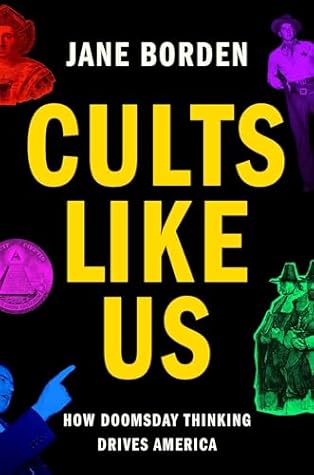
More on this book


Kindle Notes & Highlights
by
Jane Borden
Read between
November 11 - November 18, 2025

The avatar of our country’s founding was a doomsday group. We’ve been iterating on its prototype since. We can’t stop re-creating our first trauma, whether in religious movements that eventually go mainstream (such as the Quakers and Mormons); secular groups that devolve into abuse (like NXIVM and Amway); or zeitgeisty social movements (think eugenics or welfare reform).
(About 20 percent of Americans do take the Bible literally.)
Beneath almost all apocalyptic thinking are notions of exceptionalism and, the flip side of that coin, persecution. Trample me now, but one day you’ll burn while I dance in the sky.
However, there’s a paradox in asserting no one can tell us what to do: it opens us to that exact result. The demagogue or cult leader’s pitch warns of evil agents who wish to control us. Popular paper tigers have included “communists,” our own psychological limitations, a “cabal of pedophiles” who run the government, and “woke” culture. How attractive it can be, then, when said leader offers to save us from that supposed persecution. If we follow their instructions—or buy their coaching sessions or supplements—we will receive a better life, either now on earth or everlasting, come doomsday. In
...more
The word’s meaning shifted in America around 1900, when it began describing “delusions, fanatics, enthusiasts, and imposters” and took on a decidedly derogatory tone.3 Before long, the designation was used for all manner of new, nontraditional, or non-Christian groups within our borders. Some of the biggest targets of the era were Christian Science, the Jehovah’s Witnesses, and, of course, Mormonism, all of which are now established and institutionalized religions.

The word's (cult) meaning...
“Cults can be identified by three characteristics: 1) a charismatic leader who increasingly becomes an object of worship…; 2)… coercive persuasion or thought reform; 3) economic, sexual, and other exploitation of group members by the leader and the ruling coterie.”
My definition is Lifton’s plus a few additional characteristics: that the leader enjoys unchecked power, exploits people specifically by manipulating their latent beliefs and desires, and almost always exhibits some kind of narcissistic personality disorder; and that the group can be of any size.
There are an estimated ten thousand cultlike groups in America, about twice as many now as the estimate in the early aughts.
Sociologists agree that cultlike thinking surges under certain circumstances: in times of technological revolution (social media has shattered traditional communities; AI is leading to mass layoffs), social upheaval (#MeToo; minority populations will soon be the majority in America), and crisis (climate change is arguably the biggest one humanity has ever faced).
By now, most know Columbus wasn’t who history books said he was. Americans willing to pay attention have discovered Columbus wasn’t all that motivated by adventure and progress, after all. Mostly, he wanted gold—and spices, mastic, anything to enrich his and Spain’s coffers. The search consumed him. As it turns out, though, Columbus wasn’t even who we rethought he was. It was natural to assume he sought wealth out of basic avarice. But no. In truth, he needed all that gold because it’s expensive to bring back Jesus.
Apocalyptic thinking wasn’t standard at the time. It wouldn’t go mainstream until a century later in England, following the Protestant Reformation.
Adherents argued that the practice of “good works” could do nothing to gain one entry into heaven because God has already determined who will and won’t be saved before any of us has a chance to appeal it.
The immigrants eventually chose a spot that was already partially developed: an existing Native village on the mainland, emptied after an epidemic brought by previous western explorers had all but exterminated the Patuxet people. Naturally, the English believed God had left this just for them, along with the huge stash of buried corn and seed.
Which, as we know from Over My Dead Body, the "stash" were graves!
A persistent myth, supported by decades of misled historical scholarship, tells us that the Puritans aimed to detach from the cruel world of commerce and live a spiritual life unspoiled by worldliness. “You can still sometimes see that image in textbooks,” Pestana told me, “but that’s wrong.” Plymouth and the MBC were economically active from the jump. They had to be. The MBC was a joint-stock corporation, meaning it had shareholders. It owed money to investors. And Plymouth had basically the same investment structure, though less formal. As early as 1624, Plymouth was described as a place
...more
Even so, the secret to their economic success was in their religion. They believed having and pursuing a calling was the best way to glorify God. Ergo, work is holy. They also believed God made people specifically to glorify him, meaning there’d be trouble if they didn’t. So everyone had to work.
Anyway, if work is holy, then idleness is a sin. A twelve-hour day keeps the devil away.
Intiguing theory - is that also why we had to fight tooth and nail for workers rights. I mean, obviously greed was a big factor, but underlying cause?
they believed God impelled them to use the natural world for their benefit. Buttressing this was the more elemental and heartbreaking belief that nature is evil. This predates Protestantism, sure. But the Puritans upped the ante, thanks to their notion of predestination, which reasoned that anyone pre-chosen by God as saved had been given grace and contained no nature in them whatsoever. That’s the hierarchy: holy grace above evil nature. But, they reasoned, if you use the material world for a godly purpose (for example, your work), then you are improving the world and making it more godly.
...more
That is from “The Day of Doom,” a long-form poem by the pastor Michael Wigglesworth. Dark stuff from a guy whose name sounds like a toddler in a tickle fight. It catalogues Judgment Day—when Jesus swipes everyone left or right—in gory, exhaustive detail. Published in 1662, it’s a cosmic eff-you and I-told-you-so to the masses of those presumed damned. The Puritans loved it. The first eighteen hundred copies sold out within a year, remarkable considering New England’s population was only about thirty thousand total. It’s been called America’s first bestseller. One in twenty New Englanders
...more
Punishment was central to the colony’s theology and government, as well as to everyone’s identity and understanding of their relationship with both corporeal and eternal life. Punishment was also New England’s primary source of entertainment.
America today has one of the highest incarceration rates in the world.
Tied to "Punishment was central..." highlight
This was not just a culture of punishment; this was a high-control group, meaning the power structure in the group regulated residents’ behavior, beliefs, and information intake, all via high pressure to conform.
High-control groups are often most damaging to youth.
If they gave their children too much affection, it was sinful because it showed love for a creature, which was dangerous, since you couldn’t love anything as much as you loved God. For the same reason, widows were not allowed to grieve much, since doing so would suggest they had inordinately loved their spouses. Surviving diaries are full of worries over the sadness felt following the death of loved ones.
Scholars have deduced, after poring over diaries, that the second and third generations of New England Puritans exhibited during adolescence significant increases in melancholy, pathological abnormalities, nervous breakdowns, suicide, and insanity.24
liberty, at the time, was often shorthand for religious liberty or liberty of conscience. Both were defined as the ability to worship solo, beyond the literal or metaphorical walls of the Church of England. However, in turn, liberty could grant said petitioners the right to invalidate said church. Those seeking liberty, in other words, did not intend to grant the same tolerance to others.
another identity trait of God’s chosen people was to destroy sin in others? It was a Puritan duty to self-righteously intervene. As minister Thomas Hooker argued, “What ever sins come within his reach, he labors the removal of them, out of the familyes where he dwells, out of the plantations where he lives, out of the companies and occasions, with whom he hath occasion to meet and meddle at any time.”
Some of the Puritans’ controlling doctrine and behavior started at the jump, but much of it developed beginning around the 1640s and 1650s, when founders and elders became rigidly determined to hold what they’d built and developed—that is, when they became corrupted by power and refused to relinquish it. The Puritans came here as dissenters, but ended up as rigid and intolerant as the leadership they’d fled, arguably more so. Their lofty ideals twisted over time. For example, as more community members developed the inner conviction of being saved, ministers feared their leadership would lose
...more
In high-control groups, unchecked hunger for power can never be sated; its ultimate destination is violence. Granted, most cults implode or dissipate first. Yet the Puritans did arrive at such a terminus: the Salem witch trials of 1692 and 1693. Some scholars believe the craze developed specifically in response to the MBC’s strict patriarchal structures. “The hysteria began with the most powerless among the powerless.”28 Accusations were lobbed by children, females, and servants, that is, exactly those most controlled by the colony’s system of family governance.
one was pressed to death with stones,
Get it, Giles Corey
Robert Jay Lifton, the leading modern scholar of coercive groups, developed eight criteria of “thought reform,” eight indicators that a group psychologically controls its members: information and communication are controlled; perfection and purity are demanded; sins and faults are openly discussed and excoriated; doctrine and leadership are ultimate truth and beyond criticism; personal experiences are subordinate to ideology; language and thought-terminating clichés are used to force conformity; everyone in the outside world is evil; and experiences are orchestrated to appear spontaneously
...more
I find seven of their credos to be most pervasive and problematic and I’ve devoted a chapter to each: our innate desire for a strongman to fix our problems and punish those who aggrieve us; the temptation to feel chosen, which justifies acting on our base desires; our knee-jerk anti-authoritarianism and anti-intellectualism; our impulse to buy and sell salvation on the open market; the belief that hard work is holy, while idleness is a sin; how quickly and easily we fall into us-versus-them thinking; and, finally, an innate need for order, which makes us vulnerable to anyone screaming,
...more
The Pilgrims and the Puritans believed almost all humans had been created just so God could watch them grovel before tossing them into fire where, for eternity, he would listen to them scream. But before that judgment, Jesus pulls up everyone going to heaven—so they can witness and help. Their first heavenly reward is to watch their friends and family beg for mercy.
But one belief in particular made Elizabeth Clare Prophet a national media sensation: her prophecy that the Soviets would drop nuclear bombs on America on March 15, 1990. Church members felt such cataclysms were inevitable whenever earthly karma from evils, such as rock ’n’ roll and abortion, accumulated to a breaking point. Such disasters rebalance the world—in spite of the fact that, or perhaps because, millions perish.
This is always the case with doomsday groups: followers believe they have been chosen to survive an inevitable disaster—one delivered specifically in order to save the chosen from evil. Evil, in this case, is everyone else: those who didn’t listen to the chosen and, especially, those who persecuted the chosen. Fortunately, that means they needn’t feel bad for everyone else, since the afflicted clearly had it coming.
I’m not sure by what standards CUT’s behavior wouldn’t merit attention. The group had spent $25 million on materials alone to build the biggest private bomb shelter in the United States, outfitted to house 756 people for several years. A month prior, an accidental fuel leak at the site had dumped thirty-two thousand gallons of diesel oil and gasoline into the Montana wilderness just north of Yosemite Park. And in the summer of ’89, two church members had been arrested for purchasing weapons under a false name, which revealed a plan to arm at least two hundred members, including with
...more
if someone wanted to secure a spot in the fallout shelter, they were indeed expected to move to Montana and to sign away their assets. Many members were left penniless following the failure of the prophecy. Some had accrued substantial debt and even written bad checks to local businesses, totaling, Erin reports, $100,000, including $35,000 to a local grocery store. Church members’ debt put a lumber company out of business.
As high-control groups and cults age, punishment is increasingly used as a tool for conformity. Fear keeps people in line and leaders in power.
Sean thinks his mother felt she didn’t have a choice either, that destruction was God’s will, and she was the instrument of that will. But, he says, she confused the will of God with her own: “The world persecuted God’s messenger, and so she felt that in order for divine justice to be done, the world must be destroyed.”8 It sounds like the kind of grievance narrative often motivating desires for divine punishment.
Sean says his mother was different after the trial. The feeling of persecution changed her.
Elizabeth Clare Prophet did want violence, vengeance against those who failed to see her. She just wanted someone else to deliver it. That desire, as we will explore, is one of America’s most enduring legacies. In the mid-1960s, at Morningside College in Sioux City, Iowa, Robert Jewett and John Shelton Lawrence discussed the Vietnam War. They wondered how and why the nation could tolerate such extreme violence. Then they made a startling discovery about narratives of violence in popular culture. It eventually became their 1977 book, The American Monomyth.11 Basically, Jewett and Lawrence
...more
The authors trace the local origin of this ubiquitous myth to a collection of early American writings known as “Indian captivity narratives,” a genre developed during the Puritan era, in which settlers who had been abducted by Native tribes recounted their harrowing journeys and rescues. In these stories, the violent means by which captives are saved also redeems the larger community and cleanses the wilderness. The monomyth as we know it today, however, really took shape in the 1920s and 1930s, with an explosion of cowboy Westerns and the development of superheroes. But all of those were just
...more
Revelation is not simply the title of this work. It’s the title of a genre. Many works in the genre were produced during the first and second centuries, times of great economic and martial strife, which are always marked by increases in end-time thinking and the accompanying visions of how it will go down. But of the revelations produced around then, only John’s has stood the test of time. First, its vague and coded language—likely employed to save himself from Roman retribution, via plausible deniability—has allowed groups throughout history to plug their own enemies into its narrative. It’s
...more
Revelation is basically only in the Bible by accident. Because the author’s name is John, some early Christians mistakenly believed it was written by John of Zebedee, to whom is attributed the Gospel of John and who was one of Jesus’s disciples. That guy is a legend! They figured anything he wrote ought to be in the Bible, no matter how freaky. But Revelation, it turns out, was written by a dude named John of Patmos.
We know his story is about Rome because John left rather intentional clues. For example, the beast has seven heads, one for each of Rome’s emperors up to that point. Plus, the whole 666 thing. John writes, “Let anyone with understanding calculate the number of the beast, for it is the number of a person.”17 In Jewish numerology, 666 spells the imperial name of Nero, the cruelest of the emperors.
If this story originates in first-century Judea, how did it become American? It happened the same way these kinds of stories always develop: in the wake of a promise broken. These are grievance narratives.
One Union Pacific Railroad ad painted Western settlers as a kind of chosen people, “the advance column of civilization… a peaceable, even-tempered race, who hate war, love peace… honor their wives, raise honest children, live within their income, and grow rich out of Kansas soil.”
Droves of people moved west just in time for the fantasy to shatter. The economic panic of 1873, the depression of 1882−1885, and the panic of 1893 devastated many homesteaders who were already struggling to grow food with very little water. In short, Western settlers experienced the cultural equivalent of what’s known in cult studies as a failure of prophecy: a promise broken.
After the event failed to occur, researchers witnessed group members struggling to hold two beliefs at once: their belief in the prophecy of a cataclysm, and their belief in their eyes and ears, which saw and heard no sign of saucer or flood. The researchers coined this psychological struggle cognitive dissonance. To relieve the tension of this dissonance, some members chose reality and left the group. But many instead relieved dissonance by digging in their heels—by rationalizing reality until it supported prophecy. They readily accepted Martin’s claim that the group’s steadfastness had
...more
we humans typically prefer to explain away pesky evidence rather than change our beliefs. The degree to which one has invested in a set of beliefs will largely determine how willing they are to argue away reality in the face of disconfirmation. If, for example, it’s the middle of the 1800s and you left everything behind on the East Coast to move your family west to homestead on a plot of land in Kansas, which is now all you own in the world, you’re pretty invested. When it all goes to hell, will you accept your mistake, cut your losses, and leave? Or will you fall for a second prophecy that
...more
On September 17, 2021, former United States national security advisor Michael Flynn spoke at a Christian Right conference in Iowa, where he led the congregation in an unusual prayer.
