
More on this book
Community


Kindle Notes & Highlights


We might say that theme, or what I call moral argument, is the brain of the story. Character is the heart and circulation system. Revelations are the nervous system. Story structure is the skeleton. Scenes are the skin.
KEY POINT: Each subsystem of the story consists of a web of elements that help define and differentiate the other elements.
Like the storyteller, nature often connects elements in some kind of sequence.
Nature uses a few basic patterns (and a number of variations) to connect elements in a sequence, including linear, meandering, spiral, branching, and explosive.
Storytellers use these same patterns, individually and in combination, to connect story events over time.
The linear and explosive patterns are at the op...
This highlight has been truncated due to consecutive passage length restrictions.
The linear pattern has one thing happening after another on a straight-line path. Explosion has everyt...
This highlight has been truncated due to consecutive passage length restrictions.
The linear story tracks a single main character from beginning to end, like this: It implies a historical or biological explanation for what happens.
Meandering Story The meandering story follows a winding path without apparent direction. In nature, the meander is the form of rivers, snakes, and the brain:
Myths like the Odyssey; comic journey stories like Don Quixote, Tom Jones, Adventures of Huckleberry Finn, Little Big Man, and Flirting with Disaster; and many of Dickens’s stories, such as David Copperfield, take the meandering form.
The hero has a desire, but it is not intense; he covers a great deal of territory in a haphazard way; and he encounters a number of characters from different levels of society.
A spiral is a path that circles inward to the center:
Thrillers like Vertigo, Blow-Up, The Conversation, and Memento typically favor the spiral, in which a character keeps returning to a single event or memory and explores it at progressively deeper levels.
Branching Story Branching is a system of paths that extend from a few central points by splitting and adding smaller and smaller parts, as shown here:
In storytelling, each branch usually represents a complete society in detail or a detailed stage of the same society that the hero explores.
The branching form is found in more advanced fiction, such as social fantasies like Gulliver’s Travels and It’s a Wonderful Life or in multiple-hero stories like Nashville, American Graffiti, and Traffic.
Explosive Story An explosion has multiple paths that extend simultaneously; in nature, the explosive pattern is found in volcanoes and dandelions.
a story, you can’t show the audience a number of elements all at once, even for a single scene, because you have to tell one thing after another; so, strictly speaking, there are no explosive stories.
But you can give the appearance of simultaneity. In film, this is done with the technique of the crosscut.
Stories that emphasize simultaneous action tend to use a branching structure and include American Graffiti, Pulp Fiction, Traffic, Syriana, Crash, Nashville, Tristram Shandy, Ulysses, Last Year at Marienbad, Ragtime, The Canterbury Tales, L.A. Confidential, and Hannah and Her Sisters
but each emphasizes characters existing together in the story world as opposed to a single character developing from beginning to end.
Most writers don’t use the best process for creating a story. They use the easiest one.
We could describe it in four words: external, mechanical, piecemeal, generic.
The writer comes up with a generic premise, or story idea, that is a vague copy of one that already exists.
Or it’s a combination of two stories that he has creatively (he thinks) stuck together.
Knowing the importance of a strong main character, our writer focuses almost all of his attention on the hero. He “fleshes out” this character mechanically, by tacking on as many traits as possible, an...
This highlight has been truncated due to consecutive passage length restrictions.
He thinks of the opponent and minor characters as separate from and less important than the hero. So they are almost alwa...
This highlight has been truncated due to consecutive passage length restrictions.
He sets the story in whatever world seems normal for that character, most likely a major city, since that’s where most people in his audience live.
He doesn’t bother using symbols because that would be obvious and pretentious.
He comes up with a plot and a scene sequence based on one questio...
This highlight has been truncated due to consecutive passage length restrictions.
Often he sends his hero on a physical journey. He organizes his plot using the three-act structure, an external imprint that divides the story into three pieces b...
This highlight has been truncated due to consecutive passage length restrictions.
If he is ambitious, he has his hero state the theme directly in dialogue near the end of the story.
If most writers use an approach that is external, mechanical, piecemeal, and generic, the writing process we will work through might be described as internal, organic, interconnected, and original.
Here’s the writing process we’re going to use in this book:
We will work through the techniques of great storytelling in the same order that you construct your story.
Most important, you will construct your story fro...
This highlight has been truncated due to consecutive passage length restrictions.
That means two things: (1) making the story personal and unique to you and (2) finding and developing what is ...
This highlight has been truncated due to consecutive passage length restrictions.
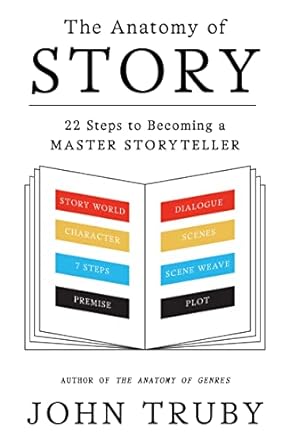
Premise We begin with the premise, which is your entire story condensed to a single sentence. That premise will suggest the essence of the story, and we will use that to figure out how to develop it so as to get the most out of the idea.
Seven Key Story Structure Steps The seven key story structure steps are the major stages of your story’s development and of the dramatic code hidden under its surface. Think of the seven structure steps as your story’s DNA. Determining the seven key steps will give your story a solid, stable foundation.
Character Next, we will create the characters, not by pulling them out of thin air but by drawing them out of your original story idea. We will connect and compare each character to every other character so that each one is strong and well defined. Then we’ll f...
This highlight has been truncated due to consecutive passage length restrictions.
Theme (Moral Argument) The theme is your moral vision, your view of how people should act in the world. But instead of making the characters a mouthpiece for a message, we will express the theme that is inherent in the story idea. And we’ll express the theme throug...
This highlight has been truncated due to consecutive passage length restrictions.
Story World Next, we’ll create the world of the story as an outgrowth of your hero. The story world will help you define your hero and show the audi...
This highlight has been truncated due to consecutive passage length restrictions.
Symbol Web Symbols are packets of highly compressed meaning. We’ll figure out a web of symbols that highlight and communicate different aspects of the ...
This highlight has been truncated due to consecutive passage length restrictions.
Plot From the characters we will discover the right story form; the plot will grow from your unique characters. Using the twenty-two story structure steps (the seven key steps plus fifteen more), we will design a plot in which all the events are connected under...
This highlight has been truncated due to consecutive passage length restrictions.
Scene Weave In the last step before writing scenes, we’ll come up with a list of every scene in the story, with all the plotlin...
This highlight has been truncated due to consecutive passage length restrictions.
Scene Construction and Symphonic Dialogue Finally we’ll write the story, constructing each scene so that it furthers the development of your hero. We’ll write dialogue that doesn’t just push the plot but has a symphonic q...
This highlight has been truncated due to consecutive passage length restrictions.
MICHAEL CRICHTON doesn’t have the deep human characters of a Chekhov or the brilliant plots of a Dickens. He just happens to be the best premise writer in Hollywood.
Take Jurassic Park, for example. Crichton’s story might have come from this designing principle: “What if you took the two greatest heavyweights of evolution—dinosaurs and humans—and forced them to fight to the death in the same ring?” Now that’s a story I want to see.
But most begin with the shortest expression of the story as a whole, the premise line.
The Godfather: The youngest son of a Mafia family takes revenge on the men who shot his father and becomes the new Godfather.
