
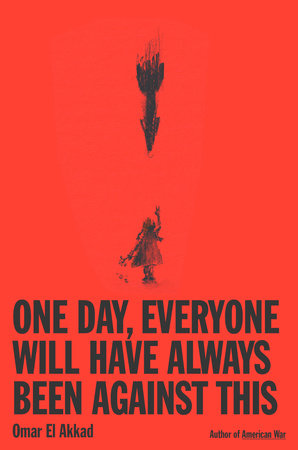
More on this book
Community


Kindle Notes & Highlights


But for now we argue, in this part of the world, the part not reduced to rubble, about how words make us feel. It’s a kind of pastime. Almost every day an influential opinion columnist or think tank expert or spokesperson for the president of the United States will feign outrage at how hurtful words such as “genocide” and “occupation” are, how disparaging, how uncouth.
Once far enough removed, everyone will be properly aghast that any of this was allowed to happen. But for now, it’s just so much safer to look away, to keep one’s head down,
And just as they (and we, and most everyone who comes to places like Qatar to do anything other than manual labor) became bigger, in Montreal my family settled into our smaller selves.
In the earliest days, in the chaos that precedes systemic annihilation, it is not what the party deemed most malicious has actually done that matters, but rather what it is believed capable of doing.
Western world is Fox News, an entity that more than any other has normalized the practice of severing any relationship between the truth and what one wishes the truth to be.
Jettisoning the requirement to report news in favor of inciting the rage and fear and hatred of your audience before serving them up ads for guns and bunkers is a perfectly functional business model. It might not be journalism, might be the opposite of journalism, but the checks clear.
A reporter is supposed to agitate against power, against privilege. Against the slimy wall of press releases and PR nothingspeak that has come to protect every major business and government boardroom ever since Watergate. A reporter is supposed to agitate against silence.
I remember, early in the 2016 election campaign, Donald Trump musing about forcing American Muslims to carry special identification cards—a proposal that is by any honest measure reminiscent of the preamble to some of history’s worst atrocities. Hillary Clinton condemned the idea and returned to her talking point about how American Muslims were important allies in the War on Terror, the government’s “eyes and ears” on the front lines of radicalization and extremism. That’s not why such a proposal deserves condemnation. It deserves condemnation because it is morally repugnant. But morals
...more
Palestinian reporters are in effect the world’s sole source of information about the reality of the obliteration of Gaza, the plain truth of the horror in the face of a mass propagandist effort that at one point included the president of the United States claiming to have seen pictures of dead babies he never saw, claiming a United States ally did not bomb a hospital among the myriad hospitals it now regularly bombs. The price of reporting under these conditions is everything.
In articles about atrocities committed by groups or nations that are not Western allies, nobody ever perishes in a blast. Buildings don’t collapse of their own volition. Civilian victims aren’t ordered by their interviewers to performatively condemn groups with which they have no affiliation. The violence is named, as is its perpetrator.
The afflicted don’t need comforting, they need what the comfortable have always had.
Tomorrow more Palestinians will die, but the unsaid thing is that it is all
right because that’s what those people do, they die. Just for a moment, cease to believe that this particular group of people are human.
At the checkpoints some pass, others are made to wait hours and hours, just for the hell of it, just as a reminder. A woman miscarries, waiting. A cancer patient dies, waiting. An area is designated safe, then bombed. A soldier shoots a teenage girl seventeen times and is found not guilty. Life goes on, for some but not others.
Are you, as someone who looks like those people who blow themselves up, for or against this? Will you condemn it, condemn it ceaselessly and no matter how unrelated to your existence it may be? Are you one of the bad ones who hate us, or one of the good ones who will tell on the ones who hate us? Should you be caught in the crossfire of our efforts to weed out the bad people, will you understand we had no choice but to do this? What is your relationship with the limitless violence of which you have always been capable in our minds?
When a white man kills dozens of people in a concert or a synagogue or a school, it’s a crime. A hate crime, sometimes. But terrorism requires a distance between state and perpetrator wide enough to fit a different kind of fear. The kind of fear that justifies the creation of entirely new laws, new modes of detention, new apparatuses of surveillance, anything, anything at all.
Against those people, those lesser people, anything can be justifiably done. The point is to flaunt permission. Am I allowed to be afraid of this? And if so, what is the purchasing power of my fear?
Today I watched footage of a man kissing his son’s foot as he buried the body so torn apart by the missiles that the foot was one of the only pieces the father could find in the rubble. Tell me this man doesn’t know love, hasn’t been made to know it in a way no human being should.
Anyone who has dragged a relative out from under the wreckage of a bombed building, who has held a friend bleeding to death in the street while the officer who pulled the trigger looks on, who has watched their water poisoned, their land burned, their communities starved, is intimately well versed in love. But in the eyes of the empire such a thing can never be called love, because the directive was never in the first place, Love, but rather, Love me. In spite of it all, love me.
I want to live in a world where the worst thing imaginable is a protest nearing a hospital. I want the narcotic capacity to unsee mangled bodies, surgeons sniped in their operating room, a handcuffed prisoner ordered into a hospital to tell everyone to leave and then, on his return outside, executed—so that I too might calibrate my condemnations accordingly. It would be good to live in that world.
Colonialism demands history begin past the point of colonization precisely because, under those narrative conditions, the colonist’s every action is necessarily one of self-defense.
How does one finish the sentence: “It is unfortunate that tens of thousands of children are dead, but…”
I have spent the entirety of my life stitching together costumes to make Westerners feel at ease in my presence—a massive internal compendium of cultural references and jokes and shorthand and all these alternate means of saying, Don’t worry, I’m not foreign, I’m like you—and suddenly I’ve run out of things to wear.
As a matter of course, Western officials are generally untroubled when they say things like this, that a ceasefire resolution represents a greater threat to lasting peace than the ongoing obliteration of an entire people.
It’s a shoving aside of the present system, a system that makes it more and more clear there is no future, no community, for this or any other generation to come. Only endless taking—and
While accepting an award for excellence, NYU nurse Hesen Jabr describes the killing in Gaza as a genocide—she’s fired for it. The director of a literary organization I admire, acknowledging at the start of a reading that so much of what we do right now feels so pointless, returns still to the rallying cry issued by the Palestinian poet Rasha Abdulhadi: “Wherever you are, whatever sand you can throw on the gears of genocide, do it now. If it’s a handful, throw it. If it’s a fingernail full, scrape it out and throw. Get in the way however you can.”
It will take the form of grandchildren who, when the subject comes up, will pretend not to know how their grandparents behaved, will awkwardly try to talk about anything else. It will take the form of previous statements quietly deleted, previous opinions abandoned and replaced with shiny new ones about how, yes, it was such a terrible thing that happened. And finally, it will take the form of a quiet unheard reckoning in the winter of life between the one who said nothing, did nothing, and their own soul. And there will be no words exchanged then, only a knowing.
In the midst of the world’s first livestreamed genocide, when plain before the eyes of anyone who cares to look are shown the most visceral details, one of the few things that inspires any real panic on the part of most Western power centers is the prospect of reduced shipping activity through the Red Sea.
every derailment of normalcy matters when what’s becoming normal is a genocide.
“As with many events in the war between Israel and Hamas,” The Economist reports, “the facts are destined to remain fiercely contested.” It is destiny for facts to be fiercely contested.
University administrators express shock at the utter inappropriateness of students’ demands to cut ties with weapons makers and institutes complicit with occupation, and punish those students by withholding their degrees.
Just for a moment, cease to believe that this particular group of people are human.
that 10 percent of people are
fundamentally good, 10 are fundamentally evil, and the other 80 swayable in either direction.
When the time comes to assign blame, most of those to blame will be long gone. There will always be feigned shock at how bad things really were, how we couldn’t have possibly known. There will be those who say it was all the work of a few bad actors, people who misled the rest of us well-meaning folks. Anything to avoid contending with the possibility that all this killing wasn’t the result of a system abused, but a system functioning exactly as intended.
One day it will become impossible to accept the assurances of the same moderates who say with great conviction: Yes the air has turned sour and yes the storms have grown beyond categorization and yes the fires and the floods have made of life a wild careen from one disaster to the next and yes millions die from the heat alone and entire species are swept into extinction daily and the colonized are driven from their land and the refugees die in droves on the borders of the unsated side of the planet and yes supply chains are beginning to come apart and yes soon enough it’ll come to our
...more
Entire departments of postcolonial studies will churn out papers interrogating the obliviousness that led us all to that very dark place, as though no one had seen from the beginning exactly what that place was, as though no one had screamed warnings at the top of their lungs back
