
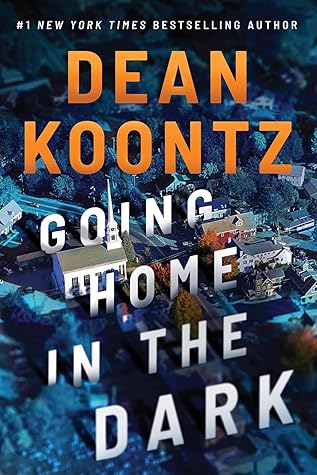
More on this book
Community


Kindle Notes & Highlights


“Whatever talents you might possess, Spencer, you must never pretend to others or yourself that you are to any extent whatsoever a good judge of character. You are of little importance to me, but because you are a friend of my son, I would prefer that you didn’t embarrass yourself with such a manifestly false claim.”
Sherry liked this
Curiously, the library burned down on the night of Alma May’s death. Voters eventually declined to fund a new one for pretty much the same reason that they wouldn’t fund a buggy-whip factory or an encirclement of massive catapults to protect the town from invading barbarians.
This is not the place to reveal whether Ernie came out of his coma and lived; maybe he did, maybe he didn’t. These immediate pages are for the purpose of introducing the fourth of the four amigos so that readers—or their robots—will understand who all the principal characters are, thus allowing the wheels of the narrative to turn faster from this point.
Ernie Hernishen no less than the others. He was just eighteen when he wrote his first song, “The Girl Next Door Is to Die For,” which Garth Brooks came out of retirement to record; it spent eleven weeks as the number one country song in the USA, even crossing over to rise to number two on the pop charts. That was of course quickly followed by “Mama...
This highlight has been truncated due to consecutive passage length restrictions.
Sherry liked this
acres a few miles outside town, where a hundred thousand tons of worn-out solar panels were to be buried along with undisclosed thousands of cumbersome burnt-out wind turbines. His activism had led to unannounced visits by Britta, his mother, who insisted that his priorities were foolish.
“Sustainability. Renewables. A cleaner way. What about this don’t you understand, Ernest?”
“What is it you claim not to smoke, Ernest?” “How can such a question be answered?”
“Your father passed his anger down to you.” “I never knew my father.” “He was handsome but ignorant. He thought he could tame me. When I wouldn’t leave the university and wallow in ignorance with him, he couldn’t bear to live as a shadow in my light.” “What does that mean—‘as a shadow in my light’?” “If you had furthered your education, you would understand such things. Here is your potato peeler.”
“Ernest, there’s no point speaking to God. You might as well have a conversation with a rock.” “I know the feeling,” Ernie said, returning to the potatoes. “I ask only that you keep your strange environmental views to yourself and cause me no further embarrassment in the community. By the way, it would behoove you to eat fewer potatoes and more lean protein.”
Sherry liked this
This edition contained the original text; Ernie refused to purchase revised editions that had been rendered into gibberish by aggressive “sensitivity readers” and published for semiliterate mobs with the hope they might read it instead of burn it either symbolically or literally.
“Listen to me, boy. Great is my frustration. Greater still is my anger. Greatest of all is my determination. I will probe your brain for answers.” The unseen speaker laughed merrily. In a pleasant voice, he said, “Just joking. There will be a little coma, but you’ll be okay. I’m pretty sure.”
One strategy is to divide long chapters into two shorter ones, wherever possible, to distract the reader from the amount of character detail and to contribute to the illusion of headlong suspense. That is why the material in this chapter was moved from Chapter Three, where it appeared in the first draft.
“Some of these objects actually seem to be entities, organisms.” “Don’t they?” said Spencer. “Some might say they find them frightening or even disgusting. What would your response be to that?” Channeling Bobby the Sham, Spencer said, “That is a danger one faces when interpreting art. One can inadvertently reveal more about oneself than about the work under discussion.”
Sherry liked this
Dusterheit said, “One thing.” “What’s that?” “You talk too much.” “I can fix that.”
