
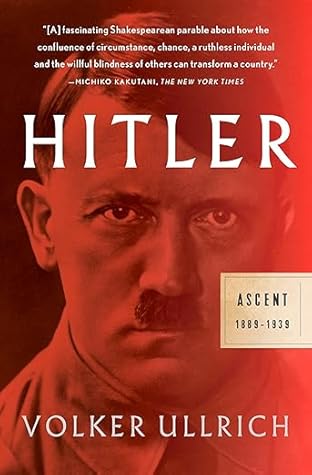
More on this book
Community


Kindle Notes & Highlights

The experience of being forced to toughen up while growing ever more indifferent to human suffering was one of the main lessons Hitler would take from the First World War.
Without Hitler, the rise of National Socialism would have been unthinkable. In his absence, the party would have remained one of many ethnic-chauvinist groups on the right of the political spectrum. Nonetheless, the special conditions of the immediate post-war years in both Bavaria and the German Reich were also crucial: without the explosive mixture of economic misery, social instability and collective trauma, the populist agitator Hitler would never have been able to work his way out of anonymity to become a famous politician.
The receptivity of large masses is very limited. Their capacity to understand things is slight whereas their forgetfulness is great. Given this, effective propaganda must restrict itself to a handful of points, which it repeats as slogans as long as it takes for the dumbest member of the audience to get an idea of what they mean.61
Ironically, therefore, the beer-cellar rabble-rouser, who liked to depict himself as a man of the people, in fact despised the masses, which he regarded as nothing more than a tool to be manipulated to achieve his political ambitions.
Reich President Paul von Hindenburg and his closest advisers were by no means dismayed that government and parliament were shooting themselves in the foot. Hindenburg had long been pondering how to remove the SPD from power and subordinate Germany’s political parties to an authoritarian rule by the presidency.7 That was the brief handed to Heinrich Brüning, the chairman of the Centre Party, who was appointed Germany’s new chancellor. He governed without a parliamentary majority in the interest of Hindenburg and his camarilla, relying on the president’s support and on Article 48 of the Reich
...more

I hope we're not headed in that direction.
Veteran, highly skilled civil servants suspected of sympathising with the SPD were fired and replaced with Nazi stooges.
Sounds familiar...
Prayers were made mandatory in schools in order, as Frick told the Landtag, to “prevent the people being swindled by Marxism and the Jews.”
HMM. Precedent here, too.
After a demonstration by the League for Human Rights, at which journalist Leopold Schwarzschild and author Arnold Zweig spoke, among others, Thea Sternheim noted: “The most horrible thing…is the fact that all the speakers assume that we are on the threshold of the Third Reich, that the grim fantasies of purveyors of violence laid out in the Hessian document will become reality.”166
Or to borrow a different metaphor from Alan Bullock: Hitler had “knocked on the door of the Chancellery, only to have the door publicly slammed in his face.”158
From the very beginning, the vote did not take place under fair circumstances. On 4 February, Hindenburg issued a Decree for the Protection of the German People that allowed the government to curtail the right to free speech and free assembly and subjected the two left-wing parties, the SPD and the KPD, to massive restrictions.
“Dear God, strike me numb / Lest to Dachau I do come” was an oft-repeated saying in the Third Reich.87
“The best of my young friends are declaring their allegiance to National Socialism…You can’t talk to them at all. They simply believe. And there are no rational arguments against faith.”
When it came to the economy, Hitler promised something for everyone. Agriculture would once again be made profitable for farmers; the middle classes would be protected from excessive competition; labourers and office workers would enjoy increased spending power; the unemployed would be reintegrated into the production process; and the interests of the export economy would receive additional attention. As far as foreign policy was concerned, Hitler struck a conciliatory note. Germany only wanted “the same rights and freedoms” as other countries and aimed to “live in peace with the world.” Only
...more
Looking back at the summer of 1933, Sebastian Haffner described the situation of non-Nazi Germans as “one of the most difficult a human being could find himself in…a state of being completely and hopelessly overwhelmed as well as suffering from the after effects of the shock of being bowled over.” Haffner concluded: “The Nazis had us completely at their mercy. All bastions had fallen, and any form of collective resistance had become impossible.”194
In their first years in power, the National Socialists may never have tired of excoriating the alleged dishonesty of democratic politicians during the Weimar Republic, but they themselves flung the door to corruption wide open within their own ranks. This began with preferential treatment for long-standing party members in the procurement of jobs. Thanks to political favouritism, National Socialists poured into open positions in the civil service even though they sometimes lacked even the most basic qualifications.
National Socialism…means hostility towards our foreign neighbours, a reign of terror domestically, civil war and wars between peoples. National Socialism means lies, hatred, fratricide and boundless misery. Adolf Hitler is preaching the legitimacy of lying. It is time for those of you who have fallen for the swindle of this power-mad individual to wake up!28
“To my mind, everyone who believes in their grand promises and indeed their Christian beliefs is a fool. You should recognise them by the fruit of their deeds, and those fruits are murder, manslaughter, violence of every sort and ruthless careerism.” In the same breath, Thimme branded the attitude of the Protestant Church “towards this organised hatred, murder and forced expulsion” as “simply shameful.”33 “How can God’s blessing be upon a movement that is a slap in the face to the simplest and clearest tenets of Christianity?” he asked in May 1933. “The Church has an absolute duty to
...more
