
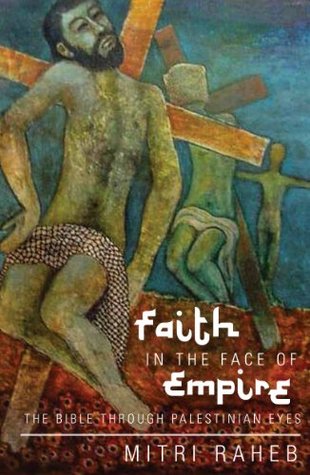
More on this book


Kindle Notes & Highlights


Empires create their own theologies to justify their occupation. They create matrices of control for people and goods.
Prophetic imagination helps us see beyond the current realities, and Christian hope empowers us to move to put a new vision into action.
Yet, I also see how the entire Bible, both Old and New Testaments, struggles to find a faithful response to various and recurring empires. I understand sacred history to be one response to the secular histories of brutal empires. As powerful empires continue to be a recurrent theme in the history of Palestine, the question of God remains crucial, and faith is both challenged and engaged.
Knowing the diverse identities that the people of the land had to undergo tells me that with my current identity I am not at the end. My identity is still in process. And I am not just an object but a subject who has a say in how identity is shaped and how history develops.
The one who interprets assumes power; the one who dominates the story makes it his-story, her-story, literally creating history.
Perhaps the most important articulation in this matter is the recognition of Jon Levenson that Israel’s tradition demonizes and dismisses the Canaanites as a parallel to the anti-Semitism that is intrinsic to the New Testament.
This is precisely the crux of the problem: the natives of the land have been made strangers in order to make room for an invented people to occupy the land.
