
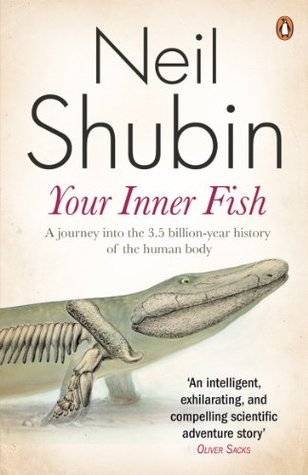
More on this book
Community


Kindle Notes & Highlights

by
Neil Shubin
Read between
January 9 - February 20, 2021

If you consider that over 99 percent of all species that ever lived are now extinct, that only a very small fraction are preserved as fossils, and that an even smaller fraction still are ever found, then any attempt to see our past seems doomed from the start.
But why live in these environments at all? What possessed fish to get out of the water or live in the margins? Think of this: virtually every fish swimming in these 375-million-year-old streams was a predator of some kind. Some were up to sixteen feet long, almost twice the size of the largest Tiktaalik. The most common fish species we find alongside Tiktaalik is seven feet long and has a head as wide as a basketball. The teeth are barbs the size of railroad spikes. Would you want to swim in these ancient streams? It is no exaggeration to say that this was a fish-eat-fish world. The strategies
...more
For years, paleontologists have argued about why hard skeletons, those containing hydroxyapatite, arose in the first place. For those who believed that skeletons began with jaws, backbones, or body armor, conodonts provide an “inconvenient tooth,” if you will. The first hard hydroxyapatite-containing body parts were teeth. Hard bones arose not to protect animals, but to eat them. With this, the fish-eat-fish world really began in earnest. First, big fish ate little fish; then, an arms race began. Little fish developed armor, big fish obtained bigger jaws to crack the armor, and so on. Teeth
...more
One of the joys of being a scientist is that the natural world has the power to amaze and surprise. Here, in ostracoderms, an obscure group of ancient jawless fish, lies a prime example. Ostracoderms are among the earliest creatures with bony heads. Cut the bone of the skull open, embed it in plastic, pop it under the microscope, and you do not find just any old tissue structure; rather, you find virtually the same structure as in our teeth. There is a layer of enamel and even a layer of pulp. The whole shield is made up of thousands of small teeth fused together. This bony skull—one of the
...more
Teeth not only herald a whole new way of living, they reveal the origin of a whole new way of making organs. Teeth develop by an interaction of two layers of tissue in our developing skin. Basically, two layers approach each other, cells divide, and the layers change shape and make proteins. The outer layer spits out the molecular precursors of enamel, the inner layer the dentine and pulp of the inside of the tooth. Over time, the structure of the tooth is laid down, then tweaked to make the patterns of cusps and troughs that distinguish each species. The key to tooth development is that an
...more
This highlight has been truncated due to consecutive passage length restrictions.
When you look into eyes, forget about romance, creation, and the windows into the soul. With their molecules, genes, and tissues derived from microbes, jellyfish, worms, and flies, you see an entire menagerie.
Some groupings are so strong that, for all intents and purposes, we consider them fact. The fish–turtle–polar bear–human grouping, for example, is supported by characteristics from hundreds of genes and virtually all features of the anatomy, physiology, and cellular biology of these animals. Our fish-to-human framework is so strongly supported that we no longer try to marshal evidence for it—doing so would be like dropping a ball fifty times to test the theory of gravity.
Carl Sagan once famously said that looking at the stars is like looking back in time. The stars’ light began the journey to our eyes eons ago, long before our world was formed. I like to think that looking at humans is much like peering at the stars. If you know how to look, our body becomes a time capsule that, when opened, tells of critical moments in the history of our planet and of a distant past in ancient oceans, streams, and forests. Changes in the ancient atmosphere are reflected in the molecules that allow our cells to cooperate to make bodies. The environment of ancient streams
...more
What are the leading causes of death in humans? Four of the top ten causes—heart disease, diabetes, obesity, and stroke—have some sort of genetic basis and, likely, a historical one. Much of the difficulty is almost certainly due to our having a body built for an active animal but the lifestyle of a spud.
The real story is that Apollo 8 is a symbol for the power of science to explain and make our universe knowable. People can quibble over the extent to which the space program was about science or politics, but the central fact remains as clear today as it was in 1968: Apollo 8 was a product of the essential optimism that fuels the best science. It exemplifies how the unknown should not be a source of suspicion, fear, or retreat to superstition, but motivation to continue asking questions and seeking answers.
