
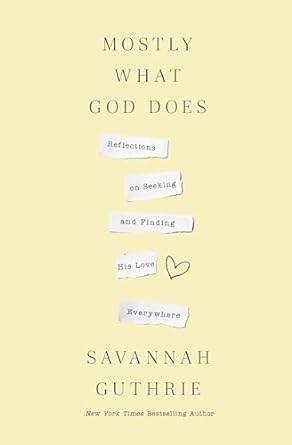
More on this book
Community


Kindle Notes & Highlights

Read between
July 15 - July 23, 2024

I have just this one life, and it is certainly not an example to hold up for others or a monument to great righteousness or faith. It’s just a life of a person who has felt the love of God and been saved by it, over and over and over again.
I like to tell people about the God I know. The one whose hand rests gently on my shoulder, whose presence I can feel behind and beside me when I’m under pressure. The one whose persistent but kind nudging can prod me into perspective, whose forbearance and tenderness can coax me into change. The one who surprises and delights me with the imagination of his creation and the beautiful potential of his humanity. The one whose revelations spark my intellect
and ignite my passions and purpose. The one who melts me with unexpected favor and unmerited generosity. The one who holds me, firmly and purposefully, when the weight of my ...
This highlight has been truncated due to consecutive passage length restrictions.
Humiliation, shame, self-berating, and browbeating are not God’s intention for us. But neither is self-aggrandizement or puffery.
humility is not humiliation; it is not being forcefully brought down low—either by ourselves or by God. Humility is simply recognizing our need for God. Acknowledging our need, as opposed to telling ourselves we’re fully self-sufficient, leaves space for him.
How we feel about our kids is how God feels about us. The way we adore them. The way they make our hearts leap with joy. The way we revel in their personalities and gifts and quirks. The way we glory at their milestones and accomplishments, no matter how minor.
Now imagine those words from God. About us. And we begin to grasp his perspective toward his children. We are imperfect humans who stumble and fail. We make bad decisions. Things go wrong and we don’t understand what God is
doing. We complain and rebel. We withdraw, sulk, and give God the silent treatment. We can’t see the big picture. Like kids who are incapable of seeing the long view
He just matter-of-factly conveyed what he considered to be his most significant feature.
God is here, now, and his speaking to us does not depend on our speaking to him. His thoughts about us do not depend on our thoughts about him. He doesn’t wait to come until he is called. We don’t summon him with our pious practices and diligent spiritual routines. They help us tune in. They open the window through which his light is ready to shine. But he is present to us, whether or not we are present to him.
The first thing I learned that day at the boring old church: there is no wasted time spent with God. You can always get something out of it if your heart is in the right place. (Or, as in my case, even when it’s not.) And
In our moments of weakness, in our moments of deep need and helplessness, sometimes the best we can do is just to come. Don’t worry. He can work with that.
“80 percent of success in life is just showing up.”1 In prayer, it’s 100 percent. By simply arriving to a quiet moment with God, its purpose is accomplished.
Prayer is a success simply if you do it. Because whether you perceive it right then and there or not, you are building something together with God.
God. If we want to recognize God’s voice, an intimate connection is vital. Moments spent together, just logging time. We must do life with him, like a baby does with Mom.
To be quiet enough to hear God’s voice, we need more than a quiet place; we need quiet in our spirits and our souls.
make space for him, just being present to him—hearts open, ears peeled.
when I hear God’s voice, it is usually saying something I never expected to hear him
words don’t constrict him. Sometimes he doesn’t need words at all.
When we are looking down, looking inward too much, we miss so much.
May we pray for a vantage point that spans time and space, that processes the meaning of things not across moments but across millennia. A
The scene of the Last Supper always strikes me. Jesus was reclining when he predicted his betrayal and death. Reclining. You have to be careful not to read too much into something like that, to overanalyze.
He was not confrontational or overly emotional. He spoke from an intimate, relational position. Yes, his words had authority and were devastating. He pulled no punches. Yet he didn’t browbeat or inflame.
God’s voice “gentle but relentless.”2
In my life, when it comes to the dawning of change, it can feel as if God presses a thumb down on something in my life. As if to say, “here, this spot, this one, let’s stay here for a while. I want to lean on this.”
Doubt is just faith being worked out,
In the face of our doubt and fear, Jesus says, in effect, “Come closer.”
would rather be hopeful and wrong—than hopeless and right.
would rather spend my life in a state of believing, a state of optimism and expectancy—even if I am someday proven to be a fool.
Cynicism and despair only pile more heartbreak upon the original heartbreak. Hopelessness does not solve the problem; it compounds it.
“You are simultaneously more sinful and flawed than you ever dared believe, yet more loved and accepted than you ever dared hope.”2
can’t wait to see Jesus. Note the word choice. Not meet Jesus—see him. Tim was not afraid of where he was going because he knew someone there. He was going to see Jesus, not meet him for the first time.
Tim told his son, “There is no downside to me leaving—none.”4 I love his certainty.
The more we keep company with God, the more that aroma lingers—of love and acceptance, gentleness and forgiveness, truth and authentic peace.
Loving strangers is hard. Exposing ourselves and being vulnerable is frightening—even with friends and family. Left to our instincts, most of us can’t muster it and don’t even want to. We are often too busy, too preoccupied, too wrapped up in our own real struggles.
On the Mercy Ships, the doctors say healing begins before even one medicine is administered, before one surgical incision is made. Healing begins at the clinic door, when someone says hello, greets them, shakes their hand, looks them in the eye, and looks past their disfigurement, as if to say, I know you’re in there. I see you.
We are so tempted to avert our eyes from the suffering all around us. And it is heartbreakingly understandable to think, I’m sorry, I can’t look at you.
He looks past what is disfiguring about us: our self-absorption, our pettiness, our greed, our deception. He looks past our failings and sees our souls. He sees our hearts and who he designed us to be.
Lesson one: there is no such thing as a wasted opportunity—not if you are determined to make something of it. Just keep going.
challenged. Comfortable is not where the action is. It is not where you will find out who you really are.
To discover your purpose, you probably need to get uncomfortable.
When we step out of our comfort zones, we step into our need. This is where God gets a chance to do his thing.
Faith is believing God will take you where you’re meant to go, one way or the other. You cannot write yourself out of your destiny. He won’t let you.
make friends with your troubles—make them your teachers, instead of your tormentors.
Who am I? What are the qualities God uniquely has given me? What is the best use of those gifts while I am on this planet?
“Set a guard over my mouth” (Psalm 141:3),
a key part of our understanding of God has to do with wonder and awe—that sense of astonishment and reverent surprise when we encounter him.
