
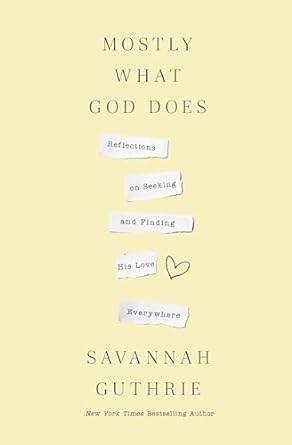
More on this book
Community


Kindle Notes & Highlights

Read between
April 20 - April 27, 2024

I have just this one life, and it is certainly not an example to hold up for others or a monument to great righteousness or faith. It’s just a life of a person who has felt the love of God and been saved by it, over and over and over again.
What are the six foundational aspects of a connection to God? Here is what I came up with: Love. Presence. Praise. Grace. Hope. Purpose.
Blank space. Quiet. Nothingness. This is where God has the greatest opportunity to do his thing.
All I know is it took me a long time, a lifetime of church and no church, faith and not much faith, seeking and failing, hoping and falling, to understand this basic precept: mostly what God does is love us.
Where is God and what is he up to? Mostly what God does is love you.
How does God feel about me? Mostly what God does is love you. What job should I take? Where should I live? Whom should I marry? Do I forgive that person? Do I deserve forgiveness? Am I shallow? Am I selfish? Am I unworthy of love? Have I broken my life? What does God think about the choices I’ve made? Mostly what God does is love you.
It is so easy to conflate the critiques of our parents, our culture, or our own harsh self-judgments and subconsciously attribute them to God—especially when we are distant from his presence.
I’ve always felt believing in God isn’t really the hard part; believing he is good and actively engaged in our lives and the world in the face of so much pain—that is the hard part.
I have always believed in God. But I have not always found it easy to believe that he is unfailingly good, or at least well-intentioned toward me.
Imagine it—God loving you. Seeing you, appreciating you, delighting in you. Knowing you, having compassion on you, healing you, forgiving you. See it, appreciate it, grasp it, hold on to it. Inhale deeply of his goodwill and attune yourself to evidence of his love. Look for it everywhere.
What you will find is that love like that is not just for you. It is for the world. For love like that cannot be contained—it is exuded and exhaled outward.
Love like that. This is our great commission: choose to believe in God’s love. Wrap yourself in it; let it warm you from the inside. Then go out into the world, and you do it too.
Going through deep crises, profound adversity—those are the make-or-break moments for faith; they can be existential threats to your belief, or they can be extraordinary teachers. Sometimes they are both, and not always at the same time.
Knowledge of and belief in the deep love of God is how we come to love ourselves.
God loves us, and his love is contagious. If we stick close to him, we can’t help but catch it.
God’s connection to his children is stunningly intimate and tender—like a mother to her child. I don’t know about you, but I can scarcely take that in. It is overwhelming to imagine that God could feel that way about me. Too good to be true. But transformative if truly absorbed.
God’s feelings for us have nothing to do with our feelings toward him. His thoughts toward us have nothing to do with our thoughts toward him. We cannot do or say anything to make him love us more—or less. He loves us not because of who we are or what we do but because of who he is and what he does. He loves. Like a mother. But better.
We may not be able to sustain the emotion of being loved by God, but we can remain in the knowledge of being loved by God. We can remain in the memory of being loved by God—and let that sow confidence within us that nothing about his posture toward us has changed.
It is a choice every day to remain in God’s love, actively believing it, looking for it everywhere, choosing to interpret circumstances in that light.
In a way, prayer, at its essence, is simply processing our feelings and emotions and concerns in the presence of God. It is our intentional turning to him.
Because whether you perceive it right then and there or not, you are building something together with God. You are building a connection—the fact of it, if not the immediate feeling. It may be much later before you realize the depth of the foundation that has been formed.
If we want to recognize God’s voice, an intimate connection is vital. Moments spent together, just logging time. We must do life with him, like a baby does with Mom.
God knows our love language. Think about the times you felt touched by him. It could be through a person, an interaction, a song, or a scene in a movie. God knows what moves us. He knows how to connect to our hearts. And words don’t constrict him. Sometimes he doesn’t need words at all.
True, spiritual rest comes when we do not feel frantic and desperate to care for ourselves, grasping and hoarding out of a sense of scarcity and fear. True rest comes when we know who we are: the beloved and cared-for of God himself.
Suddenly, I got it. If praise is a garment, who is wearing it? We are. We are ones who are adorned. God tells us to praise him not for what it does for him but for what it does for us.
Wherever you are in this moment and however you feel, if you want to immediately alter the atmosphere, if you want to instantly change the air, praise him.
But with a heavenly perspective, we will not be consumed. We will not be overwhelmed. For when we look to the heavens, we see God—looking right back at us.
Journals are a place to let it all hang out: the good, the bad, the ugly, and the even uglier. God invites us not to deny or ignore our feelings but to process them in his presence.
I learned to trust God not because the terrible thing never happened but because it did. I learned to trust God when I failed catastrophically and unmistakably, and he was there. I learned to trust God when I went out into the wilderness, hiding from him and from myself for years (I might have occasionally called or texted), and still, he stood right there waiting for my return.
Fear forgets that God is at hand and working things out for good. No, not necessarily positive outcomes or rosier circumstances. He is not against those things, but that is not the main goal. God, over time, works things out in the direction of closeness to him. His trajectory is of ever-increasing intimacy and communion with him. That’s it. Kind of simple, really.
God does not change. His opinion of us does not change. His love for us does not change. “As Thou hast been, Thou forever wilt be,” as the lyrics of the great hymn go on to say.2
It is a hard habit to break. But with the grace of advancing age, these childhood behavior patterns have softened as I’ve become older and a bit wiser. The little girl who always wanted to please and keep things calm is learning to live through the discomfort of people not always being happy. I’m slowly learning to accept I cannot try to set and maintain the emotional temperature of the room at a perfect seventy-two degrees.
My religious upbringing emphasized the former far more than the latter. Heavy on guilt, light on grace. No wonder I grew up fearing God more than loving him. To me, to know God was to be judged by God, and to be found wanting, of course.
I know one thing. If we can’t confront the truth about ourselves—what’s good and what just isn’t—then we are likely to avoid ourselves, distract ourselves, anesthetize ourselves. We will run from ourselves into work, sex, drugs . . . or even positive things like exercise or wellness routines taken to unhealthy levels.
There is no greater feeling than confronting and facing your weaknesses and shortcomings, and finding out that you are loved, accepted, and forgiven anyway.
God hacks off our burden and our shame, frees us, then envelops us in love. The failings we are afraid to admit, the sides of ourselves we would never dare show, the sins within that even we cannot forgive—they go tumbling down the mountainside.
An authentic relationship with God invites uncertainty and questioning.
But doubt is not a lack of faith. It is not the opposite of faith. It is an aspect of faith—a feature, not a bug, as the computer nerds like to say. Doubt is just faith being worked out, like a muscle. Put in the effort, do the reps, and ask the questions—it’s spiritual strength you’re building.
In the face of our doubt and fear, Jesus says, in effect, “Come closer.” He does not recoil or take offense. To him, our skepticism and questioning are an opportunity for deeper connection. So often our instinct is to do the opposite, to keep our distance.
So bring your questions to God. Bring your bright mind, bring your intellect. But also, bring your stout heart and your strong legs because, in the end, there will always be a leap. A leap of faith.
This is what it comes down to for me: I would rather be hopeful and wrong—than hopeless and right.
If our belief structure, whether consciously or unconsciously, includes a version of God exacting pain on us, it is potentially problematic. At a minimum, it creates a trust problem with God.
But while we are here, while he is working out a cosmic rescue and reconciliation that is far beyond our understanding, he promises to be present with us. He promises to make good out of bad. He promises to transform what is wrong into something that is right. That is an act of God.
way. Faith does not and cannot explain why the innocent are allowed to suffer. It simply gives us hope that there is a place and time when that suffering will end, when connections will be restored, when life will be eternal—“On earth as it is in heaven”
That’s the answer. There is no answer. Sometimes faith is simply choosing to live, choosing to coexist with questions for which there will never be a satisfying explanation. Not in this life anyway.
May we all simply exude the sweet aroma that is a telltale sign of time spent with God: goodness, kindness, and love. And let that fragrance linger in the air.
He looks past what is disfiguring about us: our self-absorption, our pettiness, our greed, our deception. He looks past our failings and sees our souls. He sees our hearts and who he designed us to be. He pours out his love in abundance. And that is mostly what we can try to do too.
Lesson one: there is no such thing as a wasted opportunity—not if you are determined to make something of it. Just keep going.
Yes, he shows us what we’re made of, but he shows us what he is made of too. We lean on him, trust him, hope in him—and start to know him in a whole new way.
Faith is believing God will take you where you’re meant to go, one way or the other. You cannot write yourself out of your destiny. He won’t let you.
