
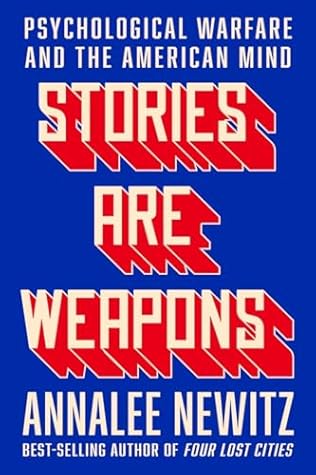
More on this book
Community


Kindle Notes & Highlights

Read between
March 18 - March 19, 2025

Propaganda is, after all, a story we tell to win allies and frighten enemies. The more compelling and emotionally engaging the story is, the more people will want to read, watch, or listen to it.
Today in the United States, psywar is virtually indistinguishable from culture war.
When we use psyops in our cultural conflicts, we tear down the wall between what’s appropriate in domestic disagreements among Americans and what’s acceptable in combat against a foreign enemy.
Linebarger argued in his work that successful propaganda always contains a slice of the truth: it refers to actual events and true histories, but decontextualizes them, relocates them to an imaginary terrain of mythical good guys and bad guys. And that’s why it gets us in our hearts and guts.
There are three major psychological weapons that combatants often transfer into culture war: scapegoating, deception, and violent threats. These weapons are what separate an open, democratic public debate from a psychological attack.
Increasingly, Americans are not engaging in democratic debate with one another; they are launching weaponized stories directly into each other’s brains.
“Psychological warfare is good for everybody,” Linebarger wrote enthusiastically, characterizing it as “the affirmation of the human community against the national divisions which are otherwise accepted in war.”11 This counterintuitive framing of propaganda as “affirmation of human community” fits neatly into a worldview where the only alternative to words is the Bomb.
“Propaganda must use the language of the mother, the schoolteacher, the lover, the bully, the policeman, the actor, the ecclesiastic, the buddy, the newspaperman, all of them in turn,”
Historian Rebecca Lemov writes that at its peak, the MK-Ultra program cost taxpayers almost a billion dollars per year, and funded everyone from behaviorist B. F. Skinner, who experimented with conditioning animals in his “Skinner Boxes,” to famed anthropologist Margaret Mead.
Secretary of the Interior Carl Schurz framed it in 1882. “[His] argument was that it was less expensive to educate Indians than to kill them,” Adams writes. “[Schurz] estimated that it cost nearly a million dollars to kill an Indian in warfare, whereas it cost only $1,200 to give an Indian child eight years of schooling.”
F-Scale Test,
After a lot of testing, they hit on a message that got a powerful response: they asked subjects to “imagine an America where you can’t pronounce anyone’s name,” then showed them a series of non-Western names and asked, “Can you recall a time where people were laughing at someone who messed up an ethnic name? Do some people use political correctness to make others feel dumb or get ahead?” By arousing people’s sense of humiliation in an everyday situation—trying to pronounce an unfamiliar name—they hit a nerve. Once they had hooked people with this message, they escalated, feeding them stories
...more
Some of the most effective online manipulation of the American public came from a private Russian psyops firm called the Internet Research Agency (IRA).
In one case, the IRA set up two opposing Facebook groups in Texas—both fake—called Heart of Texas and United Muslims of America.34 In May 2016, when they had amassed enough followers, the IRA’s Heart of Texas announced on their page a “Stop Islamification of Texas” protest in front of the Islamic Da’wah Center of Houston. Then the IRA announced a counterprotest against “Save Islamic Knowledge” on the United Muslims of America page for the same day. Unwitting followers showed up to fight it out in real life, never knowing that they were all victims of Russian psyops.
Other ads were intended to alienate Black voters from US politics. Al-Rawi and Rahman discovered that over a hundred ads were specifically targeted at Black people in Ferguson, St. Louis County, Missouri, and Baltimore, Maryland, after the police shooting of Michael Brown, the death of Freddie Gray, and subsequent Black Lives Matter uprisings. They also targeted Detroit and Washington, DC, which have large Black communities. Many of these ads emphasized police brutality and violence against Black people, suggesting that neither Democrats nor Republicans would fix the problem. Rather than
...more
clothes. In a 2022 interview on Telegram, Yevgeny Prigozhin, the late Russian oligarch who owned the IRA, talked about his company’s role in US elections: “Gentlemen, we interfered, we interfere and we will interfere . . . carefully, precisely, surgically. . . . During our pinpoint operations, we will remove both kidneys and the liver at once.”42
“stochastic terrorism,” a term that has become increasingly popular in the last decade to explain random violence inspired by online media.
Though the line between psychological war and culture war can be blurry in the United States, there is one way to tell the difference. In a culture war, the combatants are all Americans, fighting over domestic issues.
They are, like all psyops, based on telling emotional stories and appealing to entrenched prejudices. Sometimes fighting them with fiction works better than fighting with facts.
Psyops are pernicious because they are designed to create a mental catch-22. If you notice the psyop, your own psychological health is called into question.
