
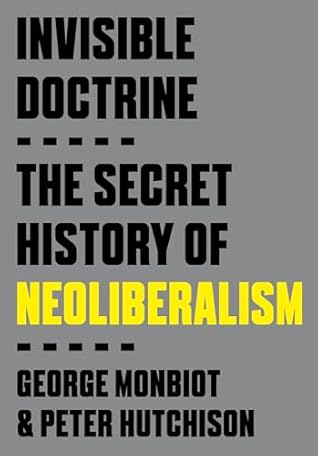
More on this book


Kindle Notes & Highlights

Read between
July 6 - July 7, 2025

What is neoliberalism? It’s an ideology whose central belief is that competition is the defining feature of humankind.
As a general rule, privatization is legalized theft from the public realm.
Perhaps it’s time we recognized that “prosperity” has less to do with growth than with the distribution of power.
History shows that when political choice is lacking and people see no prospect of relief, they become highly susceptible to the transfer of blame.[3] This transfer—attacking refugees and fomenting culture wars—is already well under way. Techniques of distraction—scapegoating, an intense focus on issues that have little impact on general welfare (“woke” academics, curatorial decisions in museums and historic houses,[4] unisex bathrooms, young people allegedly identifying as cats[5])—coupled with frustration and the transfer of blame, open the door to authoritarianism.
In 1987, Margaret Thatcher said the following in a magazine interview: I think we have gone through a period when too many children and people have been given to understand “I have a problem, it is the Government’s job to cope with it!” or “I have a problem, I will go and get a grant to cope with it!,” “I am homeless, the Government must house me!” And so they are casting their problems on society, and who is society? There is no such thing! There are individual men and women and there are families, and no government can do anything except through people and people look to themselves first.[8]
In this short quote, we see three of the ideology’s core tenets distilled: First, everyone is responsible for their own destiny, and if you fall through the cracks, the fault is yours and yours alone. Second, the state has no responsibility for those in economic distress, even those without a home. Third, there is no legitimate form of social organization beyond the individual and the family.
Studies of “green” and “nongreen” consumers show that the main driver of a person’s environmental impact is not their attitude. It is not their mode of consumption or the particular choices they make.[12] It’s their money.[13] If people have surplus money, they spend it. While you might persuade yourself that you are a green mega-consumer, in reality you are just a mega-consumer. This is why the environmental impacts of the very rich, however eco-friendly they may appear to be, are massively greater than those of everyone else.[14]
