
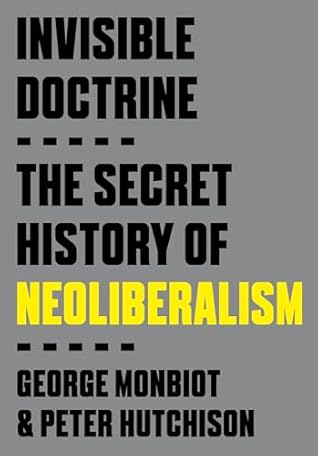
More on this book


Kindle Notes & Highlights

Read between
December 24, 2024 - January 4, 2025

Capitalism is an economic system founded on colonial looting. It operates on a constantly shifting and self-consuming frontier, on which both state and powerful private interests use their laws, backed by the threat of violence, to turn shared resources into exclusive property, and to transform natural wealth, labor, and money into commodities that can be accumulated.
Capitalism is not, as its defenders insist, a system designed to distribute wealth, but one designed to capture and concentrate it. The fairy tale that capitalism tells about itself—that you become rich through hard work and enterprise—is the greatest propaganda coup in human history.
The progress of society, Hayek held, depends on the liberty of these “independents” to gain as much money as they want, and to spend it as they wish. All that is good and useful therefore arises from inequality.
Bill Clinton and Tony Blair thought it was sufficient to triangulate. In other words, they extracted a few elements of the Keynesianism their parties had once advocated, mixed them with aspects of their opponents’ neoliberalism, and developed from this unlikely combination a “Third Way.” This “Third Way” was little more than a rhetorical device used to justify and disguise the capitulation of the left to neoliberal forces.
For all his grace and touch, Barack Obama (who didn’t possess a narrative either, except for “hope”) was guided by neoliberalism’s vast apparatus—by then dominating the perspectives of both government and the media, its doctrines treated as orthodoxy across the political spectrum.
Grace and decency alone cannot defeat structural injustice.
as the choice between different parties, committed to the same program to varying degrees, increasingly narrowed—people began to lose faith in politics. Disappointment turned to disempowerment. Disempowerment turned to disenfranchisement.
The “freedom” that neoliberals celebrate—which sounds so beguiling when expressed in general terms—turns out to be freedom for the pike, not for the minnows.[5]
But neoliberalism developed in a different era, by which point most adults had the vote. It recognized that, in the face of widespread resistance, the state would have to intervene to impose its desired political outcomes on an unwilling population, to liberate “the market” from democracy.
The majority of claims are brought by companies based in rich nations,[16] and are often imposed upon far weaker countries that have fewer resources with which to defend themselves. The ISDS has become little more than a form of colonial looting by other means.
is highly misleading to describe neoliberalism as “free-market economics.” In many ways it’s quite the opposite. Neoliberalism is the tool used by the very rich to accumulate more wealth and power. Neoliberalism is class war.
in the UK, for example, 70 percent of the cost of housing arises from the price of the land on which the home is built.[5] Homes are more expensive in more desirable locations not because bricks and mortar cost more in such places, but because of the higher price of the land on which they stand. So when you pay “rent” for a home in the UK, 30 percent of that money, on average, provides you with the shelter you need. The rest is the charge you pay to use the space it occupies.
Almost inevitably, privatization leads to a decline in both access to, and the quality of, public services. There’s no mystery about why this should be: the owners’ incentive is to extract as much money from the service as possible.
We end up with what the economist John Kenneth Galbraith described as “private opulence and public squalor”:[12] the rich become ever wealthier, while the services on which the rest depend are hollowed out.
In looking back on the Keynesian era, we have a tendency to see two seemingly contradictory histories—the march of social progress in the rich nations and the brutal wars, resource grabbing, and social regress in the Global South—and to discuss them as if they occurred on separate planets. But these apparently divergent trends are, in fact, closely connected.
Far from ensuring that money trickles down, neoliberalism is the hydraulic pump that drives the transfer of wealth from the poor to the rich.
A study of ten European nations found that changes in happiness could best be explained not by varying rates of economic growth, but by varying levels of spending on public welfare.[15]
For while neoliberal capitalism continues to loot the South to enrich the North, it also loots the future to enrich the present.
Neoliberalism is a political neutron bomb. The outward structures of politics—such as elections and parliaments—remain standing, but following the irradiation of market forces, little political power remains to inhabit the space behind the facades.
The invisible doctrine of the invisible hand of private interest is sustained by invisible backers.
Those who fronted the campaign—people like Boris Johnson and Nigel Farage—were human smoke bombs, generating a camouflaging cloud of xenophobia and culture wars. They pitted “us” against “them.” Leavers were “true patriots” who claimed to be “taking back control”—reasserting state sovereignty and limiting immigration—against “elitist” cosmopolitan liberals happy to surrender national autonomy to faceless Eurocrats.
The persistent trick of modern politics is to disguise economic and political conflicts as cultural conflicts.
In the end, all the world is Madeira.
Catastrophe is not a matter of fate. It’s a matter of choice.
while campaigners and progressive politicians have been playing solitaire, power has been playing poker.
