
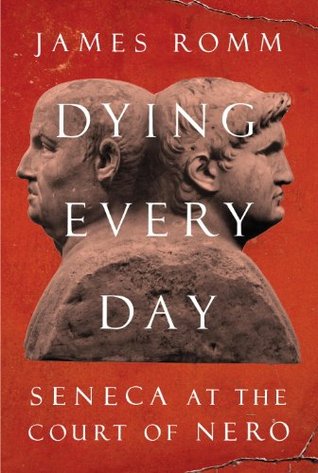
More on this book
Community


Kindle Notes & Highlights

by
James Romm
Read between
November 6 - November 8, 2017

Perhaps he could not mention these topics without provoking the princeps; perhaps silence was the price he paid for freedom to publish. Whatever the reason, the Letters form a strangely partial self-exploration. Seneca examines himself from every angle, seeks the truth at every turn, seems willing to confide all—yet he says nothing about the most consequential part of his life, still ongoing at the time he was writing.
Not for the first time, Seneca portrays his moral self as suffering from incurable illness—a trope that allowed him both to acknowledge shortcomings and to disclaim responsibility.
Seneca quotes two obsequious lines of verse, originally addressed by the poet Vergil to the emperor Augustus: He is a god who made this serenity for us, A god—such he will always be, to me. The quote suggests a continuing effort to cut a deal with the princeps, a deal Nero had already once refused. Seneca will go quietly into retirement and not defame the regime, in exchange for being left unharassed. If Nero will become an Augustus and provide safety, Seneca will become a Vergil and give praise.
In a third passage of Natural Questions, Seneca confronted his Nero problem by way of historical analogy. As was well known to Seneca’s readers, the Macedonian king Alexander the Great had brought a philosopher to his court to elevate its moral standing—much as Seneca had been brought to Nero’s. For years that sage, Callisthenes, had dutifully played his part, until one day, for unknown reasons, he shook off subservience. He stood up at a banquet and, before the assembled high command, denounced Alexander’s pretensions to godhood. Within a few months, he was dead, on Alexander’s orders.
Callisthenes, if he shared the outlook of Socrates and Cato, the one all Stoics professed to admire, must have felt the sacrifice was worth it. Had Seneca ever tried to emulate Callisthenes, or did he now hope to? With all his eloquence and inside knowledge, he could have done much to harm Nero’s regime. Nothing suggests he felt tempted to use those weapons.
By insisting that death is everywhere and cannot be escaped, Seneca seems to relieve himself of the burden of action. For indeed, Seneca was taking very little action in these years to help himself or others. History supplies an ironic footnote to Seneca’s discussion of the Campania quake. The refugees he scoffed at for leaving Campania were in fact, as time would tell, saving their lives. Seventeen years later the region would be enveloped by ash and hot gases, in the volcanic eruption that entombed Pompeii and Herculaneum. The earthquake had been not a disaster so much as a warning. Seneca,
...more
This last idea strikes the keynote of apocalypse, another theme that had haunted Seneca from his earliest writings. His Stoic training taught that all humankind would be wiped out, then reborn in a primitive state, in an endless cycle designed to renew the tired world. But Seneca imagined the scene more vividly than any Stoic before him. And he was more certain that the last days were near.
The problem that the principate presented to Stoic men of morals was indeed insoluble. The Stoic creed, with its emphasis on service to the common good, required involvement in political life, unless the regime was hopelessly evil or the Stoic’s own life was in danger. But what if the Stoic’s life was more endangered by leaving politics than by staying? And what if, by his departure, he made an evil regime more evil? The let-out clauses posed perils of their own. And the question of when to invoke them—at what point a regime’s malady became incurable, or one’s own risks rose unacceptably—was a
...more
Now in his midtwenties, Nero was growing fat. He had already lost the graceful lines and angles that his youthful portraits reveal. His jowls were heavy, his brow doughy and soft. Soon he would grow a chin beard, the first facial hair yet seen on a princeps, perhaps as a way to disguise the fleshiness of his thick neck.
Those who now surrounded Nero, in particular Tigellinus, saw an opening in this temperamental divide. They whispered in Nero’s ear that the moral gravity of the Stoics was somehow a threat to his regime. In months to come, they would openly allege that mere gloomy looks, or ascetic ways of life, were treasonous in that they implied disapproval of Nero’s exuberance. To be “schoolteacherly”—to go about with a superior or censorious air—became a crime against the state. Nero would rely on such prejudices to brand the Stoics his enemies and to destroy some of the best men of his time.
Nero was at Antium in mid-July of 64, the place of his daughter’s birth and his own, when messengers from Rome told him of a fire in the city. It had begun near the Circus Maximus, a racecourse built of stone but surrounded by wooden shops crammed with flammable goods.
Nero could not save Rome, but he did what he could for the Romans. He threw open his own properties, imperial gardens in untouched places like the Vatican hill, to survivors and ordered shelters built. The Field of Mars, thus far out of the path of the fires, was converted into a refugee camp. Emergency grain supplies were brought up from Ostia and sold at a subsidized price. Those still able, and willing, to live would have the means to do so. After six days the fire was apparently stopped by a brake, but it flared up again and burned for three more days. Finally it died out for good, mostly
...more
What mattered to Nero was that people believed him guilty. He threw himself into the reclamation of the city and of his battered reputation. He poured fortunes from the treasury and from his own funds—the two were hard to distinguish—into relief and reconstruction. And he began a campaign to shift blame from himself to others. The sect the Romans called Christiani, and their founder Christus, appear first in Latin literature in Tacitus’ account of the great fire. According to this famous passage, the Christians were arrested on spurious charges and brought to Nero’s palace grounds for
...more
Money had to be found. Imperial agents scoured the provinces, squeezed taxpayers, and ransacked the treasuries of Greece and the Near East. Not even temples of the gods were spared, for many contained precious statues clad in gold and ivory. The hoard of art stolen from the Greeks during Rome’s eastward expansion, two and three centuries earlier, had been largely lost in the fire. Replacements were ripped from their shrines by Acratus, one of Nero’s trusted freedmen, and Carrinas Secundus, a lackey who had been trained in Greek philosophy and could sweet-talk his way through the East. It was
...more
Seneca’s last stratagem was the course he had urged on Lucilius, his friend in Sicily, when advising him how to practice otium. He feigned illness and stayed in his chambers. He must live a lie, if he was to live at all. Tacitus reports that at this point Seneca discovered from his loyal freedman, Cleonicus, that Nero was trying to have him poisoned. There is no reason to doubt the information, though Tacitus indicates it did not have solid authority. Nero had the means for such a crime, thanks to Locusta, and plenty of opportunity. Simple dislike would have served for a motive, or the fear
...more
What could have prompted a committed Stoic, a man who thought happiness came from Nature and Reason, to also pursue wealth and rule? Seneca never referred this question to himself, but he pondered it in a mythic parallel, in his greatest verse tragedy, Thyestes. Seneca almost certainly composed this play during his time at Nero’s court, or afterward in retirement. It is the most self-referential of his dramas, so much so that one doubts it could have been published in his lifetime. Here Seneca used the conflict between two royal brothers—Atreus, a bloody autocrat possessed by spirits of Hell,
...more
Thyestes now enters the scene, walking toward the trap we know is waiting. Seneca portrays him as a virtuous Stoic, disgusted by the world he long ago renounced: How good it is to be in no one’s way, to eat safe meals stretched out on open ground. Hovels don’t house crimes; a narrow table holds a wholesome feast; it’s the gold cup that’s poisoned—I’ve seen, I know. It is as if Seneca has turned back the clock on his own life and given Thyestes the same choice he faced on Corsica, but also given him knowledge of what
...more
After Thyestes’ cannibal banquet, not only the sun but the stars, too, seem about to vanish. The play’s chorus members, the citizens of Argos, envision the zodiac tumbling into the sea, leaving only black void above:
Are we, out of all generations, deserving of the sky’s collapse, its axis knocked from beneath its dome? Is it on us the last age comes? A harsh destiny has brought us to this: Wretches, either we lost our sun, Or else we drove it away. In these words we seem to hear Seneca’s own voice, speaking about his own time. Thyestes is a bleak cri de coeur, the most despairing Seneca ever allowed himself to utter. For him, the benign stars of Corsica had been extinguished. His sky had become blind, black,
...more
Could Lucan, or any writer, hope to escape with his life after exercising such license? Was the young genius courting arrest? It seems rather that Lucan was hopeful that the current regime would soon be over and that he would emerge into the next era as a hero of the opposition. For by late 64 or early 65, he had become a leading member of a plot to assassinate Nero.
Lucan and his fellow conspirators decided to test that possibility. They chose an amiable, flamboyant aristocrat, Gaius Calpurnius Piso, to be put in Nero’s place, should they succeed in killing the princeps. Strangely, they bypassed Junius Silanus, the only male Julian left. Perhaps they regarded him as too young to rule; other young men who had taken the throne, first Caligula and now Nero, had been driven by it into self-absorption, delusion, and fantasies of omnipotence. That pattern, it was felt, could not be repeated. A dynastic marriage was arranged for Piso, such that the
...more
During one torture session, Faenius was assisted by another closet conspirator, Subrius Flavus, while Nero himself looked on. At a certain point, Flavus realized the absurdity, the bizarre futility, of what was taking place: of three men in the room who wanted Nero dead, two were attacking the third, while Nero stood by and watched, unarmed and outnumbered. Flavus used covert gestures to suggest to Faenius that they kill Nero then and there; he even began to draw his sword. But Faenius passed up the plot’s unexpected second chance. He shook his head to Flavus and turned back to his work. The
...more
Immunity was promised to those who would implicate others, and many grasped at the slender hope that this bargain would be honored. The poet Lucan was one of them. Though he had been among the fiercest of the plotters, even offering Nero’s head as a gift to several of his friends, the chance to preserve his own life, so young and full of promise, turned him compliant. He confessed his guilt and gave names of several accomplices, even throwing in that of his own mother, Acilia. If we believe Suetonius’ cruel analysis, he hoped to please Nero, the killer of Agrippina, by joining him in
...more
But Seneca was never to learn of Epicharis’ end. Even as his brother’s bedmate was being stretched on the rack, Praetorians, led by Gavius Silvanus, were surrounding the villa outside Rome where he was taking dinner with his wife, Paulina.
After that, the military’s huge role in the plot was unmasked. This led to some remarkable exchanges, as Nero questioned Praetorians who, with nothing left to fear, were blunt in their replies. Subrius Flavus explained to the emperor the origins of his disaffection. “No one in the army was more loyal to you than I—when you deserved our love,” Flavus said. “But I began to hate you, after you became the murderer of your mother and wife, a chariot driver, an actor, and an arsonist.” Tacitus remarks that nothing Nero heard during the crisis wounded him more than this terse catalogue of crimes.
One by one the soldier-conspirators were betrayed, arrested, and beheaded, willingly stretching their necks for their comrades’ blades. Flavus is said to have looked impassively at his own grave as he went to the block, finding it too shallow. “Not even this is up to code,” he sneered.
In the great catalogue of deaths that ends the extant text of Tacitus’ Annals—a list so long that Tacitus fears it will bore and disgust his readers—only one man is said to have gone down fighting. Junius Silanus, the last male descendant of Augustus other than Nero himself, was in detention in the town of Barium when a soldier arrived to kill him. Though unarmed, Silanus fought back with all the strength he had, quipping to his assassin that he would not get a free pass for his job. He alone died in combat, wounds on the front of his body, rather than fading slowly away in the warm, languid
...more
Seneca was also in mind of his wife, Pompeia Paulina, whose life in exile—if that was to be her fate—would be much harder without him. “Her spiritus depends on mine,” he had written in one of the Letters, using the Latin word for the breath of life. “The spiritus must be called back as it flees—though in torment—out of reverence for our dear ones, and held on the tip of our lips. For a good man must live not as long as he wants, but as long as he ought.” Those words might have recurred to him as he sat with Paulina, a woman who had never offended Nero but, if familiar patterns prevailed, would
...more
She was, it would turn out, a rarity. All Seneca’s other kin and associates were consumed in the inferno of Nero’s wrath. Lucan’s death followed close on the heels of his uncle’s. Though the young man had been promised amnesty in exchange for information, Nero was thoroughly sick of the poet who outshone him, and ordered his suicide. Lucan opened his veins and bled to death, retaining his literary gifts even as his limbs grew cold.
Rome was scorched clean of all whom Nero or Tigellinus considered threats. It was as though the ekpyrosis, the world-ending conflagration of the Stoics, had arrived but in a different form than expected. Rather than cleansing the world of a corrupt human race, the blaze claimed only the best and the brightest, the flowers of Rome’s literary elite and military officer class. Among the last to go into the inferno was Thrasea Paetus.
While rubbing out successors whom he feared and dreaded, Nero also caused the death of one he desperately wanted. Poppaea was pregnant in the summer of 65, perhaps with the son who would cement Nero’s rule. But just after the second Neronia, the princeps, riding high on a wave of acclaim for his singing, threw a tantrum at Poppaea. Suetonius says she had carped at him for coming home late from the chariot races—an endearingly domestic vignette. Whatever the cause of his rage, Nero kicked his beloved wife hard enough to cause internal bleeding and the death of both mother and fetus. Nero never
...more
In the spring of 68, three years after quashing the conspiracy against his life, Nero faced rebellion—not within Rome this time, but in the camps of the provincial legions.
Nero woke in the middle of the night to find the palace guard posts abandoned. He called out for a gladiator named Spiculus, one of his favorites, or some other percussor—expert swordsman—to come to his aid. He felt now that his life must end, but he wanted a capable executioner to end it. Instead two Greek freedmen, Phaon and Epaphroditus, answered the summons, and Sporus, the youth whom Nero had dressed to resemble Poppaea. Along with one or two others, they became Nero’s last cohort and honor guard. They disguised the princeps and helped him sneak out of Rome, a city that was already at
...more
Nero was dead at age thirty-two, having ruled since before his seventeenth birthday. By his crackdowns of 65 and 66, the savage purge that took the lives of Lucan, Thrasea Paetus, Seneca and his brothers, and many more, he had bought himself less than three more years on the throne, time he had largely squandered on singing tours in the East.
The Julian line had come to an end. Nero had survived in power long enough to eliminate all potential heirs. The principate was up for grabs, and many pairs of hands were reaching to grab it. Rome was destined for a four-way civil war, though mercifully it lasted only a year. A new imperial family, led by the general Vespasian and his son Titus, took over the palace, and a new dynasty was begun.
Another admirer of Seneca’s tragedies left behind a play modeled after them. That play, Octavia, stands as the greatest Roman tribute to Seneca—
It was not long before the regime of Vespasian went down Nero’s path with regard to the Stoics. Delatores seeking the emperor’s favor again depicted the sect’s solemnity as a kind of sedition. Vespasian took drastic action in 71, banishing all Stoics and Cynics from the city of Rome; he even sent some of the more extreme agitators to the Pontine Islands. Helvidius, of course, he had killed. For the first time in the principate, Rome saw the systematic repression of an entire school of thought.
For unknown reasons, Vespasian allowed one sage, Musonius Rufus, to stay in Rome during this diaspora and continue giving lectures. Attending these talks was a young man, a foreign-born slave, whose name would soon be known across the Roman world: Epictetus. Once a member of Nero’s staff—he belonged to Epaphroditus, the freedman who had helped Nero die—Epictetus somehow obtained freedom and began giving philosophic lectures of his own, attracting even bigger crowds than those of Rufus.
As Vespasian’s reign gave way to those of his two sons, first Titus and then Domitian, new crackdowns on Sto...
This highlight has been truncated due to consecutive passage length restrictions.
Domitian again, as his father had done, banished the Stoics from Rome, including Epictetus, whose magnetic personality had by now become a phenomenon. Epictetus landed in Nicopolis, in the Greek East, and began attracting new followers. His conversations and quips were written down by one of them, young Arrian of Nicomedia (later a famous historian), and began circulating as the Discourses and Encheiridion (“Handbook”). In time these writings, in Greek, filtered back to Rome, where they came under the eyes of an aristocratic youth named Marcus Aurelius Antoninus. One day, after his elevation
...more
