
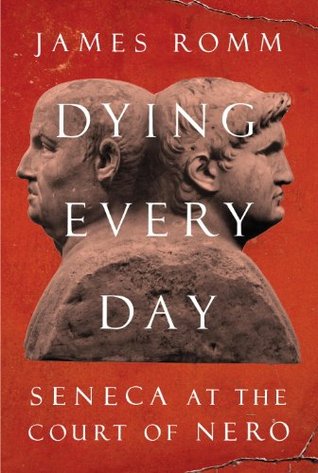
More on this book
Community


Kindle Notes & Highlights

by
James Romm
Read between
February 7 - February 15, 2025

For eight years, Seneca had worked hand in glove with Burrus, a political ally who esteemed his judgment and shared his values. It is easy to forget this partnership while reading Seneca’s prose works, for he mentions Burrus only once, in De Clementia, and then only tangentially. But Burrus was, without doubt, Seneca’s close collaborator in the palace. By supporting each other in conclaves with Nero, Seneca and Burrus had been able to manage the princeps, check his worst impulses, and in the estimation of some historians, run the empire in his name.
Nero ended up the owner of Burrus’ house, which perhaps supports the poisoning theory. His need for cash to subsidize the empire, and his own extravagant lifestyle, made it difficult for him to wait for his testators to die a natural death.
If Nero really did speak like this, he expressed what had been implicit from the start: Seneca’s dignity and stature were vital assets to his regime. Seneca could not now withdraw those assets, or buy them back with cash, without doing the regime grave harm. He was shackled by chains forged of his own moral virtue. He must see the drama through. The interview ended as it began, according to Tacitus: with insincere efforts to keep up appearances. Nero embraced and kissed the man he had just condemned to a joyless old age. Seneca, says Tacitus, with chilling insight into the courtier’s
...more
Seneca too urged Nero to stay in the marriage, if we can judge by Octavia, the anonymous Roman play that centers on the young girl’s tragedy. The author offers startling insight, perhaps based on firsthand knowledge, of what was going on behind closed doors in the palace in 62. A crucial scene brings Seneca and Nero onstage together, for an intimate, even tender, exchange.
The dialogue is invented, but the insights ring true. Seneca had always defended the gravitas of the principate, keeping Nero out of chariots and off the stages of theaters. Octavia, with her sober bearing and high birth, represented the same gravitas, especially by contrast with Poppaea. Seneca is bound to have stuck by her, but doing so put him on the same side as the ghost of Agrippina. Nero had already shucked off his mother; he was done listening to his surrogate father as well. And that spelled danger for his beleaguered wife.
These are the words Nero utters as he comes onstage in Octavia, an entrance that rivals Richard III’s in Shakespeare for boldness of characterization. Nero was hardly as resolute a leader as he is shown in these lines, if we credit the account of Tacitus. Nonetheless, assailed by the urgings of Tigellinus, he decided in the spring of 62 to do away with his two most prominent cousins. It was to them that Romans would turn, as Nero knew, should he lose support, as he might well do by divorcing the adored Octavia.
Seneca alone remained, of the old guard who had helped usher in Nero’s age of gold. Isolated and vestigial, he lingered on, with no clear role to play in the regime but no hope of leaving it. The job Agrippina had given him long ago, that of rector, “steersman,” of the emperor’s youth, had ended. So too had the roles he had subsequently taken on—senior counselor, speechwriter, caretaker of government, voice of Nero’s conscience. He lived now in twilight, a prisoner chained to the palace by the very moral stature that had brought him there to begin with.
There was no precedent for this plight amid the galleries of historical exempla in which Seneca often roamed. In the Greek world, philosophers had been banished, outlawed, or even killed by rulers they had sought to instruct; none had been retained at court against his will. Only Octavia, before her fall, furnished an analogue to Seneca’s situation: an outsider whom the princeps did not like or trust yet could not set free. But Octavia’s grim end did not bode well for Seneca. And her absence now made it harder for him to withdraw, for Nero could ill afford to lose both his most visible badges
...more
Unable to resign even at the price of his huge estate, Seneca had nonetheless withdrawn from court to the degree that was safe. He no longer kept up the routine of a powerful statesman, no longer saw crowds of clientelae, friends in need of favors, in his chambers each morning. He rarely went out in public, and when he did, he no longer had a large retinue of attendants. He was trying, within the limits Nero had set, to reduce his visibility.
The Letters contain no mention of Seneca’s political career. The deeds he took part in, the crises he managed, the people he had watched, or helped, Nero kill—none of them even entered his thoughts, if we judge the Letters to be their record. Perhaps he could not mention these topics without provoking the princeps; perhaps silence was the price he paid for freedom to publish. Whatever the reason, the Letters form a strangely partial self-exploration. Seneca examines himself from every angle, seeks the truth at every turn, seems willing to confide all—yet he says nothing about the most
...more
Examples of suicide also surrounded Seneca, reminders that the path of “freedom,” as he had called it in De Ira, was always open. Two cases greatly impressed him, both involving enslaved gladiators forced to fight in the arena. Finding their plights intolerable, both men resolved to die, despite being constantly under guard. One man contrived to visit a privy and force the lavatory sponge down his throat, choking himself to death. Another, while being driven to the arena on a cart, drooped toward the ground as though falling asleep, then inserted his head between the wheel spokes so that its
...more
This highlight has been truncated due to consecutive passage length restrictions.
The quote suggests a continuing effort to cut a deal with the princeps, a deal Nero had already once refused. Seneca will go quietly into retirement and not defame the regime, in exchange for being left unharassed. If Nero will become an Augustus and provide safety, Seneca will become a Vergil and give praise. A parent, a teacher, a god—Seneca, in his midsixties, could not have relished giving these roles to Nero in his midtwenties, his own former pupil. He kept the discussion general and left the analogy implicit. But in another work composed at the same time, Natural Questions, he was more
...more
Had Seneca ever tried to emulate Callisthenes, or did he now hope to? With all his eloquence and inside knowledge, he could have done much to harm Nero’s regime. Nothing suggests he felt tempted to use those weapons. Rather, he sought to keep writing, keep mum about the crimes he had seen, and keep alive. He would take a different path than Callisthenes. He would make himself too respected a sage for even Nero to kill.
This refusal to lament Campania’s fate exemplifies the Stoic approach to misfortune. Happiness comes not from one’s circumstances but from cultivation of Reason, the Stoics taught; a true sage, a sapiens, would be unharmed by torture or loss, even loss of life. But such acceptance can translate all too easily into passivity, especially in an autocracy where death often arrives by imperial order. By insisting that death is everywhere and cannot be escaped, Seneca seems to relieve himself of the burden of action. For indeed, Seneca was taking very little action in these years to help himself or
...more
Earlier Stoics had theorized that flames would cause the world’s end, the fiery cosmic exhalations they called ekpyroseis. But Seneca, in Natural Questions, imagined, as he had before in Consolation to Marcia, a universal flood. With grim foreboding, he notes that water is everywhere on earth—collecting in every hollow, flowing down every mountain, pooling beneath every acre of ground. “Nature has put moisture everywhere—so that, when she wishes, she can attack us from all sides,” he writes in Natural Questions. In a special-effects spectacular, he imagines each source breaking its bounds,
...more
“All boundaries will be sundered,” he foresees, in the same ecstatic tone he had used in Consolation to Marcia. “Whatever Nature has split into separate parts will be merged together.… Waters will converge from East and from West. A single day will serve to bury the whole human race. All that fortune’s favor has preserved for so long, all that it has raised above the rest—the noble, the glorious, the kingdoms of great peoples—all will plunge alike into the abyss.” The twilight of the world, it seemed to Seneca, was coinciding with the twilight of his own life. Soon, he foresaw, virtue and vice
...more
Seneca wrestled all his life with the issue of otium or nonparticipation, expressing different views in different works and even in different sections of a single work. He devoted an entire treatise to it, De Otio, only part of which survives. In a modern scholarly study, an analysis of Seneca’s views on otium runs to fifty dense pages and even then comes to no firm conclusions. “It is difficult, if not impossible, to give an account of Seneca’s views which, while remaining faithful, would produce a consistent and coherent system,” concedes Miriam Griffin, the author of that study. The problem
...more
the regime was hopelessly evil or the Stoic’s own life was in danger. But what if the Stoic’s life was more endangered by leaving politics than by staying? And what if, by his departure, he made an evil regime more evil? The let-out clauses posed perils of their own. And the question of when to invoke them—at what point a regime’s malady became incurable, or one’s own risks rose unacceptably—was a thorny one. Seneca’s own career exemplified the dilemmas, yet he could not safely write from experience. He had to frame all discussions of withdrawal in general, even hypothetical, terms. This gives
...more
Was Nero far enough gone in mind to torch his own city? Or to treat its destruction as an occasion for song? What would have been his purpose in setting the fire—to build a new Rome in his own image, a Neronopolis, as Suetonius says he planned to do? Or to lash out at disapproval of his new persona and at the Stoics, whose scowls hurt him so deeply? Rome was his conscience, the city he dreaded to enter after killing his mother, the city that had, briefly, made him ashamed to reject Octavia. If, as psychologists tell us, arson often springs from buried rage and a quest for revenge, then Nero
...more
Seneca’s prose works offer forgiveness, but in the bleak world of the tragedies, the sin of weakness comes back on the sinner’s head a thousandfold. In a gruesome messenger speech, we hear how Atreus butchered, fileted, and stewed Thyestes’ children. Then we watch as Thyestes unknowingly consumes the horrid casserole.
Throughout his political career, Seneca, a practiced diplomat, had hedged bets and navigated between extremes. Now, at his most important crossroads, he once again temporized. He would neither join the conspiracy nor oppose it. His reply to Piso was this: it would not be in his own interest or in Piso’s to meet or have further communication. But, he added, his own well-being depended on Piso’s safety. The remark was an elaborate pleasantry, but it carried a tone of approbation; he seemed to be signaling he would not stand in the plotters’ way. It was a sentence he would come to regret.
Of all the tantalizing but ambiguous clues to the mind of Seneca, this is surely the most tantalizing and the most ambiguous. It has no more substance than a story heard and recorded, several decades after the fact, by a man who was not sure he believed it. Yet Tacitus was not willing to dismiss it; nor are many modern historians. It raises the awesome possibility that Seneca, while holding back from action, had hopes of ending up the new princeps, the Western world’s first philosopher king. But it remains only that, a possibility, not subject to proof or refutation. Here is the greatest
...more
In his prose treatises and in Letters to Lucilius, Seneca examined suicide from every angle, especially the question of when it was called for. Wasting disease might justify it, or the abuse of a cruel tyrant, or the certainty that death was coming soon in any case. As he awaited word from Nero’s palace, Seneca might have reflected that though he was approaching a critical threshold in all three areas, he had not crossed it in any. He still might hope that banishment, not death, would be Nero’s verdict. His philosophic stature might protect him, as it later shielded his fellow Stoic sage
...more
Imago is a multilayered word. Like its English derivative image, it can mean simply “shape” or “form.” But it can also mean “illusion,” “phantom,” or “false seeming,” something “imagined.” Tacitus, a superb ironist and verbal artist, chose this word with care. Seneca, too, as Tacitus was aware, was a consummate ironist—an author who had painted his self-portrait in half a million words yet had never, in all his treatises, plays, and epistles, addressed the truths of his life in power. He had created an imago of himself since the day he began writing. He was shaping it still in his last hours,
...more
The most complex life of the Neronian age had ended fittingly, with the most complex death. Seneca’s protracted, three-stage suicide had not gone at all according to plan, a plan he had contemplated for years. Yet it was his own distinctive construction, composed without interference from the soldiers. In the end, he must have been pleased with the autonomy and single-mindedness of his exit. It was the one thing he owned that Nero couldn’t touch. His body was cremated and the ashes interred without rites or ceremony, as he had requested in his will.
Seneca allegedly once told Nero—the occasion of the remark is not known—“No matter how many you kill, you can’t kill your successor.” But in this case, as in many others, Nero proved his teacher wrong. He had indeed eliminated all possible successors, men belonging to the Julian line, by the end of 65.
Seneca, had he lived, would have appreciated the irony: his wayward pupil, in the end, became a student of his hardest lesson. The questions of when and how to die had preoccupied Seneca in his last years. Seneca too had stored up poison, the means to a clean, quiet end, but in the event he had preferred the blade and the shedding of blood. Even that had not killed him, but Seneca had suffered in death, a point he considered crucial. It was what set Cato, Seneca’s great moral hero, apart from ordinary men.
Perhaps the most apt judgment on Seneca’s career can be taken from something Quintilian said in his Institutio Oratoria. On its surface the remark applies to Seneca’s literary style, but it seems to reach beyond that and into the realms of morality, politics, and character—the arenas in which Seneca’s strange drama played out. “There is much we should approve in him, much that we should even admire,” Quintilian wrote. Then he urged Seneca’s readers to be selective in winnowing out good prose from bad, saying: “Only take care in making your choice.” Finally he added, speaking this time of
...more
Marcus Aurelius achieved, a century after Seneca had sought it, the reconciliation of Stoic morality and Roman political authority, a development as pathbreaking as Nero’s ill-fated fusion of the roles of princeps and performing musician. The record Marcus left behind of his thoughts and musings, Meditations, still inspires countless readers today. It has appeared in no fewer than six new editions during the year this book was written. It attests to the power of ethical teachings to enlighten even an autocrat, if only he is willing to listen. Had Seneca lived a century later than he did, he
...more
