
More on this book
Community


Kindle Notes & Highlights

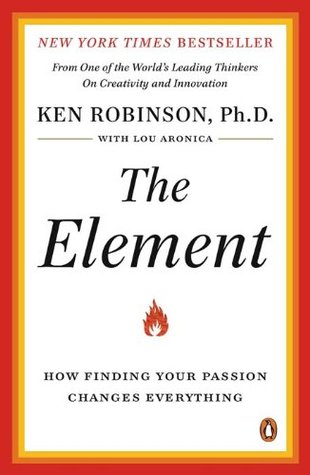
I use the term the Element to describe the place where the things we love to do and the things we are good at come together.
I don’t mean to say that there’s a dancer, a cartoonist, or a Nobel-winning economist in each of us. I mean that we all have distinctive talents and passions that can inspire us to achieve far more than we may imagine.
What is true is that if you’re not prepared to be wrong, you’ll never come up with anything original.
If the corporate world sees you as a financial type, you’ll have a difficult time finding employment on the “creative” side of the business. We can fix this by thinking and acting differently ourselves and in our organizations.
Alvin Toffler’s Future Shock.
It’s very possible that our children will have multiple careers over the course of their working lives, not simply multiple jobs.
The Element is the meeting point between natural aptitude and personal passion.
The Element has two main features, and there are two conditions for being in it. The features are aptitude and passion. The conditions are attitude and opportunity. The sequence goes something like this: I get it; I love it; I want it; Where is it?
Most people will answer five—taste, touch, smell, sight, and hearing. Some will say there’s a sixth sense and suggest intuition.
They were speaking of a sense that we all have, and that is fundamental to our functioning in the world. They were talking about our sense of balance.
Ironically, Alfred Binet, one of the creators of the IQ test, intended the test to serve precisely the opposite function. In fact, he originally designed it (on commission from the French government) exclusively to identify children with special needs so they could get appropriate forms of schooling. He never intended it to
identify degrees of intelligence or “mental worth.”
Harvard psychologist Howard Gardner has argued to wide acclaim that we have not one but multiple intelligences. They include linguistic, musical, mathematical, spatial, kinesthetic, interpersonal (relationships with others), and intra-personal (knowledge and understanding of the self) intelligence.
He argues that there are three types of intelligence: analytic intelligence, the ability to solve problems using academic skills and to complete conventional IQ tests; creative intelligence, the ability to deal with novel situations and to come up with original solutions; and practical intelligence, the ability to deal with problems and challenges
in everyday life.

Investigar métodos de este tipo
If you don’t embrace the fact that you think about the world in a wide variety of ways, you severely limit your chances of finding the person that you were meant to be.
definition of imagination is “the power to bring to mind things that are not present to our senses.”
“Is man what he seems to the astronomer, a tiny lump of impure carbon and water crawling impotently on a small and unimportant planet? Or is he what he appears to Hamlet? Is he perhaps both at once?”
Creativity is a step beyond imagination because it requires that you actually do something rather than lie around thinking about it.
creative work is a delicate balance between generating ideas and sifting and refining them.
“If you’re not prepared to be wrong, you’ll never produce anything original.”
Creative thinking depends greatly on what’s sometimes called divergent or lateral thinking,
Importante
there is far more to our minds than the deliberate processes of conscious thought.
So at times, creativity is a conscious effort. At others, we need to let our ideas ferment for a while and trust the deeper unconscious ruminations of our minds, over which we have less control.
“There is nothing good or bad, only thinking makes it so.”
“The greatest discovery of my generation is that human beings can alter their lives by altering their attitude of mind. . . . If you change your mind, you can change your life.”
Flow: The Psychology of Optimal Experience, Dr. Csikszentmihalyi
