
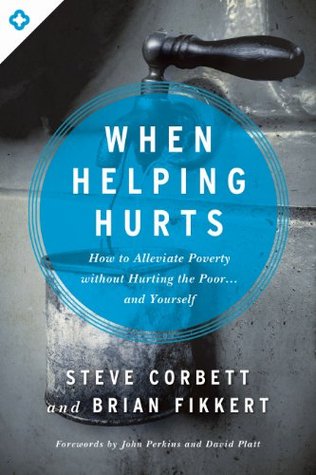
More on this book
Community


Kindle Notes & Highlights

Read between
September 5 - November 13, 2024

If Christ is Lord of all, how do we do farming, business, government, family, art, etc., to the glory of God?
We are not bringing Christ to poor communities. He has been active in these communities since the creation of the world, sustaining them “by his powerful word” (Heb. 1:3).
one of the biggest problems in many poverty-alleviation efforts is that their design and implementation exacerbates the poverty of being of the economically rich—their god-complexes—and the poverty of being of the economically poor—their feelings of inferiority and shame.
The fact that all of humanity has some things in common with the materially poor does not negate their unique and overwhelming suffering nor the special place that they have in God’s heart,
material poverty alleviation involves more than ensuring that people have sufficient material things; rather, it involves the much harder task of empowering people to earn sufficient material things through their own labor, for in so doing we move people closer to being what God created them to be.
If poverty alleviation is about reconciling relationships, then we do not have the power to alleviate poverty in either the materially poor or in ourselves.
“Thy kingdom come, Thy will be done in earth, as it is in heaven, for without You we cannot fix our communities, our nations, and our world.”
However, it does mean that we cannot hope for the transformation of people without the involvement of the local church and the verbal proclamation of the gospel that has been entrusted to it.
people’s faults are far more obvious than the fallen systems in which they live.
Evangelicals tend to believe that systemic arguments for poverty amount to shifting the blame for personal sin and excusing moral failure.
Development is not done to people or for people but with people.
This help could very well include providing them with financial assistance, but such assistance would be conditional upon and supportive of their being productive.
All of us need to remember that the materially poor really are created in the image of God and have the ability to think and to understand the world around them.
Wherever the Bible speaks specifically about church life, it must be heeded. But where the Bible is silent, North American pastors must be careful not to impose their own culturally determined ministry styles into settings in which the local pastors might know more about the most effective way to minister.
However, starting with a focus on needs amounts to starting a relationship with low-income people by asking them, “What is wrong with you? How can I fix you?”
It would be far better to let a nonemergency need go unmet than to meet that need with outside resources and cripple local initiative in the process.
the North American need for speed undermines the slow process needed for lasting and effective long-run development.
Participation is not just the means to an end but rather a legitimate end in its own right.
The primary questions concerning STMs to poor communities need to focus on the impacts of the trips on those communities. It is not about us. It is about them!
Stay away from the “go-help-and-save-them” message and use a “go-as-a-learner” message.
Moreover, the fact is that many of us are better equipped to minister closer to home, as there may be fewer cultural and contextual barriers, although these barriers can still be significant as we start to cross even local socioeconomic divides.
Typically, the biggest challenge that ministries face is an insufficient number of people who are willing to invest the time and energy that it takes to walk through time with a needy individual or family.
Middle- and upper-class North American Christians need to be aware that their networks constitute an enormous resource that they can bring to bear on the lives of materially poor people, not just as an act of “mercy,” but also as an act of “justice” in addressing the broken systems that oppress and marginalize many materially poor people.
A good rule of thumb for achieving an early, recognizable success is to “start small, start soon, and succeed.”
Having the attitude of a humble learner throughout the process is far more important than having comprehensive knowledge at the start of it.
one of the many things the institutional church must consider before corporately engaging in any activity is the extent to which such engagement allows the church to clearly articulate the gospel message.
