
Kindle Notes & Highlights


It is the belief of our people that all elements of the Natural World were created for the benefit of all living things and that we, as humans, are one of the weakest of the whole Creation, since we are totally dependent on the whole Creation for our survival.
Russell McOrmond liked this
He argued not for the establishment of law and order, but for the full establishment of peace. Peace was to be defined not as the simple absence of war or strife, but as the active striving of humans for the purpose of establishing universal justice. Peace was defined as the product of a society that strives to establish concepts that correlate to the English words power, reason, and righteousness.
all people have a right to the things they need for survival, even those who do not or cannot work, and no person or people has a right to deprive others of the fruits of those gifts.
Abu-Isa Webb liked this
The law was also based to an impressive degree on a logic that looked to nature for its rules.
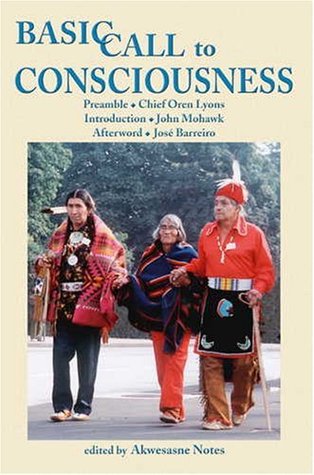
Oren Lyons spoke first. He explained how he would address the duty of all human beings to respect not only "human rights," but the rights of all the beings of the Creation. This he went over carefully and seriously, explaining that this was the foundation for any life that would be full and decent and that could begin to guarantee the rights of future generations.
They evolved a law that recognized that vertical hierarchy creates conflicts, and they dedicated the superbly complex organization of their society to function to prevent the rise internally of hierarchy.
An ordered society that has the capability of protecting people against abuse and, at the same time, is dedicated to a containment of hierarchy, is a complex society.
the most politically powerful and independent non-Western political body surviving in North America.
The original instructions direct that we who walk about on the Earth are to express a great respect, an affection, and a gratitude toward all the spirits that create and support life. We give a greeting and thanksgiving to the many supporters of our own lives-the corn, beans, squash, the winds, the sun. When people cease to respect and express gratitude for these many things, then all life will be destroyed, and human life on this planet will come to an end.
Herding and breeding of animals signaled a basic alteration in the relationship of humans to other life forms. It set into motion one of the true
revolutions in human history. Until herding. humans depended on nature for the reproductive powers of the animal world. With the advent of herding, humans assumed the functions that had for all time been the functions of the spirits of the animals. Sometime after this happened, history records the first appearance of the social organization known as "patriarchy."
European civilization has a history of rising and falling as its technologies reach their material and cultural limits. The finite natural world has always provided a kind of built-in contradiction to Western expansion.
Western technology and the people who have employed it have been the most amazingly destructive forces in all of human history.
When faced with the reality of its own destructiveness, Western civilization can only go forward into areas of more efficient destruction.
our essential message to the world is a basic call to consciousness. The destruction of the Native cultures and people is the same process that has destroyed and is destroying life on this planet. The technologies and social systems that have destroyed the animals and the plant life are also destroying the Native people. And that process is Western civilization.
The majority of the world finds its roots in the Natural World, and it is the Natural World and the traditions of the Natural World that must prevail if we are to develop truly free and egalitarian societies.
The people who are living on this planet need to break with the narrow concept of human liberation and begin to see liberation as something that needs to be extended to the whole of the Natural World.
The episode was repeated by Canada in 1934 on our territories at the Thames River community of Oneida.23
In 1972, our people journeyed to Sweden to take part in an international conference on the environment and ecology.28
Invested in the names we carry today are the lives of thousands of generations of both the past and the future.
We were a people of a great forest. That forest was a source of great wealth. It was a place in which was to be found huge hardwoods and an almost unimaginable abundance and variety of nuts, berries, roots, and herbs. In addition to these, the rivers teemed with fish and the forest and its meadows abounded with game. It was, in fact, a kind of Utopia, a place where no one went hungry, a place where the people were happy and healthy.
Property is an idea by which people can be excluded from having access to lands or other means of producing a livelihood. That idea would destroy our culture, which requires that every individual live in service to the Spiritual Ways and The People.
Our people live a simple life, one unencumbered by the need for endless material commodities. The fact that their needs are few means that all the peoples' needs are easily met. It is also true that our means of distribution is an eminently fair process, one in which all of the people share in all the material wealth all of the time.
Ours was a wealthy society. No one suffered from want. All had the right to food, clothing, and shelter. All shared in the bounty of the spiritual ceremonies and the Natural World. No one stood in any material relationship of power over anyone...
This highlight has been truncated due to consecutive passage length restrictions.
To this day, Canada, the former colony of England, has never made a treaty for the lands in the St. Lawrence River Valley.
The Native land base was held in common, and this was perceived as an uncivilized and un-American practice. The assimilationists urged that if every Indian family owned its own farmstead, they could more readily acquire "civilized" traits. Thus the Dawes Act of 188710 ordered the Native nations stripped of their land base, resulting in the transfer of millions of acres to European hands."
