
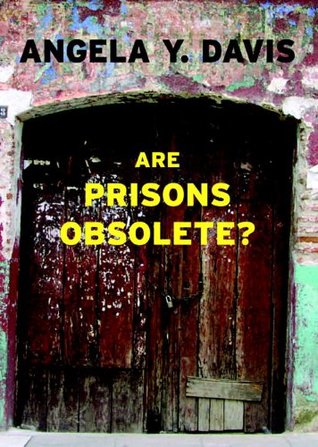
More on this book
Community


Kindle Notes & Highlights

Read between
November 8 - November 10, 2023

The reality is that we were called upon to inaugurate the twenty-first century by accepting the fact that two million people—a group larger than the population of many countries—are living their lives in places like Sing Sing, Leavenworth, San Quentin, and Alderson Federal Reformatory for Women. The gravity of these numbers becomes even more apparent when we consider that the U.S. population in general is less than five percent of the world’s total, whereas more than twenty percent of the world’s combined prison population can be claimed by the United States. In Elliott Currie’s words, “[t]he
...more
California artist Sandow Birk was inspired by the colonizing of the landscape by prisons to produce a series of thirty-three landscape paintings of these institutions and their surroundings. They are collected in his book Incarcerated: Visions of California in the Twenty-first Century.
The prison therefore functions ideologically as an abstract site into which undesirables are deposited, relieving us of the responsibility of thinking about the real issues afflicting those communities from which prisoners are drawn in such disproportionate numbers. This is the ideological work that the prison performs—it relieves us of the responsibility of seriously engaging with the problems of our society, especially those produced by racism and, increasingly, global capitalism.
The prison has become a black hole into which the detritus of contemporary capitalism is deposited. Mass imprisonment generates profits as it devours social wealth, and thus it tends to reproduce the very conditions that lead people to prison. There are thus real and often quite complicated connections between the deindustrialization of the economy—a process that reached its peak during the 1980s—and the rise of mass imprisonment, which also began to spiral during the Reagan-Bush era. However, the demand for more prisons was represented to the public in simplistic terms. More prisons were
...more
Cultural critic Gina Dent has pointed out that our sense of familiarity with the prison comes in part from representations of prisons in film and other visual media. The history of visuality linked to the prison is also a main reinforcement of the institution of the prison as a naturalized part of our social landscape. The history of film has always been wedded to the representation of incarceration. Thomas Edison’s first films (dating back to the 1901 reenactment presented as newsreel, Execution of Czolgosz with Panorama of Auburn Prison) included footage of the darkest recesses of the
...more
“Advocates of incarceration . . . hoped that the penitentiary would rehabilitate its inmates. Whereas philosophers perceived a ceaseless state of war between chattel slaves and their masters, criminologists hoped to negotiate a peace treaty of sorts within the prison walls. Yet herein lurked a paradox: if the penitentiary’s internal regime resembled that of the plantation so closely that the two were often loosely equated, how could the prison possibly function to rehabilitate criminals?” —Adam Jay Hirsch
The above example from Douglass demonstrates how whiteness, in the words of legal scholar Cheryl Harris, operates as property.23 According to Harris, the fact that white identity was possessed as property meant that rights, liberties, and self-identity were affirmed for white people, while being denied to black people. The latter’s only access to whiteness was through “passing.” Douglass’s comments indicate how this property interest in whiteness was easily reversed in schemes to deny black people their rights to due process. Interestingly, cases similar to the one Douglass discusses above
...more
One of the many ruses racism achieves is the virtual erasure of historical contributions by people of color. Here we have a penal system that was racist in many respects—discriminatory arrests and sentences, conditions of work, modes of punishment—together with the racist erasure of the significant contributions made by black convicts as a result of racist coercion. Just as it is difficult to imagine how much is owed to convicts relegated to penal servitude during the nineteenth and twentieth centuries, we find it difficult today to feel a connection with the prisoners who produce a rising
...more
And there is even more compelling evidence about the damage wrought by the expansion of the prison system in the schools located in poor communities of color that replicate the structures and regimes of the prison. When children attend schools that place a greater value on discipline and security than on knowledge and intellectual development, they are attending prep schools for prison. If this is the predicament we face today, what might the future hold if the prison system acquires an even greater presence in our society? In the nineteenth century, antislavery activists insisted that as long
...more
Some scholars have argued that the word “penitentiary” may have been used first in connection with plans outlined in England in 1758 to house “penitent prostitutes.” In 1777, John Howard, the leading Protestant proponent of penal reform in England, published The State of the Prisons,44 in which he conceptualized imprisonment as an occasion for religious self-reflection and self-reform.
The new generation of super-maximum security facilities also rely on state-of-the-art technology for monitoring and controlling prisoner conduct and movement, utilizing, for example, video monitors and remote-controlled electronic doors.51 “These prisons represent the application of sophisticated, modern technology dedicated entirely to the task of social control, and they isolate, regulate and surveil more effectively than anything that has preceded them.”
Studies indicating that women have been even more likely to end up in mental facilities than men suggest that while jails and prisons have been dominant institutions for the control of men, mental institutions have served a similar purpose for women. That is, deviant men have been constructed as criminal, while deviant women have been constructed as insane.
It is true that if we focus myopically on the existing system—and perhaps this is the problem that leads to the assumption that imprisonment is the only alternative to death—it is very hard to imagine a structurally similar system capable of handling such a vast population of lawbreakers. If, however, we shift our attention from the prison, perceived as an isolated institution, to the set of relationships that comprise the prison industrial complex, it may be easier to think about alternatives. In other words, a more complicated framework may yield more options than if we simply attempt to
...more
Eve liked this
