
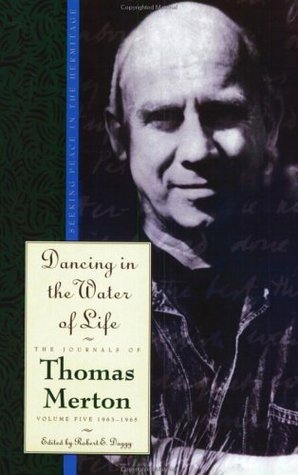
More on this book


Kindle Notes & Highlights

Read between
July 14 - December 26, 2018

One “gavotte” that nags him is the recurring feeling of “growing old.”
During these two and a half years Thomas Merton simply did not feel good most of the time.
Anselm is saying “You must because you are, and being what you are you must say what you are, by being and action, and whether you like it or not you must say you are in God and from Him and for Him, and for no other!”
I do not know if I am well or not. Or what the numbness in my left arm means (it is always going to sleep). But in my case, health or sickness, or whatever else comes: I ask only to please God in life and in death, and for the rest there is precious little to think or worry about.
No matter how good the cause may be, I realize that my own silence and interior life come first, no matter how much anyone may say, no matter how good the results may appear to be. True, there is no essential conflict between interior prayer and exterior action: but more interior prayer is God’s will for me and not so much exterior action. If I try to obey–and do not succeed in everything, that is another matter.
It is not social programs that give life the meaning it demands.
It is just that I am now in Louisville and last night I was under those trees, and I do not have to make sense out of it, still less to force it to “make sense,” which would in fact be to insist on an illusion.
“To believe is the freedom to trust in Him quite alone” (and to be independent of any other reliance) and to rely on Him in everything that concerns us.
Fine pages in Barth about God not being “pure power” in the sense of unbridled and arbitrary potentia–for this is really the power of nothing. God is potestas. The power of love and of truth, not an infinite and unbridled will purely arbitrary in itself and without responsibility to a creative plan. “Absolute power” is purely and simply the program of the devil.
And Christ, as man, elects to save man by the renunciation of power, by total poverty, annihilation and death since in this glory of the Father is manifest–the glory that leaves man free to choose, within the limits of truth.
He says: “Grace can never be possessed but can only be received afresh again and again.”
The great hope of our time is, it seems to me, not that the Church will become once again a world power and a dominant institution, but on the contrary that the power of faith and the Spirit will shake the world when Christians have lost what they held on to and have entered into the eschatological kingdom–where in fact they already are!
I have no need to judge and no capacity to (Father Miller had a good conference on judging). What matters is the struggle to make the right adjustment in my own life, and this upsets me because there is no pattern for me to follow, and I don’t have either the courage or the insight to follow the Holy Spirit in freedom. Hence my fear and my guilt, my indecisions, my hesitations, my back tracking, my attempts to cover myself when wrong, etc.
And he commends the honesty of Machiavelli for admitting that social conflict is the basis of all power.
Simone de Beauvoir has this to say, which corrects so many of the clichés about existentialism: “It is not true that the recognition of the freedom of others limits my own freedom. To be free is not to have the power to do anything you like; it is to be able to surpass the given toward an open future: the existence of others as a freedom defines my own situation and is even the condition of my own freedom.” (Ethics of Ambiguity, p. 91)
I wanted to act like a reasonable, civilized, responsible Christian of my time. I am not allowed to do this, and I am told I have renounced this–fine. In favor of what? In favor of a silence which is deeply and completely in complicity with all the forces that carry out oppression, injustice, aggression, exploitation, war. In other words silent complicity is presented as a “greater good” than honest, conscientious protest–it is supposed to be part of my vowed life, is for the “glory of God.” Certainly I refuse complicity. My silence itself is a protest and those who know me are aware of this
...more
I am coming to see clearly the great importance of the concept of “realized eschatology”–the transformation of life and of human relations by Christ now (rather than an eschatology focussed on future cosmic events–the Jewish poetic figures to emphasize the transcendence of the Son of God). Realized eschatology is the heart of genuine Christian humanism and hence its tremendous importance for the Christian peace effort for example: the presence of the Holy Spirit, the call to repentance, the call to see Christ in Man, the presence of the redeeming power of the cross in the sacraments: these
...more
For once in a long time felt as if I had spent a moment in my own family.
How badly we need a real spirit of liberty in the Church, it is vitally necessary and the whole Church depends on it.
Thank God “Serafian” has had the courage and good sense to admit and state frankly that so far the Council has dealt in relative trivialities! The problems that are largely irrelevant to the world at large, problems that are generated by gratuitously adopted and formalistic attitudes of the Church herself–incrustations of her own history.
It raises once again the serious question of my own “vocation” (frustrated (?) by a political deal between the Abbot and the Congregation?). Certainly I do not doubt Providence, but just as certainly I cannot let a strictly political, pragmatic and juridical answer be the final word.
The possibility of a long, stupid, costly, disastrous and pointless war in Asia is no mere phantasm. It will certainly bring no good whatever to anyone.
I found that in an hour’s meditation I am somnolent for the first twenty minutes or so, not asleep, but “out”–in a kind of total blackout–then after that everything is very clear. So yesterday. The blackout seems to be necessary as a passage from confusion to truth, as a recovery from pressure and motion, a return to balance. Before it I am not awake, only moving around.
But the whole decor of habits and stalls and stained glass seems unreal when you have been praying the psalms among pine trees.
Idolatry is the basic sin. Therefore that which is deepest in us, most closely related to our final sin, most likely to deceive us under the appearance of true worship, or integrity, or honesty, or loyalty, or idealism. Even Christianity is often idolatrous without realizing it. The sin of craving a God who is “other” than He who cannot be made an idol–i.e., an object.
There is no question in my mind that the artificiality of life in the community is, in its own small way, something quite atrocious (saved by the fact that the artificiality of life in the “world” is totally monstrous and irrational).
The policies of men contain within themselves the judgment and doom of God upon their society, and when the Church identifies her policies with theirs, she too is judged with them–for she has in this been unfaithful and is not truly “the Church.” The power of “the Church” (who is not “the Church” if she is really rich and powerful) contains the judgment that “begins at the house of God.”
In solitude everything has its weight for good or evil, and one must attend carefully to everything. If you apply yourself carefully to what you do, great springs of strength and truth are released in you. If you drift or go inattentively, automatic and obsessed, the strength is against you and becomes a storm of confusion, and dashes you on the rocks. And when the power, the energy of truth is well released, then everything becomes good and makes sense, and there is no contrast to be made between solitude and community or anything else, because all is good. It seems to me, though, that these
...more
The desert is given us to get the evil unnested from the crannies of our own hearts.
The only response is to go out from yourself with all that one is, which is nothing, and pour out that nothingness in gratitude that God is who He is. All speech is impertinent, it destroys the simplicity of that nothingness before God by making it seem as if it had been “something.”
This is our contemplation: the realization and “experience” of the lifegiving Spirit in Whom the Father is present to us through the Son, our way, truth, and life. The realization that we are on our way, that because we are on our way we are in that Truth which is the end and by which we are already fully and eternally alive. Contemplation is the loving sense of this life and this presence and this eternity.
“Material civilization in its demiurgic character seems to be one of the places where demonic action is most intense. Judeo-Christian tradition maintains the positive significance of political and cultural values. In this, it is opposed to the Gnostic doctrine of the cosmocratores [worldly powers] but it recognizes that, in fact, these domains are invaded and dominated by demonic powers.”
monks are becoming incapable of accepting and resting in anything–yet they do not really seek God, they seek a “perfect monasticism.”
What I find most in my whole life is illusion. Wanting to be something of which I had formed a concept. I hope I will get free of that now, because that is going to be the struggle. And yet I have to be something that I ought to be–I have to meet a certain demand for order and inner light and tranquillity. God’s demand, that is, that I remove obstacles to His giving me these.
So that is the vow of obedience: you submit yourself also to somebody else’s prejudices, and to his myths, and to the worship of his fetishes!!
I see more and more that solitude is not something to play with. It is deadly serious.
Certainly the solitary life makes sense only when it is centered on one thing: The perfect love of God. Without this, everything is triviality. Love of God in Himself, for Himself, sought only in His will, in total surrender.
Yet one thing the hermitage is making me see–that the universe is my home and I am nothing if not part of it.
I was much struck by the idea of the judicia Dei (judgments of God), and the thought took a deep hold on me that what matters in our life is not abstract ideals but profound love and surrender to the concrete “judgments of God.” They are our life and our light, inexhaustible sources of purity and strength. But we can ignore them. And that is the saddest thing of all.
It is unfortunate that so much of monastic obedience has become formal and trivial. No use in lamenting it, but nevertheless renewal in this area must mean above all a recovery of the sense of obedience to God in all things, and not just–obedience to rules and Superiors where demanded, and after that go woolgathering where you may!
Obedient unto death…Perhaps the most crucial aspect of Christian obedience to God today concerns the responsibility of the Christian in technological society toward God’s creation and God’s will for His creation.
There is no question for me that my one job as monk is to live the hermit life in simple direct contact with nature, primitively, quietly, doing some writing, maintaining such contacts as are willed by God, and bearing witness to the value and goodness of simple things and ways, and loving God in it all. I am more convinced of this than of anything contingent on my life and I am sure it is what He asks of me. Yet I do not always respond with simplicity.
The great sin, the source of all other sins, is idolatry. And never has it been greater, more prevalent than now. It is almost completely unrecognized–precisely because it is so overwhelmingly total. It takes in everything. There is nothing else left.
This is clearly one of the most important and inescapable messages of the Bible: that unless man turns from his idols to God, he will destroy himself, or rather his idolatry will prove itself to be his destruction. (The idolater is already self-destroyed.) The other thing: man as a whole will not change. He will destroy himself. The Bible sees no other end to the story.
But history is in the hands of God and the decisions of men lead infallibly to the full expression of what is really hidden in them and in their society.
Yesterday I wrote to the man at McGill [University] who thought all contemplation was a manifestation of narcissistic regression! That is just what it is not. A complete awakening of identity and of rapport! It implies an awareness and acceptance of one’s place in the whole, first the whole of creation, then the whole plan of Redemption–to find oneself in the great mystery of fulfillment which is the Mystery of Christ.
The great joy of the solitary life is not found simply in quiet, in the beauty and peace of nature, song of birds etc., nor in the peace of one’s own heart, but in the awakening and attuning of the heart to the voice of God–to the inexplicable, quite definite inner certitude of one’s call to obey Him, to hear Him, to worship Him here, now, today, in silence and alone, and that this is the whole reason for one’s existence, this makes one’s existence fruitful and gives fruitfulness to all one’s other (good) acts, and is the ransom and purification of one’s heart that has been dead in sin.
“Solitude” becomes for me less and less of a specialty, and simply “life” itself. I do not seek to “be a solitary” or anything else, for “being anything” is a distraction. It is enough to be, in an ordinary human mode, with only hunger and sleep, one’s cold and warmth, rising and going to bed. Putting on blankets and taking them off (two last night. It is cold for June!). Making coffee and then drinking it. Defrosting the refrigerator, reading, meditating, working (ought to get on to the article on symbolism3 today), praying.
There is no question of the deep inauthenticity of the common life in this monastery, in most religious communities, and in the Church. It is due in part to the way authority is conceived and exercised (to the great psychological and spiritual harm of many) and to the fact that this can hardly be remedied as matters stand (at least here). The “new” approach, however, seems to me to be equally inauthentic, for reasons that are more obscure. I think the relationships set up are based more on insecurities and superficial needs than on the Spirit and on faith. They do not spell authenticity.
He recognizes organization as a “problem.” Love is least in evidence when the Church is most organized, perhaps most in evidence when Christians were driven into deserts or catacombs.
