
Kindle Notes & Highlights
Read between
August 8 - August 26, 2020

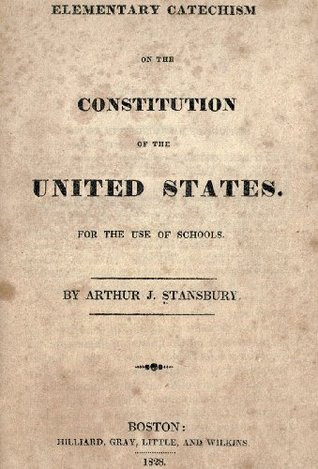
originally published in 1828 as an introductory school text on the Constitution of the United States.
As much as possible the style and formatting of the original text has been preserved as originally published. Only those serious errors not explainable by different systems of style or spelling have been corrected in this edition.
In the intervening years there have also been many amendments to the constitution which have made obsolete some of the answers given within, particularly to do with slavery, federal taxation, direct election of Senators and voter eligibility.
The interpretation of the constitution by all three branches of the federal government has also changed over the years to greatly expand its powers. While this text describes what the founders envisioned as a limited role of federal government, over time the federal government has assumed greater and greater powers.
many of the answers given here are no lo...
This highlight has been truncated due to consecutive passage length restrictions.
Most of the book is still...
This highlight has been truncated due to consecutive passage length restrictions.
W. Cleon Skousen
its principles are simple, its features plain and obvious, and its brevity surpassing all example,
how small a portion of the citizens of this Republic have even a tolerable acquaintance with their own Constitution?
It is written expressly for the use of boys, and it has been the aim and effort of the writer to bring down the subject completely to a level with their capacity to understand it.
some inaccuracies may be discovered;
Why is this country called the United States? A. Because it is made up of a number of States which were once separate, but afterwards agreed to unite together.
Why did they do this? A. Because it would promote their general welfare.
Is some government necessary in every country? A. Certainly; without it nobody would be safe: not only our property, but our lives would be in danger.
Cannot all the people of a country govern themselves? A. If every man was perfectly virtuous, and knew what would be best for himself and others, they might. But this is far from being the case; and therefo...
This highlight has been truncated due to consecutive passage length restrictions.
In some countries a single man makes the laws according to his own pleasure. Q. What is such a government called? A. A Despotism, or absolute monarchy: and the person who thus rules is a Despot, or absolute monarch. In other states a certain number of persons belonging to ancient or wealthy families make the laws.
In other cases the people themselves meet to make the laws. This is called a pure Democracy.
where the people, too numerous to meet, themselves, choose certain of their own number to meet for them. This is called a REPRESENTATIVE GOVERNMENT, because those who meet represent all the rest. It is also called a REPUBLIC.
where a single man may make what laws he pleases, and all the rest must obey him, the people are no better than slaves.
Why do they obey him? A. Because he has an army of soldiers whom he pays, and who force the people to obedience.
How is this country governed? A. It is a Republic, and is governed by persons whom the people choose from time to time to make the laws.
When a part of the people of a nation remove to some distant place, where they settle, but still continue to be governed by the nation from which they came out, these new settlements are called Colonies, and the country which governs them is called the mother country.
this country came from England, Scotland or Ireland, (which three countries make up Great Britain) and long after they had settled here, continued to be governed by laws most of which were made in England.
But afterwards very unwise and unjust laws were made, and such as threatened to destroy all liberty in the colonies.
the people of the colonies consulted with each other what was to be done, and at length took up arms, raised such armies as they could, and though they had few soldiers, no experienced officers, and but little money, they carried on a war against the whole power of Great Britain, and having (with aid from France) forced two British armies to lay down their arms and surrender themselves prisoners, they at length compelled Great Britain to acknowledge their independence.
we ought ever to remember ours with ardent gratitude to God for so great a blessing, and with lasting love and reverence for those good, wise, and brave men, who went through such dangers and sufferings that their country might be free.
19th of April, 1775.
21st of January, 1783—
the 4th of July 1776 the Colonies first declared themselves free and independent; from that day the independence of the country is reckoned in all our public proceedings; though it was not acknowledged by Great Britain till 1783.
The different Colonies became each a free STATE, having power to govern itself in any way it should think proper.
a complete plan for uniting all the states under one GENERAL GOVERNMENT—this plan is called THE FEDERAL CONSTITUTION.
On this great plan, or Constitution the safety and happiness of the United States does, under Almighty God, mainly depend: all our laws are made by its direction or authority; whoever goes contrary to it injures and betrays his country, injures you, injures me, betrays us all, and is deserving of the heaviest punishment.
laws which concern all the states or more states than one are made by the CONGRESS OF THE UNITED STATES.
even the Congress itself should make a law which is contrary to the Constitution, must the people obey it? A. No.
A person who was born in another country and comes to live in this, is not owned as a citizen of the United States till he has lived among us a certain time; and then, (after knowing something of our laws and customs), has taken a solemn oath to obey the government.

Immigration
How is it known what number of people each State contains? A. Certain persons are appointed to count the people and take a written list of them. Such a counting is called a census, and it takes place once in every ten years. [In the year 1790 the United States contained 3,929,326; in 1800, 5,309,758; in 1810, 7,239,903; and in 1820, 9,638,166.]
Census
He is called their Speaker.
a Journal of the House of Representatives, and the person who keeps it is called the Clerk of the House.
Sergeant-at-Arms, and who may, when so ordered by the House, seize any Member who disobeys the rules, or who is charged by the House with any crime, and imprison him.
their Door Keeper, who is to take care that no person be admitted into the hall where the Representatives are sitting,...
This highlight has been truncated due to consecutive passage length restrictions.
the Officers of the House of Repr...
This highlight has been truncated due to consecutive passage length restrictions.
The Legislature of each State chooses the Senators for that State.
No longer true
The person who is chosen by the people to be Vice President of the United States, is made, by the Constitution, President of the Senate;
When any civil officer of the United States (that is, not an officer of the army,) is guilty of a violation of his public duty, he is accused, or charged, by the House of Representatives, and tried by the Senate. Such an accusation is called an Impeachment.
Impeachment
The Senators take a solemn oath
that they will carefully attend to the proof that shall be brought before them, and according to that proof declare the accused person innocent or guilty, as the case may be.
None can bring an impeachment but the House of Representatives, and none can try an impeachment but the Senate.
Let every youthful American exult that he has no master but the law; let him mark the man who would change this happy state of things as the enemy of his country; and above all let him remember that as soon as he himself breaks the law, he becomes himself that enemy.
We have no master, but the law.
In some governments it is held that "the king can do no wrong;" here we know no king but the law, no monarch but the constitution:
every thing is done by settled rules, called Rules of Order.
