
More on this book
Community


Kindle Notes & Highlights


‘Uncrown, the Lord of Emperors awaits you now.’
He felt a cold wind blow through his soul, from no direction in the world. The Emperor was dead.
Without a word spoken the two of them walked side by side into the vastness of the Hippodrome as the god’s sun rose from the forests and fields east of Sarantium’s triple landward walls and the day began.
A child cried. Children always cried in the darkness, somewhere. The world was what it was.
‘Oh City, City, ornament of the earth, eye of the world, glory of Jad’s creation, will I die before I see you again?’
To say of a man that he was sailing to Sarantium was to say that his life was on the cusp of change: poised for emergent greatness, brilliance, fortune—or else at the very precipice of a final and absolute fall as he met something too vast for his capacity. Valerius the Trakesian had become an Emperor. Heladikos, whom some worshipped as the son of Jad and placed in mosaic upon holy domes, had died in his chariot bringing fire back from the sun.
Miracle, bird or golden handiwork, More miracle than bird or handiwork . . .
had a sense—honed by experience—that what he’d contrived might achieve something of the effect he wanted. That, Martinian had always said, was the best any man in this fallible world could expect.
She was nineteen years old, but queens were not, in truth, allowed to be so young.
He was going, it seemed. Sailing to Sarantium. Walking, actually, for
Thoughtful now, Crispin looked at the other man. ‘Is it difficult?’ ‘What? Creating the birds? Yes, it was.’ ‘I’m certain of that. No, I meant being aware that the world cannot know what you have done.’ Zoticus sipped his tea. ‘Of course it is difficult,’ he said at length. Then he shrugged, his expression ironic. ‘But alchemy always was a secret art, I knew that when I began to study it. I am . . . reconciled to this. I shall exult in my own soul, secretly.’
Men were born and died, wanted something, somehow, to live after them—beyond the mass burial mound or even the chiselled, too-soon-fading inscription on the headstone of a grave. An honourable name, candles lit in memory, children to light those candles. The mighty pursued fame. An artisan could dream of achieving a work that would endure, and be known to have been one’s own. Of what did an alchemist dream?
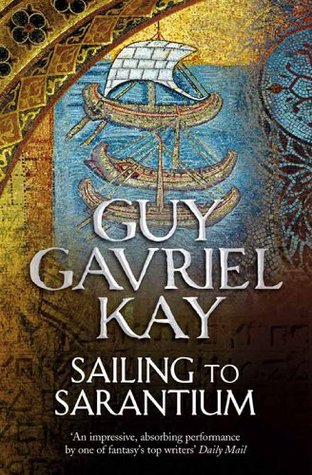
sailing to Sarantium.
‘I’m sailing to Sarantium. Of course I am,’
He dreamt of Sarantium, of making a mosaic there, with brilliant tesserae and all the shining jewels he needed: images on a towering dome of an oak tree in a grove, lightning bolts in a livid sky. They would burn him in the City for such an impiety, but this was only a dream. No one died for his dreams.
That long, unearthly note seemed to hang in the air between forest and field, earth and sky, and then it faded away like the mist.
Philosophy could be a consolation, an attempt to explain and understand the place of man in the gods’ creation. It couldn’t always succeed, though. There were times when comfort could only be found in a woman’s laughter, a friend’s known face and voice, shared rumours about the Antae court, even something so simple as a steaming bowl of pea soup at a table with others. Sometimes, when the shadows of the half-world pressed too near, one needed the world.
And yet, for all the re-emergence of the ordinary, Crispin thought, it had also become a landscape changed beyond his capacity of description. Where the bird had been about his neck there was an absence that felt oddly like a weight.
Real anguish here, Crispin thought, and was moved. They had lived through something together this morning. Wildly different paths to that glade seemed to matter less than one might have expected.
He drew a breath. ‘We worship them as the powers that speak to our souls, if it seems they do.’ He surprised himself. ‘We do so knowing there is more to the world, and the half-world, and perhaps worlds beyond, than we can grasp. We always knew that. We can’t even stop children from dying, how would we presume to understand the truth of things? Behind things? Does the presence of one power deny another?’
Men, when they think in this way—that the crisis, the moment of revealed power, has passed—are as vulnerable as they will ever be. Good leaders of armies at war know this. Any skilled actor or writer for the stage knows it. So do clerics, priests, perhaps cheiromancers. When people have been very deeply shaken in certain ways they are, in fact, wide open to the next bright falling from the air. It is not the moment of birth—the bursting through a shell into the world—that imprints the newborn gosling, but the next thing, the sighting that comes after and marks the soul.
DIVISIONS OF FAITH in the worship of Jad had led to burnings and torture and war almost from the beginning. The doctrine and liturgy of the sun god, emerging from the promiscuous gods and goddesses of Trakesia during the early years of the Empire of Rhodias, had not evolved without their share of schisms and heresies and the frequently savage responses to these. The god was in the sun, or he was behind the sun. The world had been born in light, or it had been released from ice and darkness by holy light. At one time the god was thought to die in winter and be reborn in the spring, but the
...more
This highlight has been truncated due to consecutive passage length restrictions.
They had a phrase along the Imperial road. He’s sailing to Sarantium, they said when some man threw himself at an obvious and extreme hazard, risking all, changing everything one way or another, like a desperate gambler at dice putting his whole stake on the table. That’s what he was doing.
From out at sea, sailing to Sarantium, all of this and more would spread itself out for the traveller like a feast for the famished eye,
That was if you came by sea. If you first approached by land down through Trakesia—as the Emperor himself was known to have done thirty years ago—what you saw before anything else were the Triple Walls. There were those dissenters, as there always are among travellers—a segment of mankind inclined to have, and voice, strong opinions—who urged that the might and scale of Sarantium were made most evident and overwhelming by these titanic walls, seen gleaming at a sunrise. And this was how Caius Crispus of Varena saw them on a morning exactly six weeks after he had set out from his home to answer
...more
starlit or a moonlit dome disdains All that man is, All mere complexities, The fury and the mire of human veins.
There was a smell of fear in the throne room. Plautus Bonosus, chanting gravely in his neighbourhood sanctuary two years later, knew he would never forget that moment. No man spoke. The one woman in the room did. ‘I would sooner die clothed in porphyry in this palace,’ the Empress Alixana said quietly, ‘than of old age in any place of exile on earth.’ She had been standing by the eastern window while the men debated, gazing out at the burning city beyond the gardens and the palaces. Now she turned and looked only at Valerius. ‘All Jad’s children are born to die. The vestments of Empire are
...more
Taras knew it was true. He was young. It was an opportunity. Sailing to Sarantium, men called it, when someone took a chance like this.
Crispin closed his eyes for a moment in the brilliance of the day, and just then—without any warning at all, like a flung spear or a sudden shaft of light—an image came to him. Whole and vast and unforgettable, completely unexpected, a gift. And also a burden, as such images had always been for him: the terrible distance between the art conceived in the eye of the mind and what one could actually execute in a fallible world with fallible tools and one’s own crushing limitations. But sitting there on the marble benches of the Sarantine Hippodrome, assailed by the tumult and the screaming of the
...more
It was a clear night, Pertennius’s chronicle meticulously recorded, the stars and the white moon looking down. A stupefying number of people died in the Hippodrome that evening and night. The Victory Riot ended in a black river of moonlit blood saturating the sands.
‘My lord,’ repeated the Empress quietly, ‘he was crowned. Garbed in porphyry before the people. Willingly or no. That makes two Emperors in this room. In this city. Two . . . living Emperors.’ Even Symeonis fell silent then, Bonosus remembered. The Chancellor’s eunuchs killed the old man that same night. In the morning his naked, dishonoured body was displayed for all to see, hanging
Thirty-one thousand people had died in the Hippodrome under that white moon two years ago.
In the Hippodrome they raced to honour the sun god and the Emperor and to bring joy to the people, and some of them ran in homage to gallant Heladikos, and all of them knew—every single time they stood behind their horses—that they could die there on the sands.
She walked away, still without a smile, before Kasia could correct her. It had been a kindness, though. Dear. She had meant to be kind. That could still happen then, in cities.
Had he arrived back at the inn after the racing, as he had intended, had he spoken with Kasia and learned of her encounter with a visitor—the details of which would have meant rather more to him than they did to her—Crispin would almost certainly have conducted himself differently in certain matters that followed. This, in turn, might have occasioned a significant change in various affairs, both personal and of much wider import. It could, in fact, have changed his life and a number of other lives, and—arguably—the course of events in the Empire. This happens, more often than is sometimes
...more
One arrived in the Imperial Precinct, Crispin belatedly realized, already aligned in some fashion, even before the first words or genuflections took place.
‘Mosaic,’ he said, more softly now, ‘is a dream of light. Of colour. It is the play of light on colour. It is a craft...I have sometimes dared call it an art, my lord . . . built around letting the illumination of candle, lantern, sun, both moons dance across the colours of the glass and gemstones and stones we use...to make something that partakes, however slightly, of the qualities of movement that Jad gave his mortal children and the world. In a sanctuary, my lord, it is a craft that aspires to evoke the holiness of the god and his creation.’
Exquisite as it was, beside the spectacular pearl about her throat it was almost a trifle. She was the daughter of the wealthiest family in the Empire. Even Crispin knew this. She needed this ruby about as much as Crispin needed . . . a cup of wine. Bad analogy, he thought. He did need one, urgently.
Kyros had looked over and blushed to see Strumosus’s sharp, small eyes on him. ‘Part of your education, boy. Be not seduced by cheap sentiment any more than by a heavy hand with spices. There’s a difference between the accolades of the masses and the approval of those who really know.’ He turned and went back into the heat of the kitchen. Kyros quickly followed.
Kyros wondered, though: how would it feel to be known as a competent administrator when you had once been the object yourself of all the wild cheers, the statues raised, the enraptured speeches and poems comparing you to eagles and lions, or to the great Hippodrome figures of all the ages? Was it hard? It must be, he thought, but couldn’t really know, not from looking at Astorgus.
He was the toast of Sarantium, the Emperor’s dinner companion, Glory of the Blues, wealthy beyond all youthful dreams. Pretty much the same person he’d been fifteen years ago, it seemed. Unfortunately, perhaps.
There was a golden rose on a long table by the wall to his left. Slender as a living flower, seemingly as pliant, four buds on the long stem, thorns among the small, perfect leaves, all of gold, all four buds rendered in stages of unfolding, and a fifth, at the crown, fully opened, achieved, each thin, exquisite petal a marvel of the gold-smith’s craft, with a ruby at the centre of it, red as a fire in the candlelight. The beauty caught at his heart, and the terrible fragility. If one were merely to take that long stem between two fingers and twist it would bend, distort, fall awry. The flower
...more
One might choose one’s deadly sacrilege. The dolphins carried souls to the dark god of Death in the pagans’ ancient pantheon, or they bore the body of the one god’s only son in a now-forbidden heresy.
‘An ignorant mosaicist from Varena, it seems, who now wishes to ask if he is likely to die for his transgressions.’ ‘Oh, certainly you are. One of these days,’ said Alixana, still smiling. ‘We all do.
The Emperor looked at her a moment. He turned back to Crispin. ‘I had an impression in the throne room earlier that you were of the same cast of mind as I am, solving Scortius’s challenge. Are your tesserae not . . . pieces of a puzzle, as you put it?’ Crispin shook his head. ‘They are glass and stone, not mortal souls, my lord.’ ‘True enough,’ agreed Valerius, ‘but then you aren’t an Emperor. The pieces change when you rule. Be grateful your craft spares you some decisions.’ It was said—had been said quietly for years—that this man had arranged the murder by fire of Flavius Daleinus on the
...more
At length, at great length, Crispin said the first thing that came to his lips among the many whirling thoughts, and he said it in a whisper, not to disturb the purity of that place: ‘You do not need to take Batiara back, my lord. You, and whoever it was built this for you, have your immortality.’
The Sanctuary behind them was Artibasos’s legacy, he thought, and it might end up being what the Emperor Valerius II was remembered for, and it could be—it could be—why the world might one day come to know that the Rhodian mosaicist Caius Crispus, only son of Horius Crispus of Varena and his wife Avita, had lived once, and done honourable work under Jad’s sun and the two moons.
The Emperor reads no mystic certainties of any kind in the late-night flames, sitting at the woman’s feet, one hand touching her instep and the jewelled slipper. He says, ‘Never leave me.’ ‘Wherever would I go?’ she murmurs after a moment, trying to keep the tone light and just failing. He looks up. ‘Never leave me,’ he says again, the grey eyes on hers this time. He can do this to her, take breath from chest and throat. A constriction of great need. After all these years. ‘Not in life,’ she replies.
‘This,’ said Crispin bitterly, ‘is the ambit of satisfaction for you? Clubbing someone senseless, killing him? This is what a man does to justify his place in Jad’s creation?’ Leontes was silent a moment. ‘You haven’t killed him. Jad’s creation is a dangerous, tenuous place for mortal men, artisan. Tell me, how lasting have the glories of Rhodias been, since they could not be defended against the Antae?’ They were rubble, of course. Crispin knew it. He had seen the fire-charred ruin of mosaics the world had once journeyed to honour and exalt. Leontes added, still gently, ‘I would be a poor
...more
This highlight has been truncated due to consecutive passage length restrictions.
the time the Life of the Blessed Tilliticus was written, it was either forgotten or deemed inconsequential by the recording clerics what role a minor Rhodian artisan might have played in the journey of the holy man to the god’s eternal Light. Military slang also comes and goes, changes and evolves. No coarse, ribald associations at all would attach to the name of Jad’s dearly beloved Pronobius by then.
