
Kindle Notes & Highlights

Read between
December 28 - December 31, 2018

As Willis Ware argued in a 1965 editorial in the trade journal Datamation, “It is clear that only a part—perhaps a small part, at that—of the programming process is involved with actually using a language for writing routines.” And since the rest of the work involved required “intellectual activity, mathematical investigation [and] discussions between people,” Ware maintained, there was no easy fix to the programming problem. “All the programming language improvement in the world will not shorten the intellectual activity, the thinking, the analysis, that is inherent in the programming
...more
If we take seriously the notion, foundational to the history of technology, that the things that human beings build matter—that the vast technological systems that we construct to understand and manipulate our environment both reflect our social, economic, and political values, and constrain them—then it is absolutely essential that we understand how these systems get built, by whom, and for what purposes.
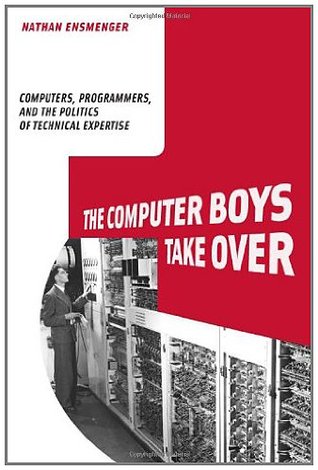
The first computer programmers were not scientists or mathematicians; they were low-status, female clerical workers and desktop calculator operators. The origins of programming as a profession lie in the commercial traditions of machine-assisted, manual computation, not in the mainstream of theoretical mathematics.
In fact, there was only one really “striking characteristic” about programmers that the Perry and Cannon study identified. This was “their disinterest in people.” Compared with other professional men, “programmers dislike activities involving close personal interaction. They prefer to work with things rather than people.”71 In a subsequent study, Perry and Cannon demonstrated this to be true of female programmers as well.72
Interestingly enough, the name of his idealized department was synnoetics (from the Greek for the “science of the mind”) rather than computer science. Synnoetics was Fein’s term for “the cooperative interaction, or symbiosis of people, mechanisms, plant or animal organisms, and automata into a system that results in a mental power (power of knowing) greater than that of its individual components.” In many ways, synnoetics was much more akin to the contemporary discipline of cybernetics that to the modern discipline of computer science.
In 1965, the ACM Curriculum Committee attempted to bring unity to computer science by defining it in terms of a single fundamental unit of analysis: computer science “is concerned with information in much the same sense that physics is concerned with energy; it is devoted to the representation, storage, manipulation, and presentation of information.”
In the end, though, it would not be information that emerged as the foundational concept of modern computer science but rather the algorithm.
