
More on this book
Community


Kindle Notes & Highlights

Read between
December 3, 2023 - January 14, 2024

In September 2005, Israeli settlers were withdrawn from Gaza, fulfilling a promise from the Israeli government that the territory would be controlled by Palestinians. It wasn’t exactly a success story. Israel acted unilaterally and the border crossings were still controlled by Israelis, but it was an important step forward all the same. At least, that’s the way I saw it. The withdrawal from Gaza was one of those momentous events that make political headlines around the world, but on the ground there are other scenes acted out on an almost daily basis that are largely ignored by the
...more
Humanitarian action can be no substitute for the credible political steps that are needed to bring about these changes.
For any human being, freedom is essential, crucial, to our dignity and our ability to be fully human.
Even in death, a Palestinian cannot travel without a permit.
The Jewish settlements on the West Bank and in East Jerusalem continued to expand at an ever-increasing rate. Palestinian houses in Gaza continued to be demolished. Land continued to be confiscated; political assassinations escalated. On each side, the habit was to accuse the other side, never examining your own actions. Where was the international community? Who was looking at what was happening to Palestinians?
By all accounts, this insane attack on the men, women, and children of the Gaza Strip—along with every other living being and anything that humans had built to shelter in—was designed to bring Hamas to its knees, although the official excuse used by the Israelis was that they needed to stop the homemade rocket attacks on Sderot, the Israeli town closest to the Strip, and to end the smuggling of arms into Gaza through the tunnels from Egypt.
The shelling seemed to be coming from every direction. We couldn’t figure out who or what the target was. All we ever heard on the radio was the body count, as though we Palestinians had been reduced to numbers rather than mothers and fathers, sisters and brothers.
Soon after the assault on the Gaza Strip started, I found myself playing the role of a journalist. Hundreds of correspondents from the international community—BBC, CNN, CBC, Fox News, Sky News—were stuck on a muddy hill outside Ashqelon, the town closest to the Erez Crossing, because the Israeli military refused to allow them access to Gaza.
raids came so often and so powerfully that they reduced the place to rubble, as though to erase the evidence that people had ever lived here—that old people and small children, teenagers, and parents walked on these streets, slept in these houses, ate together, bowed to the east, and kneeled to pray on their mats.
The audience was not particularly sympathetic as the view of most Israelis was that the Qassam rocket attacks from Hamas into the town of Sderot had to be stopped by any action necessary.” Sympathetic or not, with my voice in their ears, Israelis couldn’t entirely ignore the costs to Palestinians of their military action.
Imagine your house being taken from you by force, demolished before your very eyes. How could a person not be in despair or not feel powerless, stripped of dignity, and incapable of differentiating between good and bad? I’d seen further destruction as an adult when the headquarters of the Palestinian Authority was blasted into smithereens by a barrage of shells. How would we ever come back from this lethal attack on the men, women, and children—the innocent civilians of Palestine? How could psychologists, sociologists, medical doctors, and economists rehabilitate the people who had come
...more
Why would anyone do this to us? When will it stop? What are the leaders saying?
I told them that there was talk of a ceasefire. Major General Amos Gilad, the head of the Israeli Defense Ministry’s security coordination, was moving back and forth between Egypt and Israel trying to broker a cease-fire. While I was trying to reassure the children that the cease-fire was imminent, my private thoughts took a much darker turn. These men who meet in the sanctity of safe government offices are not serious about human life and the turmoil here in Gaza. People are dying every minute; every second is vital in saving lives. Women, girls, boys, innocent civilians are being sacrificed
...more
All I know is that my thirteen-year-old son saw the state I was in and gave me a precious gift. He told me not to be sad, that his sisters were happy and with their mother. He meant this; it came from the depths of his faith.
During the press conference, an Israeli woman interrupted the proceedings to claim that my house was targeted because I was harboring militants. Levana Stern, the Israeli mother of three sons, one of whom was with the IDF in Gaza, tried to blame me for the tragedy, screaming at me, saying I must have been hiding weapons in my home or that some Hamas soldiers must have found a safe haven in my house so they could fire at the Israeli soldiers. When I stood up to refute these accusations, Ghaida was upstairs in the intensive care unit in critical condition with shrapnel wounds all over her body,
...more
One army officer said, “The Israel Defense Forces does not target innocents or civilians, and during the operation into Gaza the army has been fighting an enemy that does not hesitate to fire from within civilian targets.”
she insisted that she still believed Israel had fought this war to defend itself. A Tel Aviv weekly newspaper put it another way when it wrote: “Levana Stern didn’t attack Abuelaish. She was protecting herself from him because he threatened her view of Palestinians as terrorists.”
Even in death we are separated from our beloved ones.
To those who seek retaliation, I say, even if I got revenge on all the Israeli people, would it bring my daughters back? Hatred is an illness. It prevents healing and peace.
But I was also consumed with the craziness of this act, the blind stupidity of attacking the citizens of Gaza and claiming the rampage was aimed at stopping the rockets being fired into Israel.
The Gaza Strip was wrecked—bombed to pieces. It wasn’t just the government buildings and police headquarters, which the Israel Defense Forces had insisted were the targets, but entire neighborhoods that had nothing whatsoever to do with political parties or militants.
That’s the thing about war: it’s never enough to disable the buildings, to blow holes into their middles; instead, they’re hit over and over again, as if to pound them to dust, to disintegrate them, to remove them from the earth, to deny that families ever lived in them. But people did live there. And they needed to return, even though there was nothing left to return to except forbidding piles of broken concrete and cable wires sticking out of the heaps like markers of malevolence.
The reports of how many were killed are inexact, but everyone on all sides agrees that the number is between 1,166 and 1,417 Palestinians and 13 Israelis. There are more statistics to cite among the living: more than 400,000 people in Gaza were left without running water; 4,000 family homes were destroyed or so badly damaged the people couldn’t return; tens of thousands became homeless; eighty government buildings were bombed.
It is important to feel anger in the wake of events like this; anger that signals that you do not accept what has happened, that spurs you to make a difference. But you have to choose not to spiral into hate. All the desire for revenge and hatred does is drive away wisdom, increase sorrow, and prolong strife. The potential good that could come out of this soul-searing bad is that together we might bridge the fractious divide that has kept us apart for six decades.
As a believer, I feel that I have been chosen to reveal the secrets of Gaza, the truth about the pain of the dislocation, the humiliation of the occupation, and the suffocation that comes from a siege, so that once and for all Palestinians and Israelis can find a way to live side by side.
We must act. It is well known that all it takes for evil to survive is for good people like you to do nothing. It is time to do and to act. We have to look forward. The dignity of Palestinians equals the dignity of Israelis, and it is time to live in partnership and collaboration—there is no way backwards.”
Palestinians are carrying a pain that has been the burden of our ancestors; they are a nation that doesn’t live on its own land and has no identity or citizenship. They are vagabonds, forced to wander from one place to another without really knowing where they are going. There is no final destination; they just keep going until they find somewhere they can settle temporarily. This is passed on from one generation to the next. It is a suffocated anger, waiting for the mercy from the heavens or for human mercy. They live in fear, frustration, and despair. All of these struggles sap their
...more
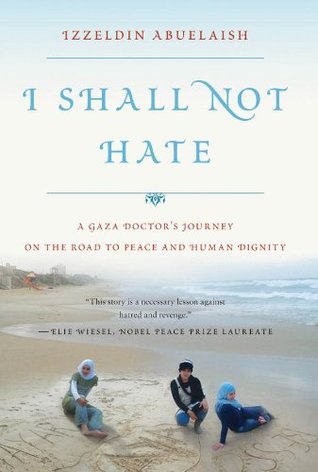
Our great philanthropists and leaders may live to see their names written on monuments in stone or metal. But our children and the poor only write their names in the sand, and only their survivors witness those names written in stone on their graves.
As Martin Luther King Jr. said, “Our lives begin to end the day we become silent about things that matter. In the end, we will remember not the words of our enemies, but the silence of our friends.”
