
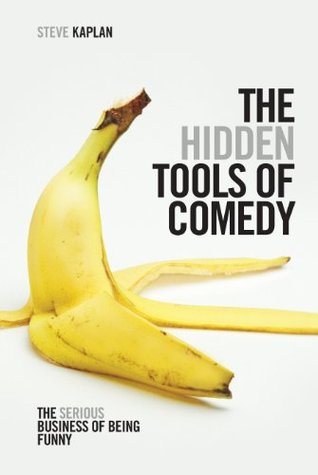
More on this book

Kindle Notes & Highlights

by
Steve Kaplan
Read between
January 11, 2016 - January 1, 2022

It takes a pretty smart cookie to play dumb.
In many sitcoms, the characters who are the most verbal, who seem the most sure of themselves, who seem to have all the information turn out, like Kramer in Seinfeld, to be idiots.
And they don’t know they’re idiots. The characters who are most like us, like Jerry, are often confused or at the very least are unsure that they are right.
People ask us who writes the jokes, but that’s not how it works. Somebody has an idea, and someone pushes it further. And that’s like a great example of how we write.
If Winning asks the question, “What do your characters want?” then Non-Hero asks why do your characters know so much?
Writers have been taught that drama is conflict, and so many comedies create conflict by inserting an antagonist into the action. While there’s nothing wrong with that, an evil-minded nemesis is not necessary for comedy (there
While I wouldn’t go so far as to say that in comedy there is no such thing as conflict, I would say that the primary conflict is between the character’s expectations versus reality.
Comedy exists in the eye — the rods and the cones — of your character.
A story is told through the multiplicity of your characters’ voices and perspectives, what the Russian philosopher Mikhail Bakhtin termed polyphony.
The comedy in this scene exists in the gap between expectation and reality.
The joke is not based on, “Wouldn’t it be funny if. . .?” It works because, again, two characters see the same thing from their own different perspectives and, based on those different perspectives, react accordingly.
man is the thinking machine except, in comedy, your machine doesn’t work that well.
You don’t need to worry about funny. Focus on comedy — a person struggling through an untenable situation, trying their best without giving up hope.
When your characters give up hope, that’s when you have drama. But until they do, they’re bumbling around creating comedy.
Jokes are not the most important element in a comedy. Characters are.
“We don’t see things as they are, we see things as we are.”
you don’t have to invent behavior; you just have to recollect it.
In fact, the more you can share what your truth is, the funnier it will be.
The beauty of Metaphorical Relationship is that it creates illogical behavior in a totally honest and organic way.
the most important moments in a comedy are those that enhance and deepen our connection to the characters and support our belief in the gags before and after. It’s a moment that you might miss or skip over if you’re just going from joke to joke.
point is to keep the characters reacting honestly within the metaphorical situation without destroying or denying the given reality of the scene.
In a Metaphorical Relationship, it’s important to maintain the reality of the surface relationship.
Rather than thinking about characters being personifications of emotions or states of being, it’s more useful to consider how they see the world in their own particular way — their World View, because a world view can be changed or altered by experience.
This “seeing” created comic behavior, rather than simply playing the label of “kooky” or “ditsy.”
Because psychologists will tell you that given the choice between being happy and being right, most people would choose to be right.
Characters don’t change their basic nature, but over time, many small, incremental changes will take place.
stereotype limits character behavior and action. A world view allows characters full and free range of behavior and action.
start from the character’s world view, and try to stay true to the character while plotting the different vectors that push and pull at him.
the only invention is that there is no invention — a standard melodramatic hospital scene has been transplanted onto Friends, but the result is decidedly comedic.
Your characters have to be the master of their own disaster, the cause of everything bad that happens to them,
just like they’re the cause of everything good that happens to them.
If it’s someone else’s fault, your character is a victim, and a victim is just the flip side of a Hero.
As Buster Keaton says, comedy is when you Think Slow, but Act Fast.
The reality could be something as fantastical as the existence of Toontown in Who Framed Roger Rabbit?, but once you’ve set the rules of the absurd universe, that universe has to stay grounded in its own reality.
This is the essential equation of comedy: a (less-than) ordinary guy or gal struggling against insurmountable odds without many of the required skills and tools with which to win yet never giving up hope.
Everything your characters do is because your characters actually think it’s going to work. If your characters didn’t think it (their action) would work, why would they bother doing it?
a negative action is just an action that creates a dramatic, as opposed to a comic, moment.
A negative action reveals the character’s emotional state without actively working toward a solution.
Because in comedy, characters protect themselves with a screen door. In other words, the character’s defenses are feeble; things get through. Actors in comedy have the obligation to express external or internal reality.
