
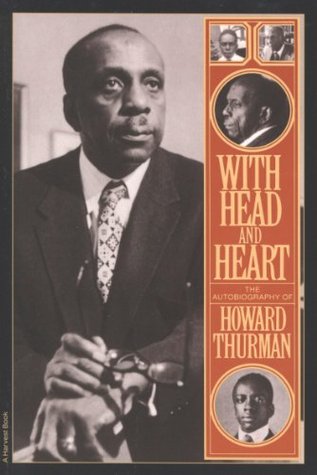
More on this book
Community


Kindle Notes & Highlights

Read between
April 10 - May 1, 2020

I said, “One thing is sure. When I grow up and become a man, I will never have anything to do with the church.”
From the beginning of my ministry I tended to be highly self-conscious in public prayer. I found it difficult to express, in public, utterances of the inner spirit. My felt needs were so profound that at first there seemed little room for the other and possibly unconnected needs of my congregation. But as I began to acquiesce to the demands of the spirit within, I found no need to differentiate human need, theirs and my own. I became more and more a part of the life of my people and discovered that at last I was able to pray in public as if I were alone in the quiet of my own room. The door
...more
However much we wanted them to be at home in a world of diverse cultures and creeds, we knew that this was possible only if they were centered in their own heritage.
When a convert is defending his new faith in the old climate, he must have fine tools. When a man becomes a Christian in a “Christian” country, what is required of him is that he renounce his former, personal life, not the life of his culture and his heritage. This becomes a personal commitment indicating the change of his private heart, but the change is not of necessity a judgment of his heritage and his culture. But in a country such as India, where the Christian religion is not part of the heritage and culture, it is required of the convert to renounce not only his private past, but also
...more
It was in response to my public lectures in Lahore that I received the following letter from H. W. Luce, father of Henry Luce, who founded Time and Life. We were both wrestling with the dilemma created by the paradoxes in the American situation. Lahore February 12, 1936 Dear Mr. Thurman: I listened with a great deal of interest to your address last night at YMCA (as also in the one given by your colleague, yesterday morning, at Arya-somaj College). I shared also in the pleasure of the delightful group as your wife sang to them at the lovely home of Mr. and Mrs. Rallia Ram. I have also been a
...more
This highlight has been truncated due to consecutive passage length restrictions.
At dinner one night, at a large university center, there was a discussion of colonialism and what it had brought by way of blessings to the country. A very beautiful young Indian woman, an instructor in a nearby college, whispered to me, “Dr. Thurman, do you know why the sun never sets on the British Empire?” “No,” I replied. “I will tell you,” she said. “God cannot trust the Englishman in the dark.”
I felt the heat in the question “If Christianity is not powerless, why is it not changing life in your country and the rest of the world? If it is powerless, why are you here representing it to us?” Hearing this, our party went from campus to campus, city to city, town to town, talking and lecturing and sharing. This question also presented a definite problem to the missionary, particularly the American missionary.
At the final leavetaking I said, “Will you now, ending, answer just one question? What do you think is the greatest handicap to Jesus Christ in India?” It was apropos of something lie had said to me about Jesus and the Sermon on the Mount. I wanted to know his real thought about the chief obstacle in his own country which prevented the spread of Christianity. He answered, “Christianity as it is practiced, as it has been identified with Western culture, with Western civilization and colonialism. This is the greatest enemy that Jesus Christ has in my country—not Hinduism, or Buddhism, or any of
...more
The leave secured, the whole family was caught up in enthusiasm. We would be pioneers in California a century after the gold rush of 1849. To our joy and surprise, there was a contagion of this spirit among many of our friends on and off campus. The Council of Churches in Washington hosted a farewell testimonial dinner on the eve of our departure. The dinner committee was chaired by our close friend Coleman Jennings, a lay reader of the Episcopal Church. The major address was given by Mrs. Eleanor Roosevelt, who, as it turned out, was one of the first national associate members of the church.
...more
There are times when guidance as to techniques and strategy is urgent, when counsel, support, and collective direct action are mandatory. But there can never be a substitute for taking personal responsibility for social change. The word “personal” applies both to the individual and the organization—in this instance, the church. The true genius of the church was revealed by what it symbolized as a beachhead in our society in terms of community, and as an inspiration to the solitary individual to put his weight on the side of a society in which no man need be afraid. It was not merely a
...more
This highlight has been truncated due to consecutive passage length restrictions.
The deeper reason for my sense of insecurity was, however, the resurgence of the old dilemma I had experienced in India: the paradox of being a black Christian minister who was representing and, by implication, defending a religion associated in the minds of many of these nonwhite peoples with racism and colonialism. The Africans traveling with me were Moslem. Nigeria itself had a large Moslem population.
The genius of the slave songs is their unyielding affirmation of life defying the judgment of the denigrating environment which spawned them. The indigenous insights inherent in the Negro spirituals bear significantly on the timeless search for the meaning of life and death in human experience.
Atlantic. I had a chance for the first time consciously to assess the journey from boyhood when I so long ago had rejected the church which had condemned my dead father and so grievously traumatized my young life. Walking by the water’s edge, gazing out at the Pacific, I had time finally to think about the life commitment that I made a scant five years later to the very church I had seen as enemy but now knew to be the Way, the only Way for which I was born. I believe the seven-year-old has been hard at work all this time to understand that which subconsciously I have never been able fully to
...more
It is important in this accounting that at bottom all of this was a part of my meaning of God in the common life. God was everywhere and utterly identified with every single thing, incident, or person. The phrases “the God of Abraham, Isaac, or Jacob,” or again, “the God of Jesus” were continuously luminous to me in my journey. I prayed to God, I talked to Jesus. He was a companion. There was no felt need in my spirit to explain this companionship. There never has been. God was a reality. Jesus was a fact. From my earliest memories, Jesus was religious subject rather than religious object. It
...more
