
Kindle Notes & Highlights


Each life must find its true threshold, that edge where the individual gift fits the outer hunger and where the outer gift fits the inner hunger.
Experience is the arena where this whole adventure happens. The hidden structures of experience become the windows of being. This is how we unfold and enter deeper into knowing. Our times are so passionate and absorbed. It is a great era to be in the world; there are so many new horizons opening up all the time. But, as always, the greater the light is, the deeper the shadow.
The assumption behind her work is that a human life can be understood in terms of a narrative of its thresholds. She identifies eight of these key frontiers. Each one is sketched in the light of the wisdom of our tradition and named in such an immediate and effective way that lends itself to easy identification. The assumption behind this is that experience does tend toward concrescence; namely, everything does not lie simply side-by-side or remain blurred forever. There are times when life sharpens, things come in to focus and, gradually, you become aware that you are standing before a
...more
She offers this invitation under five titles: task, challenge, gift, reflection, and practice.
This book would make a lovely companion to any human journey that is interested in creativity and the spirituality of integration and transfiguration.
And, to my Celtic friend and colleague, John O’Donohue, I am forever grateful for his presence in the world. His integrity, humor, brilliance, compassion, and spiritual depth continues to touch not only me, but thousands of people worldwide. His forthcoming book, To Bless the Space Between Us: A Collection of Invocations and Blessings, along with his other work can be found at www.johnodonohue.com for a guaranteed source of inspiration, solace, and a touch of Ireland. May his work and journey be blessed and protected always.
The Bushman storytellers talk about two kinds of hunger. They say there is physical hunger, then what they call the Great Hunger. That is the hunger for meaning. There is only one thing that is truly insufferable, and that is a life without meaning. There is nothing wrong with the search for happiness. But there is something great— meaning— which transfigures all. When you have meaning you are content, you belong. Sir Laurens van der Post in the documentary Hasten Slowly
If we are to live our best second half of life, to embrace these years and flourish in them, we need to consciously shift our cultural perspective.
But the skills we developed during the first half of life are not adequate, nor are they appropriate, to support us during the second half; the tasks and requirements for growth and change are completely different. From age fifty onward, we know that there will be four broad frontiers to face: • Retirement: from what, toward what? • The possibility of becoming a mentor, a steward, or a grandparent. • Coping with the natural challenges of maintaining the health of an aging body. • Mortality: losing our loved ones, and the inevitability of our own death.
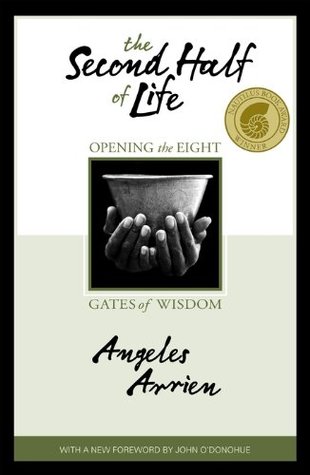
Many world tales and perennial wisdoms point to eight metaphorical gates of initiation through which we must pass in order to develop fully into wise people, or elders. These gates are archetypal passageways to deepening our experience of life in our later years. They offer powerful tools to help us shift our perspective. They map a new landscape for the second half of life, grounded in multicultural traditions that honor elders.
Each gate chapter opens with an image of hands and ends with an image of feet—both symbols of the process of entering and leaving the gate.
The lessons offered at each of the eight gates rigorously prepare us for our initiation into elderhood. The Silver Gate challenges us to invite new experiences into our lives. The White Picket Gate asks us to reflect on the roles we have played earlier in life, and to learn to assume the new role of elder. The Clay Gate urges us to care for and enjoy our bodies, even as we come to terms with their limitations. At the Black and White Gate, we learn to deepen our relationships in more intimate and mature ways. The Rustic Gate encourages us to use our creativity to enhance our lives, contribute
...more
And because of our increased longevity, for the first time in history we also have the opportunity to create a map of spiritual maturity for future generations to use as they enter their own later years.
May our journey through the eight gates of initiation liberate us from the disparaging stereotypes of aging, and light a new path for future generations. May we be the ones to reclaim and model the dignity, grace, and authentic power that true elderhood confers.
Does one really have to fret About enlightenment? No matter what road I travel, I’m going home. Shinsho
A crucible is a fired-clay vessel used to contain high-temperature chemical reactions. In alchemy, the medieval science and philosophy that sought to transmute base metals into gold, the crucible was the vessel in which the transformational process occured. In spiritual alchemy, it is a symbol of the capacity to change or transform. It is a container that reveals what is authentic within it.
The language of symbol is of the felt senses of the body, of the numinous, of the spirit, and of the heart’s yearnings. It transmits meaning in a way that touches us deeply, and leads us to wisdom. When we are drawn to a particular symbol, it often signals a transition we are about to undergo, announcing its arrival and preparing us for it, and directing us toward the inner work that can help us change, deepen, and grow.
Perseverance is a great element of success. If you only knock long enough and loud enough at the gate, you are sure to wake up something or somebody. Henry Wadsworth Longfellow
Symbolically, there is a marked distinction between a threshold and a gate. A threshold suggests the place or moment where transformational work, learning, or integration occurs. The gate suggests the protecting and testing that must occur before we are allowed entry and permitted to do work at the threshold. Gates are often considered places of initiation or entryways into holy places, sacred grounds, or spiritually significant transitions. Deep archetypal feelings may surface when we are “at the gate.” Instinctively, we recognize that we are required to let go of what is familiar, prepare to
...more
transition—our modern term for initiation.
...the actual task is to integrate the two threads of one’s life ...the within and the without. Pierre Teilhard de Chardin
Throughout our lives, transitions require that we ask for help and allow ourselves to yield to forces stronger than our wills or our egos’ desires. As transitions take place during our later years, a fundamental and primal shift from ambition to meaning occurs.
This shift often takes the form of abrupt, unexpected changes in our lives—such as a surprising new interest, a career change, a significant loss, divorce, or a move to a new location—that can align us with what truly touches our hearts and has meaning for us. With this shift comes an initial restlessness, irritability, anxiety, or discontent with our current situation, and a deep questioning of the motivation surrounding our choices in career and relationships. Everything comes up for review. Previous desires and choices to attain status, power, money, fame, or strategic relationships lose
...more
This highlight has been truncated due to consecutive passage length restrictions.
Here we must simultaneously integrate two internal journeys. One is the archetypal vertical journey of descent and ascent in which we reclaim the authentic self and release the false self. The other journey is horizontal, twining the two threads of our internal and external experiences. These two journeys—descending and ascending, and integrating the internal and external—are essential tasks. We must undertake them if we are to develop character, acquire wisdom, and cultivate spiritual maturity.
The day you were born, a ladder was set up to help you escape from this world. Rumi
In both directions, we encounter our shadows, the unclaimed, undesired, and un-befriended aspects of our nature. To become fully developed human beings, we must confront both our demons and our angels.
To achieve an adult sense of freedom, we must come to terms with unresolved anger, disappointment, despair, fear, and feelings of repugnance concerning death. We can no longer harbor our illusions, aversions, or attachments.
The raw experience of descent prepares the way for increased self-knowledge and self-acceptance that are honest and true, anchored in a kind of self-confidence that is neither inflated nor deflated. The descent allows us to experience the ascent with genuine hopefulness, curiosity, and an ennobled spirit. If we have done the rigorous work of descending to face our false self, we may then ascend to experience the joy of our essential self without pretense or judgment.
Just as we must be ready to face the challenge of exploring descent and ascent during our journey through the gates, we must also come to understand two distinct kinds of meaning. One is quantitative (external and seen); the other is qualitative (internal and sensed). Both meanings give our lives significance and substance if they are equally valued, integrated, and embodied at this final threshold.
The qualitative life experience is often more subtle, less familiar, more internal, and representative of our soul urges—those numinous, mystical, and transpersonal experiences that occur synchronistically in spontaneous and unbidden ways. These subjective experiences often appear as inner stirrings or disturbances that provoke insight, dreams, precognitions, breakthroughs, and unexpected glimpses of the mysterious aspects of who we authentically are.
Mastery of the inner world, with a relative contempt for the outer, must inevitably lead to great catastrophe. Mastery of the outer world, to the exclusion of the inner, delivers us over to the demonic forces of the latter, and keeps us barbaric despite all outward forms of culture.
Wisdom looks to see the jewel or flower shining beyond unexpected places or secured positions. Spanish saying
This more accepting and expansive way of thinking increases our tolerance for ambiguity, which is a function of wisdom. The ability to move beyond black or white, good or evil, helpful or harmful, signals wisdom’s presence.
Wisdom always looks for the most elegant solution, the one that will create a genuine win-win and serve the greater good of the majority of people.
The essential task is to allow all sides of an issue, or pairs of opposites, to exist in equal dignity and worth until their hidden unity is revealed. This is our initiation into the embodiment of wisdom, the entry point into authentic spiritual maturation and personal transformation.
The Japanese poet Basho said that the greatest riddle, aside from Creation itself, was how to know the world created by the beauty of the integration of our internal and external lives. The closest he came to describing this mystery is expressed in the following poem, which he wrote in the seventeenth century: Between our two lives, there is also the life of the cherry blossom.
Until the two are integrated, the cherry blossom symbolizes the presence of an inherent mystery that we might touch, savor, and honor, but of which we see only fleeting glimpses. In the second half of life we have the opportunity to become and radiate the life of the cherry blossom by returning home to our essential self.
Enter by the narrow Gate. The gate is wide that leads to perdition, there is plenty of room on the road, and many go that way; but the gate that leads to life is small and the road is narrow, and those who find it are few. Jesus Sermon on the Mount, Gospel of Matthew
In going through each of the eight gates, we take an individual journey, as might a hero or heroine in an archetypal story, leaving what is familiar and embarking on a new quest. And, as is true in any universal story, we are not alone. We find many helping allies, as well as obstacles, unexpected gifts, and unforeseen circumstances that catalyze our growth and strip away what is unnecessary in our lives.
Silver Gate
the White Picket Gate,
Clay Gate,
Black and White Gate
Rustic Gate,
The Rustic Gate requires that you leave behind the work of your life-dream as an offering to others.
Bone Gate.
Natural Gate
Gold Gate,
Reflection is one of numerous contemplative wisdom practices found in all world traditions. In reflecting, you review, question, and reassess, gaining new insights that may provide you with choices you had not considered before, in order to learn from and integrate your experience.
Practice is meant to be active, rigorous, and dynamic. While it builds upon reflection, and allows you to see what works or does not work, it is not merely reflective, nor is it an exercise in intellectual understanding. To practice is to take daily action that supports change and provides a discipline for incorporating and strengthening new values, skills, and character qualities. Both reflection and practice are essential to cultivating and embodying wisdom in your later years.
