
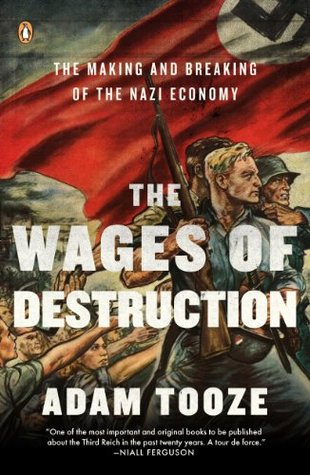
More on this book
Community


Kindle Notes & Highlights

by
Adam Tooze
Read between
September 7 - September 15, 2020

Given Germany’s position today as one of the richest and most economically powerful countries in the world, this deeply ingrained sense of inferiority is hard to comprehend. But without it, it is impossible to understand the sense of beleaguered poverty that afflicted German public debate throughout the inter-war period. And it is against this backdrop that we must view Hitler’s material aspirations for the Volksgemeinschaft.
In the 1930s hourly wages for the majority of Germans were counted not in Reichsmarks, let alone PPP-adjusted dollars of 1990, but in Pfennigs. Only the most highly paid workers such as skilled machinists or typesetters earned more than one Reichsmark per hour.
In 1936, with the German economy at full employment, 14.5 million people, 62 per cent of all German taxpayers, reported annual incomes of less than 1,500 Reichsmarks, corresponding to weekly earnings of just over 30 Reichsmarks and hourly rates of about 60 Pfennigs.
This income pyramid was sharply divided by class and gender. Male blue-collar workers on average took home 1,761 Reichsmarks in 1936, whilst working-class women earned only 952 Reichsmarks. The average white-collar male earned 3,000 Reichsmarks, almost twice the figure for his female counterpart.
A blue-collar household with a man and woman both in employment would be lucky to achieve a combined income of much more than 2,700 Reichsmarks per annum. A white-collar household, by contrast, could push its combined income above 4,000 Reichsmarks, by combining an average male salary with a second income, perhaps from an unmarried daughter.
A 1 kilogram loaf of brown bread in the 1930s cost 31 Pfennigs, the equivalent of half an hour’s work for many low-paid German workers.
A kilogram of bacon cost half a day’s work at 2 Reichsmarks and 14 Pfennigs. Butter was extraordinarily expensive. In 1936 the price per kilo of butter stood at 3 Reichsmarks and 10 Pfennigs. A 250-gram lump of butter cost more than an hour’s wage.
even beer, retailing at 88 Pfennigs per litre, was a considerable drain on the working-class food budget. Not surprisingly, the majority of Germans lived on a modest and monotonous diet of bread and jam, potatoes, cabbage and pork, washed down with water and small amounts of milk and beer.
Germans were also avid drinkers of coffee and coffee substitutes, consuming a total of almost 5 kilos per annum. And they were steady smokers, consuming two cigarettes per head per day. At only 3 Pfennigs apiece, cigarettes were a luxury even the poorest could afford.
That left a monthly total of only 67 Reichsmarks for a household of four people for all other forms of expenditure, on clothing, household equipment, transport, health care, insurance and social and educational expenditure. A pair of men’s shoes would cost 10 Reichsmarks. Having them resoled cost 4 Reichsmarks. Children’s shoes were not to be had for much less than 6 Reichsmarks, the daily wage for most workers.
In 1929, the Ford Motor Company commissioned an investigation of the wages that would be required in each of its fourteen European locations to enable its workers there to match the standard of living of those on the lowest rung of the Dearborn wage scale.24 The inquiry was carried out by the International Labour Office in Geneva with financial assistance from the United States and yielded a startling impression of the gap that divided America from Europe.
Even the worst paid workers in Detroit took for granted an apartment of four and a half rooms. This caused the investigators in Frankfurt and Berlin some embarrassment since such spacious accommodation was ‘not usually occupied by working men’. Annual rent for a basic four-and-a-half-room apartment would come to at least 1,020 Reichsmarks.
In total, to have matched the standard of living of Detroit in either Frankfurt or Berlin in the early 1930s would have required an income of between 5,380 and 6,055 Reichsmarks, sums that were beyond the wildest dreams of the majority of the German workforce.
To escape its relative poverty what Germany needed was broad-based economic growth driven by technological change and the accumulation of both physical and human capital. This would enable increased labour productivity, better wages and lower prices for high-quality goods, permitting a general increase in the standard of living.
Improvements to the system of industrial training had been discussed intensively in the 1920s. And from 1933 onwards apprenticeships and on-the-job training were given massive state support.
In 1939 only 30,000 male school leavers entered the workforce as unskilled labourers, as compared to 200,000 in 1934.
For many working-class families, the 1930s and 1940s were a period of real social mobility, not in the sense of an ascent into the middle class, but within the blue-collar skill hierarchy, prompting one author to speak of the ‘deproletarianization’ of the German working class.
It cannot be stressed too strongly, that in the early 1930s Germany looked back on almost twenty years in which economic decline and insecurity massively outweighed the experience of prosperity and economic advancement. Over the previous decade, international economic integration had brought crisis. Investment had led to bankruptcy. Hundreds of thousands of young people who had embarked optimistically on apprenticeships and university degrees found themselves stranded in unemployment. In light of this experience, one did not have to be a radical right-wing ideologue or paranoid anti-Semite to
...more
Those economists in Germany who did think about issues of long-term economic growth tended to agree with Rosa Luxemburg in arguing that the search for industrial expansion would lead to ever more fierce competition for export markets, a rivalry which provided both Stresemann and Hitler with their prime explanations for the disaster of World War I.
Contrary to the post-war popularization of his work, the Keynes of the 1930s was no apostle of growth. Keynes’s General Theory of 1936 showed ways in which economies stuck in deflationary depressions could be helped to recover by government fiscal policy.
Keynes and many of his leading acolytes in the United States were sceptical about the possibility of sustained long-run economic expansion.
Economic growth could not be taken for granted and Hitler was by no means the only person to say so.
Hitler and his acolytes were firmly convinced that the development of the German standard of living had been held back since 1918 by an unholy alliance formed between selfish bourgeois liberals and primitivist socialists.33 This conspiracy of low expectations had benefited only the German bourgeoisie, whilst robbing the majority of the German population of the full benefits of the new technologies of mass-production.
The Third Reich made it its mission to use the authority of the state to coordinate efforts within industry to devise standardized and simplified versions of key consumer commodities. These would then be produced at the lowest possible price, enabling the German population to achieve an immediate breakthrough to a higher standard of living.
In fact, by 1933 the use of the term ‘Volk’ had become so inflationary that the newly established German advertising council was forced to ban the unlicensed use of the term.
the majority of the Volksprodukte met with failure.
Knowing what we do about Germany’s economic development after 1945, we can plausibly argue for the continuity and irresistible momentum of long-run economic growth. But why should that have been a plausible vision to Germans in 1933?
The first Volksprodukt announced by Hitler’s regime, the people’s radio, was both the most transparently politically motivated and also by far the most successful.
The cheapest radios on the market in the early 1930s were priced at over 100 Reichsmarks, which in light of the income figures we have just discussed was clearly excessive. If radio was ever to reach the mass of the population, something had to be done to design and produce a cheaper receiver.
So to increase the attractiveness of the sets a number of utility companies offered part-payment deals whereby a customer could acquire a set for an initial payment of as little as 7.25 Reichsmarks, followed by eighteen monthly instalments of 4.40 Reichsmarks.
A huge additional order was placed immediately, with more than 650,000 Volksempfaenger being sold in the next twelve months and a further 852,000 in 1934–5.
Radios became one of the genuine boom industries of the 1930s, stimulating not only electronics production, but also the manufacture of Bakelite and wood cases. By 1935 the radio industry was showing all the symptoms of a speculative bubble. Production had outrun demand, inventories had risen to unhealthy levels and three of the smaller producers, including Seibt, whose chief designer had been responsible for the Volksempfaenger, went into liquidation.
By 1938, the penetration of radios in the big cities of Germany had reached 70 per cent.
In the second half of 1938 only half of German families afforded themselves a radio, as compared to 68 per cent in Britain and 84 per cent in the United States.
A year later a major breakthrough was achieved with the introduction of a new entry-level model, the Deutscher Kleinempfaenger (DKE), priced at as little as 35 Reichsmarks. Colloquially known as ‘Goebbels’ gob’ (‘Goebbels Schnautze’), the DKE could claim credit for having brought radio within the reach of virtually every German family.
In the eight years between 1934 and 1942 radio penetration in Germany almost doubled. On the other hand it would be naive to attribute this s...
This highlight has been truncated due to consecutive passage length restrictions.
The Volksempfaenger, by contrast, was completely uncompetitive on world markets with only tiny numbers finding buyers abroad.
For Hitler, there can be no doubt, the car was the great symbol of a modern consumer lifestyle.43 But in the early 1930s the car was still a luxury reserved for a tiny minority of the German population.
In Berlin, a city of 4 million inhabitants, there were fewer than 51,000 cars. By comparison, Berlin’s streets today are crowded with 1.2 million automobiles. If one imagines a modern city street with 29 out of every 30 cars removed from the scene, one gets an impression of how exclusive motor vehicles were in Nazi Germany.
only a tiny minority of licensed vehicles were primarily for personal use.
In 1933 only 25 per cent of Germany’s major roads had hardened surfaces suitable for high-volume motor traffic. To remedy this deficit, the autobahn project was announced in the summer and by early 1934 responsibility for national road construction and repair had been consolidated in the hands of Fritz Todt.
From a total of 486,001 in 1932 the number of registered cars more than doubled to reach 1.271 million by 1938. As these figures suggest, however, the expansion in motorization had clear limits. Germany in the late 1930s was still a society in which car ownership was the preserve of a small minority.
In 1938 a comprehensive study by the Institut fuer Konjunkturforschung found that the minimum cost of purchasing a car and running it for 10,000 kilometres per year was 67.65 Reichsmarks per month.48 A working-class family of four on an income of 2,300 Reichsmarks per annum would have found that, after allowing for food, housing and utility bills, running a car consumed their entire disposable income.
By the late 1930s the price of a litre of petrol in the Third Reich stood at 39 Pfennigs (roughly $1.70 in dollars of 1990). At this price, a family outing of 160 kilometres in a fuel-efficient car cost an entire day’s work for the average German worker.49 Only a small fraction of this exorbitant price, however, was due to the market price for oil. Throughout the 1930s, given the worldwide glut of oil, the price of a litre of petrol in the Gulf of Mexico varied between 2 and 3 Pfennigs, around 10 per cent of the price charged to German motorists. Allowing for shipping, petrol could be had at
...more
What determined the actual cost of petrol in the Third Reich was politics.
Taxes and the legal requirement to add domestically produced alcohol doubled the price of petrol. If promoting motorization had been the chief priority of Hitler’s regime, it could have cut the operating cost for a small family car by as much as 15 per cent, by forgoing these taxes. This, however, was an impossibility. IG Farben had won its argument.
In the 1930s the cost of petrol produced at IG Farben’s Leuna plant was 15–17 Pfennigs per litre, implying a price of at least 30 Pfennigs per litre at the petrol pump. A tax on imported fuel was therefore indispensable to sustaining the momentum of the synthetic fuel programme.
Taxes on imported oil were a significant source of revenue, bringing in 421 million Reichsmarks in 1936, a third of the total customs revenue of the German state. And, as of December 1936, as pressure on the Reich’s finances mounted, even domestically produced fuel was subject to a tax of at least 4 Pfennigs per litre.
It was the non-negotiability of fuel tax that forced the advocates of mass-motorization in Hitler’s regime to focus with even greater intensity on the cost of the car itself.
Though Fordism was widely discussed in management circles, the small size of Germany’s producers meant that most of them were able to achieve few if any economies of scale.
