
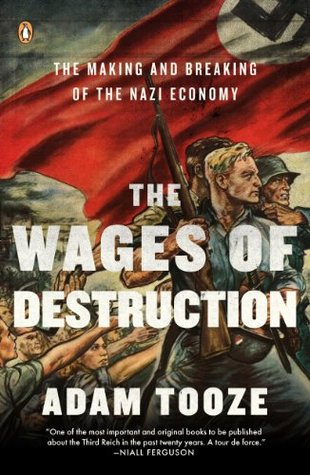
More on this book
Community


Kindle Notes & Highlights
by
Adam Tooze
Read between
September 7 - September 15, 2020

In 1938 the Third Reich embarked on Germany’s second campaign of conquest and destruction in less than a generation. At first, Hitler’s Wehrmacht seemed unstoppable, better prepared and more aggressive than the Kaiser’s armies. But as Hitler charged from victory to victory, his enemies multiplied. For the second time, a German bid to dominate the continent of Europe ran up against overwhelming opposition.
It took three years and five months, but in the end Hitler went down to a defeat far more cataclysmic than that which felled the Kaiser. Germany, along with large swathes of the rest of Eastern and Western Europe, was left in ruins. Poland and the western Soviet Union were practically eviscerated. France and Italy lurched perilously close to civil war. The overseas empires of Britain, France and the Netherlands were shaken beyond repair.
In the last instance, human will–both individual and collective–must be the starting point for any account of Nazi Germany. If we are to understand the awful deeds of the Third Reich we must seek to understand their perpetrators. We must treat Adolf Hitler and his followers seriously. We must seek to penetrate their mindset and to map the dark interstices of their ideology. It is not for nothing that biography–both individual and collective–is one of the most illuminating ways to study the Third Reich.
Somewhat surprisingly for those who think of him as a simplistic economic determinist, Marx followed up his famous aphorism, not with a disquisition on the mode of production, but with a paragraph about the way in which ‘the tradition of all the dead generations weighs like a nightmare on the brain of the living’.
And it is with good reason therefore that recent writing on the Third Reich has been preoccupied with politics and ideology. The cultural crises of early twentieth-century Europe, the vacuum left by the secularizing tendencies of the late nineteenth century, the radicalizing horror of World War I, all demand attention from anyone seriously interested in plumbing the deeper motives of National Socialism.
It is hard to imagine now, but there was a time, not so long ago, when historians routinely dismissed Mein Kampf as a historical source and thought it reasonable to treat Hitler as just another opportunistic imperialist. Those days are gone. Thanks to the work of two generations of historians, we now have a far better understanding of the way in which Nazi ideology conditioned the thought and action of the Nazi leadership and wider German society.
The statistical terminology in which much economic history is couched is inaccessible to readers trained in the humanities, and too little effort has been made by either side to bridge the gap.
Whereas our understanding of the regime’s racial policies and the inner workings of German society under National Socialism has been transformed over the last twenty years, the economic history of the regime has progressed very little. The aim of this book is to start a long overdue process of intellectual realignment.
This book is the first in sixty years to offer a truly critical account of the performance of the German war economy both under Speer and his predecessors and it casts stark new light on his role in sustaining the Third Reich to its bloody end.
it is only by re-examining the economic underpinnings of the Third Reich, by focusing on questions of land, food and labour that we can fully get to grips with the breathtaking process of cumulative radicalization that found its most extraordinary manifestation in the Holocaust.
No less urgent, however, is the need to bring our understanding of the economic history of the Third Reich into line with the subtle but profound rewriting of the history of the European economy that has been ongoing since the late 1980s but has gone largely unnoticed in the mainstream historiography of Germany.
It is hardly an exaggeration to say that historians of twentieth-century Germany share at least one common starting point: the assumption of the peculiar strength of the German economy.
the common sense of twentieth-century European history is that Germany was an economic superpower in waiting, an economic force comparable only to that of the United States. For all the argument there has been over the backwardness or otherwise of German political culture, the assumpt...
This highlight has been truncated due to consecutive passage length restrictions.
Both the real-life experience of Europeans since the early 1990s and a generation of technical work by economists and economic historians has shaken, if not demolished, the myth of Germany’s peculiar economic superiority. The master-narrative of European economic history in the twentieth century, it turns out, was one of progressive convergence around a norm that was defined for most of the period, not by Germany, but by Britain, which in 1900 was already the world’s first fully industrial and urban society.
In 1939, as the war started, the combined GDP of the British and French empires exceeded that of Germany and Italy by 60 per cent.
Germany from the late nineteenth century onwards was the home for a cluster of world-beating industrial companies. Brand names like Krupp, Siemens and IG Farben gave substance to the myth of German industrial invincibility.
Viewed in wider terms, however, the German economy differed little from the European average: its national per capita income in the 1930s was middling; in present-day terms it was comparable to that of Iran or South Africa. The standard of consumption enjoyed by the majority of the German population was modest and lagged behind that of most of its Western European neighbours.
Germany under Hitler was still only a partially modernized society, in which upwards of 15 million people depended for their living either on traditio...
This highlight has been truncated due to consecutive passage length restrictions.
In 1870, at the time of German national unification, the population of the United States and Germany was roughly equal and the total output of America, despite its enormous abundance of land and resources, was only one-third larger than that of Germany. Just before the outbreak of World War I the American economy had expanded to roughly twice the size of that of Imperial Germany. By 1943, before the aerial bombardment had hit top gear, total American output was almost four times that of the Third Reich.
The basic and possibly most radical contention of this book is that these interrelated shifts in our historical perception require a reframing of the history of the Third Reich, a reframing which has the disturbing effect both of rendering the history of Nazism more intelligible, indeed eerily contemporary, and at the same time bringing into even sharper relief its fundamental ideological irrationality.
In both respects, America should provide the pivot for our understanding of the Third Reich. In seeking to explain the urgency of Hitler’s aggression, historians have underestimated his acute awareness of the threat posed to Germany, along with the rest of the European powers, by the emergence of the United States as the dominant global superpower.
As in many semi-peripheral economies today, the German population in the 1930s was already thoroughly immersed in the commodity world of Hollywood, but at the same time many millions of people lived three or four to a room, without indoor bathrooms or access to electricity.
The originality of National Socialism was that, rather than meekly accepting a place for Germany within a global economic order dominated by the affluent English-speaking countries, Hitler sought to mobilize the pent-up frustrations of his population to mount an epic challenge to this order. Repeating what Europeans had done across the globe over the previous three centuries, Germany would carve out its own imperial hinterland; by one last great land grab in the East it would create the self-sufficient basis both for domestic affluence and the platform necessary to prevail in the coming
...more
at the same time an understanding of the economic fundamentals also serves to sharpen our appreciation of the profound irrationality of Hitler’s project. As this book will show, Hitler’s regime after 1933 undertook a truly remarkable campaign of economic mobilization. The armaments programme of the Third Reich was the largest transfer of resources ever undertaken by a capitalist state in peacetime. Nevertheless, Hitler was powerless to alter the underlying balance of economic and military force.
The German economy was simply not strong enough to create the military force necessary to overwhelm all its European neighbours, including both Britain and the Soviet Union, let alone the United States. Though Hitler scored brilliant short-term successes in 1936 and 1938, the diplomacy of the Third Reich failed to bring about the anti-Soviet alliance proposed in Mein Kampf.
The devastating effectiveness of the Panzer forces, the deus ex machina of the early years of the war, certainly did not form the basis for strategy in advance of the summer of 1940, since it came as a surprise even to the German leadership.
though the victories of the German army in 1940 and 1941 were undoubtedly spectacular they were inconclusive.
Hitler went to war in September 1939 without any coherent plan as to how actually to defeat the British...
This highlight has been truncated due to consecutive passage length restrictions.
Why did Hitler take this e...
This highlight has been truncated due to consecutive passage length restrictions.

He wa an insane asshole.
It was ideology which provided Hitler with the lens through which he understood the international balance of power and the unfolding of the increasingly globalized struggle that began in Europe with the Spanish Civil War in the summer of 1936.
It was this fantastical interpretation of the real balance of power that gave Hitler’s decision-making its volatile, risk-taking quality. Germany could not simply settle down to become an affluent satellite of the United States, as had seemed to be the destiny of the Weimar Republic in the 1920s, because this would result in enslavement to the world Jewish conspiracy, and ultimately race death.
Drawing both on archival material and a generation of brilliant historical research, I emphasize the connections between the war against the Jews and the regime’s wider projects of imperialism, forced labour and deliberate starvation. In the minds of the Nazi leadership, there were, in fact, not one but a number of different economic rationales for genocide.
Reviewing the twentieth century, it is hard to escape the conclusion that two themes have dominated Germany’s history. On the one hand there is the pursuit of economic and technological progress, which for much of the century made Germany, along with the United States and latterly Japan, China and India, one of the largest economies in the world. On the other hand there is the pursuit of warfare on a hitherto unimagined scale.
Germany was chiefly responsible for unleashing the first shattering World War of the twentieth century.
Questionable but it's not like Wilhelm tried hard to stop it either.
After the second catastrophe of 1945, the occupying powers made sure to leave Germany with no choice. Though sport, technology, science and culture were gradually readmitted as fields of national and individual self-expression, and though German politics became more multi-dimensional from the late 1960s onwards, it was the depoliticized pursuit of material welfare that dominated national life, certainly in West Germany after 1945.
Germany’s first surrender, in 1918, was far less complete and the conclusions drawn both by Germans and their former opponents were correspondingly more ambiguous. One of the many extraordinary features of German politics in the aftermath of World War I is that throughout the existence of the Weimar Republic the German electorate faced a choice between a politics centred on the peaceful pursuit of national prosperity and a militant nationalism that more or less openly demanded a resumption of hostilities with France, Britain and the United States.
Hostility towards the French and Poles and imperial designs on Germany’s neighbours both in the West and in the East were nothing new. However, an excessive stress on continuity obscures the transformative impact on German politics of the defeat of November 1918 and the traumatic crisis that followed.
Over the following months, as Berlin sponsored a mass campaign of passive resistance, the country descended into hyperinflation and political disorder so severe that by the autumn of 1923 it called into question the survival of the German nation-state as such.
On the one hand, the crisis of 1918–23 gave rise to an ultra-nationalism–in the form of the radical wing of the DNVP and Hitler’s Nazi party–that was more apocalyptic in its intensity than anything prior to 1914. On the other hand, it also produced a truly novel departure in German foreign and economic policy.
Weimar’s foreign policy prioritized the economy as the main field within which Germany could still exercise influence in the world. Above all, it sought security and leverage for Germany by developing financial connections with the United States and closer industrial integration with France.
It was a policy that enjoyed the backing of all of the parties of the Weimar coalition–the Social Democrats, the left liberal DDP and the Catholic Centre party. But it was personified by Gustav Stresemann, leader of the national liberals, the DVP, and Germany’s Foreign Minister between 1923 and 1929.
Munich, of course, was also one of the favourite stomping grounds of the NSDAP and as the leader of that fringe party, Hitler hoped to gain added attention by crossing swords with Stresemann. The voters of Bavaria were thus offered a dramatic choice between Stresemann’s conception of Germany’s future, based on four years of peaceful ‘economic revisionism’, and Hitler’s sweeping rejection of the foundations of Weimar’s foreign and economic policy.
Both by his reading of economic history and his practical experience of trade policy, Stresemann was convinced that the dominant forces in the twentieth-century world would be the three major industrial economies: Britain, Germany and the United States.
Germany needed raw materials and food from overseas export markets to provide its population with work and bread. The British Empire was better placed with regard to raw materials, but it needed Germany as an export market. Furthermore, Stresemann was convinced from an early stage that the emergence of the United States as the dominant force in the world economy permanently altered the dynamic of competition between the European powers.
But even in his most annexationist moment, Stresemann was above all motivated by an economic logic centred on the United States.12 The expansion of German territory to include Belgium, the French coastline to Calais, Morocco and extensive territory in the East was ‘necessary’ to secure for Germany an adequate platform for competition with America.
There can be no doubt that Germany’s sudden defeat in the autumn of 1918 shocked Stresemann deeply, leaving him close to both physical and psychological collapse. It permanently shook his confidence in military force as a means of power politics, certainly as far as Germany was concerned.
Already in April 1919 Stresemann demanded that, given Germany’s military weakness, the basis of its foreign policy should be the strength of its major corporations.
Crucially, the economy was the one sphere through which Germany could build a connection to the United States, the only power that could help Germany in counterbalancing the aggression of the French and the disinterest of the British.
By facing down a storm of nationalist outrage and ending the ruinous campaign of passive resistance to the French occupation of the Ruhr, whilst at the same time signalling Germany’s willingness to pay reparations, Stresemann opened the door to a special relationship with the United States.
Stresemann was vulnerable for ever afterwards to accusations from the right that he was a ‘French candidate’. 14 And these accusations were further strengthened by Stresemann’s decision to use cooperative tactics rather than confrontation, to achieve an accelerated withdrawal of the French forces that patrolled the Rhineland.
