
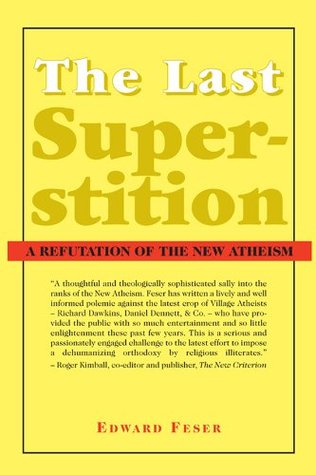
More on this book


Kindle Notes & Highlights

by
Edward Feser
Read between
March 25 - May 19, 2019

But this is, as I say, a book about natural rather than revealed theology. And we have seen that given the metaphysical picture of the world
handed on to us by the Greeks, and especially Aristotle, a powerful case (at the very least) can be made for the existence of God, the immortality of the soul, and the natural law conception of morality.
As we have seen, if the general Aristotelian-Thomistic-Scholastic picture of the world is correct, then reason itself tells us that the highest kind of life is one devoted to the contemplation and service of God, that the goal of our lives here and now ought to be to prepare for the next life, and that to the extent God wants us to concern ourselves with earthly affairs, it is largely to build families (preferably with lots of children) and to find our fulfillment in sacrificing our petty desires and selfish interests for the sake of their well being.
The bottom line is that by abandoning formal and final causes, modern philosophy necessarily denied itself any objective basis for morality.
As Alfred North Whitehead once put it, “those who devote themselves to the purpose of proving that there is no purpose constitute an interesting subject for study.”
Dualism follows necessarily if one wants to maintain a mechanistic picture of the physical world while avoiding eliminative materialism. And the only way to avoid both dualism and eliminative materialism is to return to Aristotle.
To acknowledge the truth of the Aristotelian metaphysical picture of the world is thus unavoidably to open the door to everything the Scholastics built on it. In short, Aristotle’s revenge is also Aquinas’s revenge; and for that reason alone, contemporary secular intellectuals cannot allow themselves to acknowledge it. For the project of the early moderns is their project too.
But that project is built on a lie. To quote a famous Confucian proverb, “When the finger points at the moon, the idiot looks at the finger.” The modern secularist is, as it were, positively fixated on the finger – unsurprisingly given that, if (as he falsely assumes)
there really are no fixed natures and natural ends in the world, no formal and final causes, then nothing could naturally point beyond itself to anything else. In fact, the material world points beyond itself to God; but the secularist sees only the material world. The material side of human nature points beyond itself to an immaterial and immortal soul; the secularist sees only the brain and body. The sexual act points beyond itself to marriage and fa...
This highlight has been truncated due to consecutive passage length restrictions.
