
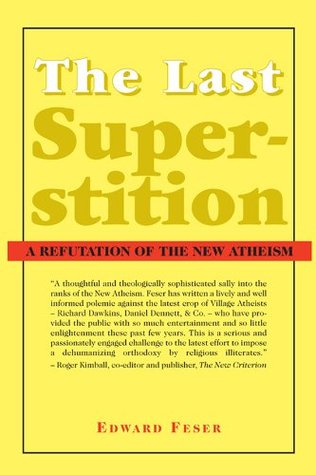
More on this book


Kindle Notes & Highlights

by
Edward Feser
Started reading
June 18, 2018

there is and must be a God.
An outside source of change is also necessary.
no potential can actualize itself,
“motion,” they mean “change”
there is an asymmetry between them, with actuality having metaphysical priority.
potentiality cannot exist on its own, but only in combination with actuality
in the real world outside our minds actuality can exist on its own while potentiality cannot.
that form is the key to understanding how something permanent underlies all change.
mere abstractions.
It is only the form and matter together that constitute the ball.
Aristotle’s famous doctrine of ...
This highlight has been truncated due to consecutive passage length restrictions.
substantial form
essence.
Being a rational animal is (according to Aristotelians) the essence or substantial form of a human being;
The form of the ball doesn’t exist by itself either; it only exists insofar as the rubber has taken on that specific form.
Still, they are different aspects of reality – in this case, of the ball.
Nothing is just a piece of matter, for matter cannot exist without form,
form (being the principle that accounts for permanence) isn’t material
(matter being the principle that account...
This highlight has been truncated due to consecutive passage length restrictions.
And that the form is just the form of a particular hunk of matter shows that
Plato is wrong to think of forms as generally existing completely independently of the material world.
The interrelationship between form and matter parallels the interrelationship between a...
This highlight has been truncated due to consecutive passage length restrictions.
purely actual being (namely God), and such a being does not have a form, certainly not in the sense other things do.
form is metaphysically prior to matter.
immaterial object
human soul
such a thing would ha...
This highlight has been truncated due to consecutive passage length restrictions.
Hence it is possible, at least in principle and in some cases, for forms t...
This highlight has been truncated due to consecutive passage length restrictions.
his version of realism is often referred to as “moderate realism,” as opposed to the “extreme realism” of Plato.
“Third Man” argument
So realism is preserved, but in a more sober and down-to-earth way than Platonism affords.
For if you don’t understand Aristotle’s four causes, then I dare say you don’t understand anything at all.
You simply cannot properly understand the one apart from the other;
Famously, they deny that there really are any final causes at all, appearances notwithstanding.
would be mystified by the modern tendency to treat cause and effect as essentially a relation between temporally ordered events.
for common sense it is ultimately things that are causes, not events.
the effect might be “contained in” the cause in various ways.
But it could also be that the cause was not itself red but had the power to generate redness in the effect;
which tells us that order (and thus information content) tends inevitably to decrease within a closed system.
They are false. Wrong.
Geometrical reasoning, and mathematical reasoning in general, is all-or-nothing.
are metaphysical in character, not scientific.
Scientific arguments start from empirical premises and draw merely probabilistic conclusions.
they take obvious, though empirical, starting points, and try to show that from these starting points, together with certain conceptual premises, certain metaphysical conclusions follow necessarily.
that they fail to understand the difference between a scientific hypothesis and an attempted metaphysical demonstration,
(which is known as “scientism” or “positivism”).
indulging in just the sort of dogmatism they claim to oppose.
itself a metaphysical
Of its very nature, scientific investigation takes for granted such assumptions as that: there is a physical world existing independently of our minds;
Every one of these claims embodies a metaphysical assumption, and science, since its very method presupposes them, could not possibly defend them without arguing in a circle.
