
More on this book
Community


Kindle Notes & Highlights

Read between
December 17, 2020 - September 3, 2021

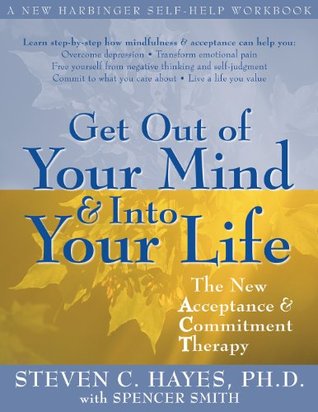
This book is based on Acceptance and Commitment Therapy, or ACT. (“ACT” is spoken as a single word, not as separate initials.) This is a new, scientifically based psychotherapeutic modality that is part of what is being called the “third wave” in behavioral and cognitive therapy (Hayes 2004). ACT is based on Relational Frame Theory (RFT): a basic research program on how the human mind works (Hayes, Barnes-Holmes, and Roche 2001). This research suggests that many of the tools we use to solve problems lead us into the traps that create suffering. To put it bluntly, human beings are playing a
...more
Here’s a sample of some of the unconventional concepts you will be asked to consider: Psychological pain is normal, it is important, and everyone has it. You cannot deliberately get rid of your psychological pain, although you can take steps to avoid increasing it artificially. Pain and suffering are two different states of being. You don’t have to identify with your suffering. Accepting your pain is a step toward ridding yourself of your suffering. You can live a life you value, beginning right now, but to do that you will have to learn how to get out of your mind and into your life.
These techniques fall into three broad categories: mindfulness, acceptance, and values-based living.
The “acceptance” in Acceptance and Commitment Therapy is based on the notion that, as a rule, trying to get rid of your pain only amplifies it, entangles you further in it, and transforms it into something traumatic.
pain of presence (issues that are present that you would prefer to go away).
Those activities you would engage in if matters changed, represent a different kind of pain: they are called the pain of absence.
The basic premise of RFT is that human behavior is governed largely through networks of mutual relations called relational frames. These relations form the core of human language and cognition, and allow us to learn without requiring direct experience.
EXERCISE: A Screw, a Toothbrush, and a Lighter
As a result of these symbolic temporal relations, most people tend to live more in the verbally remembered past and the verbally imagined future than in the present moment.
EXERCISE: A Yellow Jeep
EXERCISE: Don’t Think About Your Thoughts
EXERCISE: The Coping Strategies Worksheet
Language creates suffering in part because it leads to experiential avoidance. Experiential avoidance is the process of trying to avoid your own experiences (thoughts, feelings, memories, bodily sensations, behavioral predispositions) even when doing so causes long-term behavioral difficulties
When you take your thoughts literally, you are “riding the mind-train.”
Thus “acceptance” and “willingness” can be understood as an answer to this question: “Will you take me in as I am?” Acceptance and willingness are the opposite of effortful control.
If you commit to a particular act, use mindfulness and defusion strategies when your mind starts giving you problems with pursuing that path, and move forward accepting what your mind offers you; you will be in a better position to live a full and meaningful life—with or without unpleasant thoughts, emotions, and sensations.
Aaron Beck, the father of cognitive therapy, used the term distancing to refer to the process of objectively noticing what you are thinking (this is why ACT was originally called “comprehensive distancing” when it was first developed [Hayes 1987]).
Cognitive fusion refers to the tendency to allow thought to dominate other sources of behavioral regulation because of the failure to pay attention to the process of relating over and above the products of relating. To put it into less abstract terms, cognitive fusion involves treating our thoughts as if they are what they say they are.
the root cause of experiential avoidance is cognitive fusion.
For the next week, using the exercise below, we would like you to track your pain to try to bring into the light of day some of the thoughts that co-occur when you are struggling.
Having a Thought Versus Buying a Thought
you can learn to look at your thoughts rather than from them. These cognitive defusion techniques are a core component of ACT. They help you to make the distinction between the world as structured by your thoughts, and thinking as an ongoing process. When your thoughts are about you yourself, defusion can help you to distinguish between the person doing the thinking and the verbal categories you apply to yourself through thinking.
EXERCISE: Say the Word “Milk” as Fast as You Can
EXERCISE: Labeling Your Thoughts
I am having the thought that…(describe your thought) I am having the feeling of…(describe your feeling) I am having the memory of…(describe your memory) I am feeling the bodily sensation of…(describe the nature and location of your bodily sensation) I am noticing the tendency to…(describe your behavioral urge or predisposition)
Defusion exercises can be playful at times. When we say things to ourselves like “I’m so stressed out I feel I’m going to explode,” or, “I’m a bad person,” it can help to defuse from these thoughts by changing the normal context in which they occur.
Say It Very Slowly
Say It in a Different Voice
Create a Song
Bad News Radio
Much of our suffering comes from mistaking evaluations for descriptions.
Here are some cues that will show you when you are fused with your thoughts: Your thoughts feel old, familiar, and lifeless You submerge into your thoughts and the external world disappears for a while Your mind feels comparative and evaluative You are mentally somewhere else or in some other time Your mind has a heavy “right and wrong” feel Your mind is busy or confusing
According to the theory of language that underlies ACT, there are at least three senses of self that emerge from our verbal abilities: the conceptualized self, the self as an ongoing process of self-awareness, and the observing self
The conceptualized self is you as the object of summary verbal categorizations and evaluations. It is the verbal “I am” self, as in: I am old;
It contains all the thoughts, feelings, bodily sensations, memories, and behavioral predispositions that you’ve bought into and integrated into a stable verbal picture of yourself.
EXERCISE: Retelling Your Own Story
When you let go of an attachment to your conceptualized self, you are like a child, open to whatever is possible and willing to find out what is.
Ongoing self-awareness is your fluid, continuous knowledge of your own experiences in the present moment. It is like the conceptualized self, in that you are applying verbal categories to the self. It is unlike it because instead of being summary, evaluative categories, the categories are descriptive, nonevaluative, present, and flexible: “Now I am feeling this.”
people who can’t identify what they experience emotionally are said to have “alexithymia.” This clinical deficit correlates with a wide range of psychological problems. And, you will not be surprised to learn, it correlates highly with experiential avoidance (Hayes, Strosahl, et al. 2004)
This “I” is what some call the observing self (Deikman 1982). It is a sense that transcends both time and space,
who is the watcher who observes you thinking your thoughts?
It is this observing self that we hope to bring you in closer contact with in this part of the book because it is the place from which it is fully possible to be accepting, defused, present in the moment, and valuing.
The Chess Metaphor Imagine a chessboard stretching out to infinity in all directions.
some Eastern traditions call “big mind.”
Mindfulness is the defused, nonattached, accepting, nonjudgmental, deliberate awareness of experiential events as they happen in the moment.
Learning to be mindful of where in time your thoughts are can be helpful in shifting your focus to the present moment.
Psychologists have shown that evaluations can occur reliably only along a limited number of dimensions. Good-bad and strong-weak are two of these primary polarities.
EXERCISE: Be Where You Are
EXERCISE: Silent Walking
EXERCISE: Cubbyholing
