
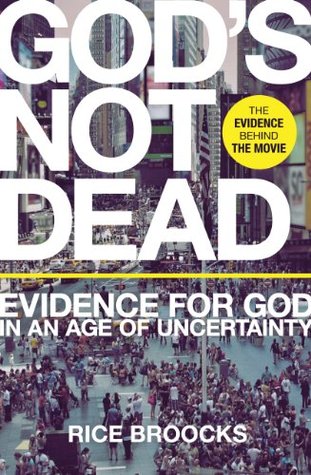
More on this book

Kindle Notes & Highlights

by
Rice Broocks
Started reading
December 2, 2019

“Always be prepared to give an answer to everyone who asks you to give the reason for the hope that you have” (1 Peter 3:15 NIV).
“speak boldly, as I ought to speak” (Ephesians 6:20).
Unlike more militant religions that force people to believe at the point of the sword, early Christianity spread by a force that was fairly unknown to men at the time—the force of divine love. This is what caused those who had grown up in the Roman Empire’s culture of violence, subjugation, and fear to turn to Christianity. Christ commanded His followers to advance His message by the irresistible force of love and the power of truth.
The message of Christ transformed the Roman Empire because that message was based in love and truth and because it did not coerce obedience as other religions did.
The gospel is the good news that God became man in Jesus Christ. He lived the life we should have lived (perfectly keeping the moral law); He then died the death we should have died (for breaking that law). Three days later He rose from the dead, proving He is the Son of God and offering the gift of salvation to everyone who will repent and believe the gospel.
For God so loved the world that He gave His only begotten Son, that whoever believes in Him should not perish but have everlasting life. (John 3:16)
“that He is a rewarder of those who diligently seek Him” (Hebrews 11:6).
Because God is real, humanity’s search for Him will not be in vain.
The Seeker is attempting to believe but faces doubts about whether God is real.
it is indeed credible as well as fulfilling to believe in God. Even before understanding Christianity or the Bible, there is ample evidence that the world around us is no accident.
The Believer knows God is real subjectively but cannot easily articulate thi...
This highlight has been truncated due to consecutive passage length restrictions.
The Skeptic may be reading this book from a critical point of view and a predetermined mind-set that there is no God.
The truth is that God has created a world where free moral agents are able to have real choices to do good or evil.
God made a world where choices are real and humanity is affected by the choices of other humans.
Truth is another word for reality. When something is true it’s true everywhere.
The fact that there are moral truths that are true everywhere points to a transcendent morality that we did not invent and from which we cannot escape.
As Creator, God has placed not only natural laws in the earth but also spiritual laws.
When these laws are broken, people are broken. Not only does violating these spiritual laws separate us from God, but it causes pain in our lives and in the lives of those around us.
The big question becomes, what can be done about our condition? When we break these spiritual laws, whom can we call for help? How can we be reconciled to God as well as break free from this cycle of pain and dysfunction?
Atheism, in all its railings against God, also has intrinsic beliefs, dogmas, and tenets that supposedly can’t be challenged. It is itself a belief system with all the markings of a religion.
Atheism as a religion (a set of beliefs) is just as intolerant and closed-minded as the claims made against any faith system it assails.
“There is no such thing as philosophy-free science; there is only science whose philosophical baggage is taken on board without examination.”
The truth is you don’t have to have an explanation for every explanation.
No God—no accountability. No God—no real morals.
Think about it: more than 90 percent of the planet believes that God exists.
To maintain that those who believe in God are deluded means atheists (or radical skeptics as I call them) believe the majority of the world is under some kind of mass delusion.
The real question is, how much proof is enough proof to convince you that God is real?
