
More on this book
Community


Kindle Notes & Highlights

Read between
August 7 - August 26, 2021

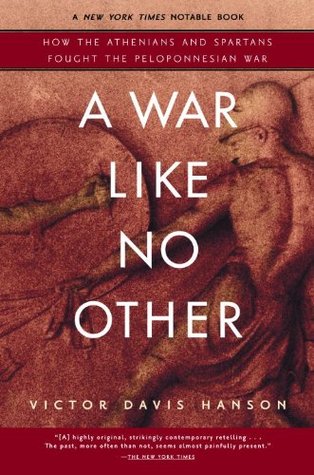
This ancient civil conflict today is called the “Peloponnesian War” since Westerners are in some respects Athenocentric.
Because Thucydides first framed the important issues that haunt us still, we naturally return to his original and seemingly unimpeachable conclusions.
Precisely because of this didactic nature of Thucydides’ lengthy narrative—predicated on the belief that human nature is unchanging across time and space and thus predictable—the conflict of Athens and Sparta is supposed to serve as a lesson for what can happen to any people in any war in any age.
What men say, the speeches diplomats give, the reasons states go to war, all this “in word” (logos) is as likely to cloak rather than to elucidate what they will do “in deed” (ergon).
Contemporary America is often now seen through the lens of ancient Athens, both as a center of culture and as an unpredictable imperial power that can arbitrarily impose democracy on friends and enemies alike.
The Peloponnesian War was also the first great instance where Western powers turned on each other. Their common commitment to rationalism, civic militarism, and constitutional government resulted not just in high culture but also in lethal militaries that could square off in mutual destruction.
What had developed into the finest infantry in Greece was by nature a domestic police force, or perhaps a Waffen-SS if you will, whose original reason for existence was to thwart domestic insurrection and ferret out alleged dissidents.
Man’s creation of cement and steel for roads and factories possesses none of the beauty or the age or the mystique of the olive among Mediterranean peoples. That the olive is an evergreen tree in a hot climate; that it possesses enormous powers of regeneration; that it can grow almost anywhere without constant attention or great amounts of water and fertilizer; that it reaches great age; that its fruits provide everything from fuel to cooking oil to food—all that combines to surround the tree with a nearly religious awe to match its undeniable utility, both now and in the past.
The Athenian philosopher, historian, and warrior Xenophon summed up “the best life” as one of farming, which gave man “the greatest degree of strength and beauty.” In moral and practical terms, agriculture made “those who work the soil brave, the best citizens, most loyal to the polis.”
In fact, that earlier traumatic evacuation of Athens in 480, by dispersing the population among nearby Aegina, Salamis, and Troezen, mitigated the chances of overcrowding and plague.
Athenian strength cannot be calibrated only through its silver mines, fleet, and income from overseas tributary allies. Like Sparta and Thebes, much of Athens’ financial power accrued from its large rural territory and population. For all the attention paid to gold, silver, and manpower, the real players in the ancient Greek world—Sparta, Athens, Thebes, and Corinth—were precisely those states that controlled the largest or most fertile tracts of farmland, the ultimate source of all wealth in early, preindustrial societies.
It was Periclean strategy, after all, that defined the new war as battle not between hoplites or even sailors but rather soldiers against the property of everyday folks. This moral quandary also remains with us today, and it has been raised in connection with the controversial careers of William Tecumseh Sherman, Lord Kitchener, and Curtis LeMay, who all argued that battle is ultimately powered by civilians and thus only extinguished when they cannot or will not pledge their labor and capital to those on the battlefield.
He would be emblematic of the entire glory and tragedy of the fifth-century Athenian imperial state, which started the war with such high hopes among a generation that inherited the pride but not the sobriety of their fathers.
the Thucydidean discourse on the plague becomes a reminder of how close humans always are to savagery—and how precious is their salvation won through law, religion, science, and custom.
only evenly matched and conventional combatants were likely to adhere to the old Hellenic idea of rules and protocols that tended to preclude gratuitous killing, given the uncertainty on both sides of victory and thus the shared need to worry about their own treatment after defeat.
Athens’ conduct during and right after the war—whether killing Mytileneans, Melians, or Socrates—was all done according to majority vote, besmirching the reputation of democracy itself for centuries to come.
Terrified by the Athenian base at Pylos (425), which raised the specter of wide-scale helot revolt, the Spartans passed a proclamation offering freedom to any of their Messenian serfs whose prior military record on behalf of the state might serve as proof of courage and their past benefaction. Once 2,000 came forward, the Spartans crowned them and paraded them as heroes around temples. Then in secret they executed all of them on the logical fear that such resolute men might someday pose a threat to the Spartan state.
the class of small-property owners that made up almost half the population—sometimes known as the “middle guys” (mesoi), the “hoplites” (hoplitai), or the “farmers” (geôrgoi)—was not all that reactionary. The birth of the Greek city-state was a result of the rise of just this class of arms-carrying farmers, and they often had no desire to hand back government either to tyrants or to a small clique of aristocrats.
As Thucydides put it, “The sensible men were delighted: for they figured that they were bound to obtain one of two good results—either they would be rid of Cleon, which they preferred, or if they were disappointed in this matter, he would beat the Spartans for them.”
The question “What did you do at Delium?” seems to have haunted men like the runaways Cleonymus, Laches, and Pyrilampes, and emboldened stalwarts such as Alcibiades and Socrates.
After all, for the purposes of killing, hoplite warfare made little sense: fewer than 40 percent of the combatants of the phalanx could even reach the enemy with their spears at any given time, quarter-inch armor kept most thrusts from hitting flesh, and the spear itself was not an especially lethal weapon.
That legacy of the Greeks defining courage as staying in rank rather than counting individual kills seems as important for the survival of the Western tradition as the much more heralded ideas of democracy and rationalism, though a heritage for the most part underappreciated today.
Greek generals—except for Spartan kings, usually amateur and elective officials—led troops on the right wing to spearhead the attack. In defeat, leaders usually perished:
This exposure of leaders was sometimes quite in contrast to the practice of the Greeks’ foreign adversaries.
There is also not a single major Greek general from any citystate in classical Greek history—Miltiades, Themistocles, Pausanias, Aristides, Pericles, Cleon, Brasidas, Gylippus, Lysander, or Epaminondas—who was not put on trial, demoted, fined, exiled, executed, or killed in battle.
In the modern world, many successful generals eye a postbellum political career; in the Peloponnesian War, most battle commanders were themselves already politicians.
In theory, the landless rowed and threw missiles. The propertied served as hoplites. Only the very wealthy rode horses or outfitted and commanded triremes. Thus, the armored ranks of spearmen were not solely a military hedge against cavalry but a social statement as well that the larger property owners of the city-state who could afford ponies were nevertheless not as important as yeomen farmers to the collective defense of their societies.
In the ancient Greek world, those with property were the most likely to fight in the deadliest fashion, as if owning a farm earned one the privilege of getting stabbed in the face in a way unlikely for the landless.
The great catastrophe to the founder of Western philosophy was not that the democracy at Athens had lost, but that it had inaugurated a type of fighting in the Peloponnesian War that divorced virtue from military efficacy.
The later tactical breakthrough of the general Epaminondas at the battle of Leuctra in 371 was not merely that he put his best on the left to a depth of 50 shields to ensure a slugfest with the Spartan elite right, but that by doing so he ensured to his own allies—and Sparta’s confederates across the battlefield as well—that neither weaker side would have to face their betters and play the roles of sacrificial lambs.
Indeed, Mycalessus proved horrific precisely because the Thracian mercenaries sought no real military objective other than the psychological terror of slaughtering children at school—the ancient version of the Chechnyan terrorist assault on the Russian school in Belsan during early September 2004, which shocked the modern world and confirmed Thucydides’ prognosis that his history really was a possession for all time, inasmuch as human nature, as he saw, has remained constant across time and space.
In that sense, much of the early cultural achievement of the Greek world was explicable in the relative economy of hoplite warfare, which required no investment in ships, dockyards, or walls, and limited fighting to a few grim hours.
Hoplite phalanxes strengthened civic ties through solidarity in the ranks; in contrast, sieges brought out personal differences and accentuated political strife.
But never again after their arrival in late summer 415 would they regain what the American general George S. Patton once called the “unforgiving minute”—that brief window of opportunity when lightning action can stun the enemy, win an entire theater, and bring dramatic results without great carnage.
True, the careers of both Alexander the Great and Julius Caesar proved that forces of fewer than 50,000 could conquer and occupy successfully huge tracts of enemy land, but such a bold military calculus demanded even bolder commanders who grasped that morale, will, and an offensive spirit alone could nullify an enemy’s numerical superiority.
Poor generalship is often synonymous with frequent requests for more troops.
it is important to remember that infantrymen themselves were about the same size as modern twelve-year-olds rather than contemporary adults, and fought as clumsy hoplites without javelins or bows.
There are few, if any, other ancient societies in which a wealthy citizen could brag to the assembly that he dismounted and chose instead to serve the state as a soldier in the ranks, despite the valuable and privileged role horsemen played in the defense of infantry.
As in the case of hoplite panoplies, the equipment of trireme warfare was recyclable, the winners sometimes ending even hard-fought battles with more ships than when they’d begun.
Drowning was considered the most nightmarish of deaths in Greek popular religion. It was angst over that dreaded end of hundreds of their comrades that led the Athenians to put their own generals on trial after the victory at Arginusae in 406.
Often it was the marines, mostly hoplite soldiers themselves, who did much of the spearing of trapped rowers—and who would have been the first to have perished in their breastplates once the ship was swamped.
The trireme, in other words, was an extension of the democratic Athenian state and served the larger civic interest of acculturating thousands as they worked together in cramped conditions and under dire circumstances.
Much of Athenian foreign policy, including its efforts to maintain an overseas empire in the Aegean, cultivate allies such as Argos and Corcyra, and establish dependencies at distant Amphipolis and Potidaea, was predicated on just the need to create permanent bases to facilitate long-distance cruises. Trireme harbors were not unlike the British Empire’s network of coaling stations throughout Africa and the Pacific to service its late-nineteenth-century global fleet.
Rather, for 20,000 poor Athenians, half the city’s citizenry at war’s outbreak, victory meant freedom and prosperity, while defeat was thought by many to presage a return to powerless existence under a hated landed oligarchy.
Prebattle observers may have thought the Peloponnesians had the far better crews; but the Athenian victory proved that there was something about the democratic élan of the empire that could turn slaves and the poor into rowers as good as Sparta’s more experienced and skilled mercenary seamen.
Yet the Christian Science Monitor (December 8, 2000) reported that both the destroyers and the owners, as traditional Mediterranean peoples, were depressed by the tactic: “We were educated not to uproot a sapling, and for us as Israelis, this has left a bad taste,” remarked Yoni Figel, an Israeli government official. In turn, the Palestinian mayor of Hares lamented, “Olives are like water to us. You cannot imagine a home without olive oil. The olive tree is a symbol of our people, surviving for centuries on these hillsides”
