
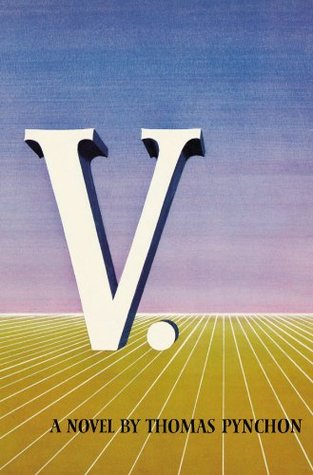
More on this book
Community


Kindle Notes & Highlights


overhead, turning everybody’s face green and ugly, shone mercury-vapor lamps, receding in an asymmetric V to the east where it’s dark and there are no more bars.
“Don’t you know,” said Dahoud, “that life is the most precious possession you have?” “Ho, ho,” said Ploy through his tears. “Why?” “Because,” said Dahoud, “without it, you’d be dead.”
Overhead every few seconds a horn sounded off to warn away anything on collision course. But yet as if there were nothing on the roads after all but ships, untenanted, inanimate, making noises at one another which meant nothing more than the turbulence of the screws or the snow-hiss on the water.
How could he tell soulless stomachs? Harangue with oil and vinegar, supplicate with heart of palm.
Love for an object, this was new to him. When he found out not long after this that the same thing was with Rachel and her MG, he had his first intelligence that something had been going on under the rose, maybe for longer and with more people than he would care to think about.
He reflected that here was another inanimate object that had nearly killed him. He was not sure whether he meant Rachel or the car.
He dragged on her cigarette and wondered if he had a compulsion to suicide. It seemed sometimes that he put himself deliberately in the way of hostile objects, as if he were looking to get schlimazzeled out of existence.
Daughters are constrained to pace demure and darkeyed like so many Rapunzels within the magic frontiers of a country where the elfin architecture of Chinese restaurants, seafood palaces and split-level synagogues is often enchanting as the sea; until they have ripened enough to be sent off to the mountains and colleges of the Northeast.
(Inanimate objects could do what they wanted. Not what they wanted because things do not want; only men. But things do what they do,
He never got beyond or behind the chatter about her world—one of objects coveted or valued, an atmosphere Profane couldn’t breathe.
Till midnight they played blackjack for all the contraceptives Wedge had not used over the summer. These numbered about a hundred. Profane borrowed fifty and had a winning streak. When he’d cleaned Wedge out, Wedge dashed away to borrow more. He was back five minutes later, shaking his head. “Nobody believed me.”
though they only thought about one another at random, though her yo-yo hand was usually busy at other things, now and again would come the invisible, umbilical tug, like tonight mnemonic, arousing, and he would wonder how much his own man he was.
“Who hasn’t seen that. It happens for other reasons besides war. Why blame war. I was born in a Hooverville, before the war.” “That’s it,” Paola said. “Je suis né. Being born. That’s all you have to do.”
Dewey’s voice sounded like part of the inanimate wind, so high overhead.
“Well, almost,” he said, to the gone bird, to the snow.
She was saying, “Come home.” The only one he would allow to tell him this except for an internal voice he would rather disown as prodigal than listen to.
If you look from the side at a planet swinging around in its orbit, split the sun with a mirror and imagine a string, it all looks like a yo-yo. The point furthest from the sun is called aphelion. The point furthest from the yo-yo hand is called, by analogy, apocheir.
If anybody had been around to remember him they would have noticed right off that Profane hadn’t changed. Still a great amoebalike boy, soft and fat, hair cropped close and growing in patches, eyes small like a pig’s and set too far apart.
He walked; walked, he thought sometimes, the aisles of a bright, gigantic supermarket, his only function to want.
All the rests of his morning songs were silent cuss words.
They swung from the handle-grips, shimmied up the poles; Tolito tossing Kook the seven-year-old about the car like a beanbag and behind it all, clobbering polyrhythmic to the racketing of the shuttle, José on his tin drum, forearms and hands vibrating out beyond the persistence of vision, and a tireless smile across his teeth wide as the West Side.
To Profane, alone in the street, it would always seem maybe he was looking for something too to make the fact of his own disassembly plausible as that of any machine.
was it only the mirror world that counted; only a promise of a kind that the inward bow of a nose-bridge or a promontory of extra cartilage at the chin meant a reversal of ill fortune such that the world of the altered would thenceforth run on mirror-time; work and love by mirror-light and be only, till death stopped the heart’s ticking (metronome’s music) quietly as light ceases to vibrate, an imp’s dance under the century’s own chandeliers. . . .
Her eyes glittered like the slopes of adjacent sawteeth.
She looked “hypocrite” at him.
Individuals do what they want, but the chain goes on and small forces like me will never prevail against it.
“My bank balance is big enough so I don’t get disillusioned,” he said.
all they had to look at each other by was one gas burner on the stove, which bloomed in a blue and yellow minaret, making the faces masks, their eyes expressionless sheets of light.
The party, as if it were inanimate after all, unwound like a clock’s mainspring toward the edges of the chocolate room, seeking some easing of its own tension, some equilibrium.
You felt she’d done a thousand secret things to her eyes. They needed no haze of cigarette smoke to look at you out of sexy and fathomless, but carried their own along with them.
Smoke seemed to be in her voice, in her movements; making her all the more substantial, more there, as if words, glances, small lewdnesses could only become baffled and brought to rest like smoke in her long hair; remain there useless till she released them, accidentally and unknowingly, with a toss of her head.
Her back was to him; through the entrance to the kitchen he could see the shadow of her spine’s indentation snaking down a deeper black along the black of her sweater, see the tiny movements of her head and hair as she listened.
the network of white halls in his own brain: these featureless corridors he keeps swept and correct for occasional visiting agents. Envoys from the zones of human crucified, the fabled districts of human love.
He didn’t particularly care to wake; but realized that if he didn’t he would soon be sleeping alone.
The pattern would have been familiar—bohemian, creative, arty—except that it was even further removed from reality, Romanticism in its furthest decadence; being only an exhausted impersonation of poverty, rebellion and artistic “soul.” For it was the unhappy fact that most of them worked for a living and obtained the substance of their conversation from the pages of Time magazine and like publications.
The group on the stand had no piano: it was bass, drums, McClintic and a boy he had found in the Ozarks who blew a natural horn in F. The drummer was a group man who avoided pyrotechnics, which may have irritated the college crowd. The bass was small and evil-looking and his eyes were yellow with pinpoints in the center. He talked to his instrument. It was taller than he was and didn’t seem to be listening.
Since the soul of Charlie Parker had dissolved away into a hostile March wind nearly a year before, a great deal of nonsense had been spoken and written about him. Much more was to come, some is still being written today. He was the greatest alto on the postwar scene and when he left it some curious negative will—a reluctance and refusal to believe in the final, cold fact—possessed the lunatic fringe to scrawl in every subway station, on sidewalks, in pissoirs, the denial: “Bird Lives.”
Outside the wind had its own permanent gig. And was still blowing.
V. ambiguously a beast of venery, chased like the hart, hind or hare, chased like an obsolete, or bizarre, or forbidden form of sexual delight.
He tended each seashell on his submarine scungilli farm, tender and impartial, moving awkwardly about his staked preserve on the harborbed, carefully avoiding the little dark deep right there in the midst of the tame shellfish, down in which God knew what lived:
Though he’d been there over coffee not fifteen minutes, already he seemed as permanent a landscape’s feature as the equestrian statue of Mohammed Ali itself. Certain Englishmen, Aïeul knew, have this talent. But they’re usually not tourists.
(How many times had they stood this way: dwarfed horizontal and vertical by any plaza or late-afternoon? Could an argument from design be predicated on that instant only, then the two must have been displaceable, like minor chess pieces, anywhere across Europe’s board. Both of a color though one hanging back diagonal in deference to his partner, both scanning any embassy’s parquetry for signs of some dimly sensed opposition—lover, meal-ticket, object of political assassination—any statue’s face for a reassurance of self-agency and perhaps, unhappily, self-humanity; might they be trying not to
...more
Let them make holiday while they could. Soon enough the fine clothes would be rags and the elegant woodwork crusted with blood. Yusef was an anarchist.
If it should come to a morning, any morning when all the muezzins were silent, the pigeons gone to hide among the catacombs, could he rise robeless in Nothing’s dawn and do what he must?
If no one happened to be in earshot they traded insults, some coarse, some ingenious, all following the Levantine pattern of proceeding backward through the other’s ancestry, creating extempore at each step or generation an even more improbable and bizarre misalliance.
How, Yusef wondered, can two men joke like that and tomorrow be enemies. Perhaps they’d been enemies yesterday. He decided public servants weren’t human.
Good timing, Max noted. And the gestures preceded the lines as they should. Whoever they were it was none of your amateur night.
Seven years he’d made the same leisurely run, and the train had never been on time. Schedules were for the line’s owners, for those who calculated profit and loss. The train itself ran on a different clock—its own, which no human could read.
Men, he felt, even perhaps Sephardim, are at the mercy of the earth and its seas. Whether a cataclysm is accident or design, they need a God to keep them from harm.
There’s no organized effort about it but there remains a grand joke on all visitors to Baedeker’s world: the permanent residents are actually humans in disguise.
