
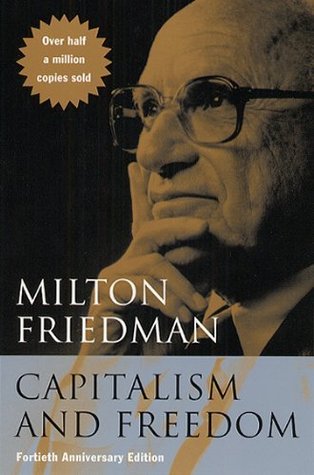
More on this book
Community


Kindle Notes & Highlights


the great disadvantage of either governmental regulation or governmental operation of monopoly is that it is exceedingly difficult to reverse.
inclined to urge that the least of the evils is private unregulated monopoly wherever this is tolerable.
Fortunately, the areas in which technical considerations make monopoly a likely or a probable outcome are fairly limited.
They would offer no serious threat to the preservation of a free economy if it were not for the tendency of regulation, introduced on this ground, to spread to situations in which it is not so justified.
Probably the most important source of monopoly power has been government assistan...
This highlight has been truncated due to consecutive passage length restrictions.
indirect assistance to monopoly consists of measures taken for other purposes which have as a largely unintended effect the imposition of limitations o...
This highlight has been truncated due to consecutive passage length restrictions.
tariffs, tax legislation, and law enforcement and legislation with resp...
This highlight has been truncated due to consecutive passage length restrictions.
Such reinvestment will tend to raise the capital value of its stock. Stockholders who would have saved the funds if distributed can simply hold the stock and postpone all taxes until they sell the stock.
“People of the same trade seldom meet together, even for merriment and diversion, but the conversation ends in a conspiracy against the public, or in some contrivance to raise prices.”3 Such collusion or private cartel arrangements
are therefore constantly arising.
Beyond this, the most important and effective step toward the reduction of monopoly power would be an extensive reform of the tax laws.
The corporate tax should be abolished. Whether this is done or not, corporations should be required to attribute to individual stockholders earnings which are not paid out as dividends.
Few measures would do more to invigorate capital markets, to stimulate enterprise, and to promote effective competition.
There are three different grounds on which it seems to me registration can be justified consistently with liberal principles.
Third, and this is the one possible justification for registration which is close to our main interest, registration may be a means to protect consumers against fraud.
liberal principles assign to the state the power to enforce contracts, and fraud involves the violation of a contract.
The main argument that is relevant to a liberal is the existence of neighborhood effects.
The first is normative and ethical: what is the justification for state intervention to promote equality?
what has been the effect of the measures actually taken?
The ethical principle that would directly justify the distribution of income in a free market society is, “To each according to what he and the instruments he owns produces.”
Marx recognized the role of capital in producing the product but regarded capital as embodied labor.
“Present and past labor produce the whole of the product. Present labor gets only part of the product.” The logical conclusion is presumably “Past labor is exploited,” and the inference for action is that past labor should get more of the product, though it is by no means clear how, unless it be in elegant tombstones.
The achievement of allocation of resources without compulsion is the major instrumental role in the market place of distr...
This highlight has been truncated due to consecutive passage length restrictions.
A capitalist system involving payment in accordance with product can be, and in practice is, characterized by considerable inequality of income and wealth.
This fact is frequently misinterpreted to mean that capitalism and free enterprise produce wider inequality than alternative systems and, as a corollary, that the extension and development of capitalism has meant increased inequality.
The great achievement of capitalism has not been
the accumulation of property, it has been the opportunities it has offered to men
and women to extend and develop and improve t...
This highlight has been truncated due to consecutive passage length restrictions.
Another striking fact, contrary to popular conception, is that capitalism leads to less inequality than alternative systems of organization and that the development of capitalism has greatly lessened the extent of inequality.
I believe that the changing distribution of families by number of children is the most important single factor that has reduced inequality of levels of living in this country during the past half century.
The methods that governments have used most widely to alter the distribution of income have been graduated income and inheritance taxation.
My impression is that these tax measures have had a relatively minor, though not negligible, effect in the direction of narrowing the differences between the average position of groups of families classified by some statistical measures of income. However, they have also introduced essentially arbitrary inequalities of comparable magnitude between persons within such income classes.
income tax structure that seems to me best is a flat-rate tax on income above an exemption, with income defined very broadly and deductions allowed only for strictly defined expenses of earning income.
Much of the actual inequality derives from imperfections of the market. Many of these have themselves been created by government action or could be removed by government action.
For example, special monopoly privileges granted by government, tariffs, and other legal enactments benefiting particular groups, are a source of inequality.
funds are to be used to help the poor, would they not be used more effectively by being given in cash rather than in kind?
Minimum wage laws Minimum wage laws are about as clear a case as one can find of a measure the effects of which are precisely the opposite of those intended by the men of good will who support it.
Farm price supports Farm price supports are another example. Insofar as they can be justified at all on grounds other than the political fact that rural areas are over-represented in the electoral college and Congress, it must be on the belief that farmers on the average have low incomes. Even if this be accepted as a fact, farm
What conceivable justification is there for taxing the young to subsidize the old regardless of the economic status of the old; for imposing a higher rate of tax for this purpose on the low incomes than on the high; or, for that matter, for raising the revenues to pay the subsidy by a tax on payrolls?
Those of us who believe in freedom must believe also in the freedom of individuals to make their own mistakes.
Humility is the distinguishing virtue of the believer in freedom; arrogance, of the paternalist.
It did not arise because people were improvident and failed to provide for their old age. It was a consequence, as we have seen, of government mismanagement.
The arrangement that recommends itself on purely mechanical grounds is a negative income tax.
The heart of the liberal philosophy is a belief in the dignity of the individual, in his freedom to make the most of his capacities and opportunities according to his own lights, subject only to the proviso that he not interfere with the freedom of other individuals to do the same.
“The beneficial effect of State intervention, especially in the form of legislation, is direct, immediate, and, so to speak, visible, whilst its evil effects are gradual and indirect, and lie out of sight. . . . Nor . . . do most people keep in mind that State inspectors may be incompetent, careless, or even occasionally corrupt .
