
More on this book
Community


Kindle Notes & Highlights


All rights reserved. Originally published 1962
Reissued with a new Preface in 1982, and again in 2002. Printed in the United States of America
In 1976 he was awarded the Nobel Memorial Prize in Economics. With his wife, Rose D. Friedman, he wrote the best-selling book, Free to Choose (1980) and a joint memoir (1998).
The limited increase in economic freedom has changed the face of China, strikingly confirming our faith in the power of free markets.
China is still very far from being a free society, but there is no doubt that the residents of China are freer and more prosperous than they were under Mao—freer in every dimension except the political.
And there are even the first small signs of some increase in political freedom, manifested in the election of some officials in a growing number of villages. China has far to go...
This highlight has been truncated due to consecutive passage length restrictions.
Preface, 1982
two books cannot, we believe, be explained by a difference in
“The only person who can truly persuade you is yourself. You must turn the issues over in your mind at leisure, consider the many arguments, let them simmer, and after a long time turn your preferences into convictions.”
IN A MUCH QUOTED PASSAGE in his inaugural address, President Kennedy said, “Ask not what your country can do for you—ask what you can do for your country.” It is a striking sign of the temper of our times that the controversy about this passage centered on its origin and not on its content. Neither half of the statement expresses a relation between the citizen and his government that is worthy of the ideals of free men in a free society. The paternalistic “what your country can do for you” implies that government is the patron, the citizen the ward, a view that is at odds with the free man’s
...more
The free man will ask neither what his country can do for him nor what he can do for his country. He will ask rather “What can I and my compatriots do through government” to help us discharge our individual responsibilities, to achieve our several goals and purposes, and above all, to protect our freedom?
How can we keep the government we create from becoming a Frankenstein that will destroy the very freedom we establish it to protect?
Fr...
This highlight has been truncated due to consecutive passage length restrictions.
Our minds tell us, and history confirms, that the great threat to freedom is the...
This highlight has been truncated due to consecutive passage length restrictions.
Government is necessary to preserve our freedom, it is an instrument through which we can exercise our freedom; yet by concentrating power in politic...
This highlight has been truncated due to consecutive passage length restrictions.
How can we benefit from the promise of government while avoiding the threat to freedom?
But there is also a constructive reason. The great advances of civilization, whether in architecture or painting, in science or literature, in industry or agriculture, have never come from centralized government.
Newton and Leibnitz; Einstein and Bohr; Shakespeare, Milton, and Pasternak; Whitney, McCormick, Edison, and Ford; Jane Addams, Florence Nightingale, and Albert Schweitzer; no one of these opened new frontiers in human knowledge and understanding, in literature, in technical possibilities, or in the relief of human misery in response to governmental directives.
Their achievements were the product of individual genius, of strongly held minority views, of a social climate permitting variety and diversity.
Government can never duplicate the variety and diversity of individual action. At any moment in time, by imposing uniform standards in housing, or nutrition, or clothing, government could undoubtedly improve the level of living of many individuals; by imposing uniform standards in schooling, road construction, or sanitation, central government could undoubtedly improve...
This highlight has been truncated due to consecutive passage length restrictions.
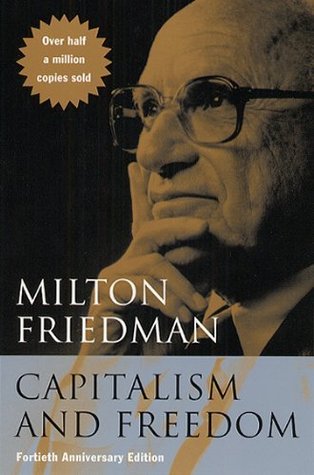
This book discusses some of these great issues. Its major theme is the role of competitive capitalism—the organization of the bulk of economic activity through private enterprise operating in a free market—as a system of economic freedom and a necessary condition for political freedom. Its minor theme is the role that government should play in a society dedicated to freedom and relying primarily on the market to organize economic activity.
The first two chapters deal with these issues on an abstract level, in terms of principles rather than concrete application.
IN THE 1920’s and the 1930’s, intellectuals in the United States were overwhelmingly persuaded that capitalism was a defective system inhibiting economic well-being and thereby freedom, and that the hope for the future lay in a greater measure of deliberate control by political authorities over economic affairs.
