
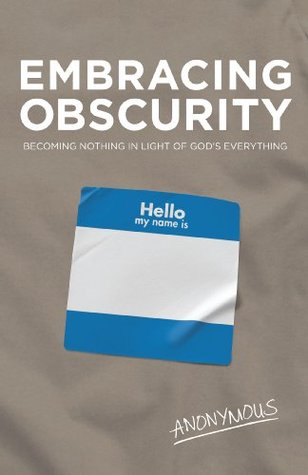
More on this book
Community


Kindle Notes & Highlights

by
Anonymous
Read between
November 12 - November 12, 2018

We’re intoxicated with a desire to be known, recognized, appreciated, and respected.
embracing obscurity is not about wiping ourselves from existence but rather, voluntarily, becoming nothing in light of everything God is and has promised us.
If any of us dare follow our suffering Servant-King, we must learn both to trust Him and to travel in His footsteps.
Wait . . . embrace obscurity? Who in their right mind would want to do that? And what would that do to my life? But no matter how much I resisted the implications, I knew—right then and there—I must. So began a journey—a sometimes painful journey—into the depth of Christ’s humility.
unimportance is good for the soul.
That’s what embracing obscurity is all about: being content with being “relatively unknown” so that Christ can be made more known.
what’s the one thing you’re tempted to bring up in the course of conversation when establishing your identity for the first time?
His success as a person—and in this case, as a believer—is interwoven into the success of “his” church.
By Christ’s own decree, we should be no more defined by the world than He is.
Did the earthly life of our Lord appear to be a thundering success? Would the statistics of souls won, crowds made into faithful disciples, sermons heeded, commands obeyed, be impressive? Hardly. Elisabeth Elliot1
So there was Jesus—Son of the everlasting God as homosapien, relying on His mommy to nurse Him and change His diapers. Ludicrathetic. Seriously, how can the magnitude of this escape us? How can we get through a complete day without falling on our knees in awe of this truth? What keeps us numb to the jaw-dropping implications of Creator becoming creature?
From God’s point of view, our value isn’t derived from how much money we’re worth, our great qualities or even our useful service. Our true and eternal value comes from something completely outside ourselves.
calls you by name. In fact, He knows everything about you, watches your every move, cares to know every inconsequential thought you have throughout the day. He knows you so well, He can tell you what you’re going to say, even before you say it. When you need someone to lead you, He’s on up ahead. When you need someone to get your back, He’s right behind you. No matter how far you wander, He’s right beside you. He can’t get enough of blessing you, guiding you, letting His light shine on you. If God were a scrapbooker, He’d have books and books of every memory of your life—from the moment you
...more
we reject the world’s shallow views of significance and instead find our true and lasting worth in Christ. Only this kind of significance produces the confidence we’ll need to live our lives following in the footsteps of our humble King.
the answer (Jesus was certainly no ascetic). No, the antibiotic for affluenza is a serum of one part simplicity, one part humility, and one hundred parts Christlikeness.
we can’t let our devotion be dictated by who’s watching.
One of the beauties of focusing our priority energies on kingdom work is that we don’t have much to lose if our earthly pursuits don’t turn out the way we hope.
Yes, God works all—even our suffering—for our good, but the end result may well look different than you had hoped. Will you still trust God if your “good” is to go on embracing obscurity—living in simplicity and devotion to Him—your entire life?
What if your “good” is to understand the deepest depths of suffering so that you have more to give to others who walk through dark times? Would you mind if your “good” is only a greater understanding of the suffering Jesus went through on your behalf and mine? What if your “good” is soley to make His name great?
Embracing obscurity allows us to relinquish our dreams for and to Him—to His timing and His ways. We prefer Him to the dream.
In a culture where dependency is seen as a weakness, this may not sound like a “gain” at all. But let’s consider what we know of God. First, He has at His disposal all the riches—material, relational, and spiritual—of the universe. Second, He loves to give good gifts to His children. Third, He knows exactly what we need and is committed to providing it—no more and no less. How much better to be dependent on, and expectant of, God than to rely on our finite ability to take care of ourselves.
your significance to God never was and never will be based on your accomplishments.
know and remember your limits. Contrary to how you might feel, you do in fact have physical, intellectual, emotional, and moral breaking points.
