
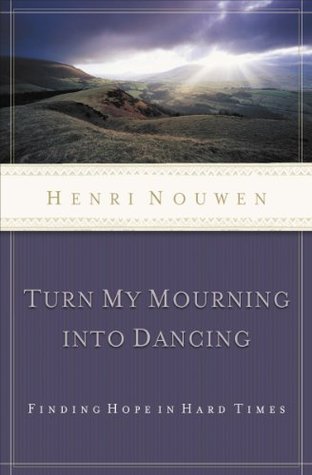
More on this book
Community


Kindle Notes & Highlights

The hardships we all endure require more than words, of course, even spiritual words. Eloquent phrases cannot soothe our deep pain. But we do find something to lead and guide us through. We hear an invitation to allow our mourning to become a place of healing, and our sadness a way through pain to dancing.
By inviting God into our difficulties, we ground life—even its sad moments—in joy and hope. When we stop grasping our lives, we can finally be given more than we could ever grab for ourselves. And we learn the way to a deeper love for others.
Ultimately mourning means facing what wounds us in the presence of One who can heal.
I realized that healing begins with our taking our pain out of its diabolic isolation and seeing that whatever we suffer, we suffer it in communion with all of humanity, and yes, all of creation. In so doing, we become participants in the great battle against the powers of darkness. Our little lives participate in something larger.
we are called to grieve our losses. It seems paradoxical, but healing and dancing begin with looking squarely at what causes us pain. We face the secret losses that have paralyzed us and kept us imprisoned in denial or shame or guilt. We do not nurse the illusion that we can hopscotch our way through difficulties. For by trying to hide parts of our story from God’s eye and our own consciousness, we become judges of our own past. We limit divine mercy to our human fears. Our efforts to disconnect ourselves from our own suffering end up disconnecting our suffering from God’s suffering for us.
...more

While Nouwen refers to paralysis in a metaphorical sense, we can also see this truth in the physical sense of bodily change that can bring social marginalization, shame, and isolation due to inaccessiblity and prejudice. We must acknowledge a defined sense of disability in order to heal the defended false optimism that blinds our reality to it.
Typically we see such hardship as an obstacle to what we think we should be—healthy, good-looking, free of discomfort. We consider suffering as annoying at best, meaningless at worst. We strive to get rid of our pains in whatever way we can. A part of us prefers the illusion that our losses are not real, that they come only as temporary interruptions. We thereby expend much energy in denial.
Several temptations feed this denial. Our incessant busyness, for example, becomes a way to escape what must some days be confronted. The world in which we live lies in the power of the Evil One, and the Evil One would prefer to distract us and fill every little space with things to do, people to meet, business to accomplish, products to be made. He does not allow any space for genuine grief and mourning.
The voice of evil also tries to tempt us to put on an invincible front. Words such as vulnerability, letting go, surrendering, crying, mourning, and grief are not to be found in the devil’s dictionary.
People are buried in ways that shroud death with euphemism and ornate furnishings. Institutions hide away the mentally ill and criminal offenders in a continuing denial that they belong to the human family. Even our daily customs lead us to cloak our feelings and speak politely through clenched teeth and prevent honest, healing confrontation. Friendships become superficial and temporary.
The Church is not exempt from this truth as they hideaway elderly and the disabled into segregated gatherings or seating, distancing themselves from inclusive participation or relational engagement with words like “affiliation”.
The way of Jesus looks very different. While Jesus brought great comfort and came with kind words and a healing touch, he did not come to take all our pains away. Jesus entered into Jerusalem in his last days on a donkey, like a clown at a parade. This was his way of reminding us that we fool ourselves when we insist on easy victories. When we think we can succeed in cloaking what ails us and our times in pleasantness. Much that is worthwhile comes only through confrontation.
I am less likely to deny my suffering when I learn how God uses it to mold me and draw me closer to him. I will be less likely to see my pains as interruptions to my plans and more able to see them as the means for God to make me ready to receive him. I let Christ live near my hurts and distractions.
One of life’s great questions centers not on what happens to us, but rather, how we will live in and through whatever happens. We cannot change most circumstances in our lives. I am white, middle class, and I have a good education. I have not always made conscious decisions about these things. Very little of what I have lived, in fact, has to do with what I have decided—whom I have known, where I came into the world, what personality tendencies have taken hold.
For in our suffering, not apart from it, Jesus enters our sadness, takes us by the hand, pulls us gently up to stand, and invites us to dance. We find the way to pray, as the psalmist did, “You have turned my mourning into dancing” (Ps. 30:11), because at the center of our grief we find the grace of God.
Our glory is hidden in our pain, if we allow God to bring the gift of himself in our experience of it. If we turn to God, not rebelling against our hurt, we let God transform it into greater good. We let others join us and discover it with us.
If God is found in our hard times, then all of life, no matter how apparently insignificant or difficult, can open us to God’s work among us. To be grateful does not mean repressing our remembered hurts. But as we come to God with our hurts—honestly, not superficially—something life changing can begin slowly to happen. We discover how God is the One who invites us to healing. We realize that any dance of celebration must weave both the sorrows and the blessings into a joyful step.
The mystery of the dance is that its movements are discovered in the mourning. To heal is to let the Holy Spirit call me to dance, to believe again, even amid my pain, that God will orchestrate and guide my life.
Gratitude in its deepest sense means to live life as a gift to be received thankfully. And true gratitude embraces all of life: the good and the bad, the joyful and the painful, the holy and the not-so-holy. We do this because we become aware of God’s life, God’s presence in the middle of all that happens.
If mourning and dancing are part of the same movement of grace, we can be grateful for every moment we have lived. We can claim our unique journey as God’s way to mold our hearts to greater conformity to Christ. The cross, the primary symbol of our faith, invites us to see grace where there is pain; to see resurrection where there is death. The call to be grateful is a call to trust that every moment can be claimed as the way of the cross that leads to new life. When Jesus spoke to his disciples before his death and offered them his body and blood as gifts of life, he shared with them
...more
Grateful people learn to celebrate even amid life’s hard and harrowing memories because they know that pruning is no mere punishment, but preparation.
Living with this kind of willingness to let go is one of the greatest challenges we face. Whether it concerns a person, possession, or personal reputation, in so many areas we hold on at all costs. We become heroic defenders of our dearly gained happiness. We treat our sometimes inevitable losses as failures in the battle of survival. The great paradox is that it is in letting go, we receive. We find safety in unexpected places of risk. And those who try to avoid all risk, those who would try to guarantee that their hearts will not be broken, end up in a self-created hell.
In so many ways, the more we insist on control and the more we resist the call to hold our lives lightly, the more we have to deny the reality of our losses and the more artificial our existence becomes. Our belief that we should grasp tightly what we need provides one of the great sources of our suffering. But letting go of possessions and plans and people allows us to enter, for all its risks, a life of new, unexpected freedom.
Another step in turning our mourning into dancing has to do with not clutching what we have, not trying to reserve a safe place we can rest in, not trying to choreograph our own or others’ lives, but to surrender to the God whom we love and want to follow. God invites us to experience our not being in control as an invitation to faith.
Awareness of how such illusions grip us often comes through a crisis or hardship. In the face of a great pain or inescapable grief, we realize how little we control our lives, how feebly our protests change reality. Something happens to make us realize we can let go of a cherished ambition, bid farewell to a friend, or accept an ailing body. We relinquish the hope of a marriage or career recognition that seems out of reach. We look in the mirror and admit that we are not strikingly handsome, not always the center of conversation at parties, not always brilliant. And we allow ourselves to
...more
The deepest joys come not from the money we earn, the friends we surround ourselves with, or the results we achieve; we are rather whom God made us to be in his infinite love. We are the gifts we are given, not just the conquests we wrest. As long as we keep running around, anxiously trying to affirm ourselves or be affirmed by others, we remain blind to One who has loved us first, dwells in our heart, and has formed our truest self. But we can also open our eyes. We can see a new way forward.
On the level of international relations, well-to-do countries, such as those where many of us live, build walls around our wealth so that no stranger can take it away from us. We build bombs to protect what we become convinced we must defend. But in a great irony, we thereby become captives of our own fears. Those who can make us afraid have power over us. Those who make us live in a house of fear ultimately take our freedom away.
Prayer then becomes an attitude that sees the world not as something to be possessed but as a gift that speaks constantly of the Giver. It leads us out of the suffering that comes from insisting on doing things our way. It opens our hearts to receive. And prayer refreshes our memory about how other people reveal to us the gift of life.
As we find freedom to cry out in our anguish or protest someone’s suffering, we discover ourselves slowly led into a new place. We become conditioned to wait for what we in our own strength cannot create or orchestrate. We realize that joy is not a matter of balloons and parties, not owning a house, or even having our children succeed in school. It has to do with a deep experience—an experience of Christ. In the quiet listening of prayer, we learn to make out the voice that says, “I love you, whoever else likes you or not. You are mine. Build your home in me as I have built my home in you.”
The gospel calls us continually to make Christ the source, the center, and the purpose of our lives. In him we find our home. In the safety of that place, our sadnesses can point us to God, even drive us into God’s loving embrace. Here mourning our losses ultimately lets us claim our belovedness. Mourning opens us to a future we could not imagine on our own—one that includes a dance.
In theology there is much talk of what God is, whom we understand God to be, how we perceive God to act. We speak of what we believe to be true. There will also be, if we do not insist on systematizing the Infinite and Ineffable, a lot of saying no—God is not just justice, not just love, not just freedom, not just this or that. God is greater than our hearts. We get enough glimpses to know that God surpasses our every ability to think or imagine.
Suddenly it can hit you how fleeting our existence is, how like water that we cannot hold in our hands. Recognizing this can fill us with sadness since it makes us realize that something of us is dying all the time. It may lead us to conclude that we should never expect much. It may make us forget that new possibilities almost always wait around the corner.
That is the enormous revolution, that in this fleeting, temporary world he comes to plant the seed of eternal life. In many ways that is what is meant by the term the spiritual life—the nurturing of the eternal amid the temporal, the lasting within the passing, God’s presence in the human family. It is the life of the divine Spirit within us. Become aware of this mysterious presence and life turns around. You sense joy even as others nurse complaints, you experience peace while the world conspires in war, and you find hope even when headlines broadcast despair. You discover a deep love even
...more
Fatalism afflicts us in many ways. It affects our relationships. We use labels and categories that prevent us from expecting anything new from each other.
When the word ‘disability’ is treated as a label, rather then a defined element in character, it allows prejudice and ableism to diminish the life potential and human value upon individuals. If it was instead held lightly as a revealing of defined human liminality and physical or mental embodiment, disability could redefine itself as individual and communal empowerment — the evolutional revelation of human potential itself.
This sort of fatalism and ableism is not necessarily absent from the internal wrestlings of the disabled themselves, either. They also must learn and repent of an ableist mindset in order to discover new potentials in life.
Fatalism may make us dependent on routines, on actions that we would feel urgency to change if we examined them. We may settle for finding satisfaction in dysfunctional, painful places, growing attached to our complaints, symptoms, addictions. One of the most insidious aspects of fatalism has to do with how it leads us to resist healing. We become hostage to a discouragement that insists that nothing more can be done. Fatalism reinforces our tenacious grasp on the old. We become stubbornly unwilling to consider anything outside our narrow experience. Fatalism can lead to depression, despair,
...more
Key here is to not ideologize our interpretations of healing. I may expect and want to walk again. But healing in God’s eyes may be learning to walk in spirit with the strength of Christ while carrying a cross that lifts and empowers my body in his glory.
A person of faith is willing to let new things happen and shoulder responsibilities that arise from unheard-of possibilities. Trust in God allows us to live with active expectation, not cynicism. When we view life as a gift, as something given to us by a loving God, not wrestled by us from an impersonal fate, we remember that at the heart of reality rests the love of God itself. This means that faith creates in us a new willingness to let God’s will be done.
Hope does not mean that we will avoid or be able to ignore suffering, of course. Indeed, hope born of faith becomes matured and purified through difficulty. The surprise we experience in hope, then, is not that, unexpectedly, things turn out better than expected. For even when they do not, we can still live with a keen hope. The basis of our hope has to do with the One who is stronger than life and suffering. Faith opens us up to God’s sustaining, healing presence. A person in difficulty can trust because of a belief that something else is possible. To trust is to allow for hope.
It is not always easy to resist impatience and boredom. Jesus told a story of ten virgins who took lamps and went to meet the coming bridegroom. Five were foolish and neglected to bring enough oil (Matt. 25:3). When the bridegroom finally came, their lamps were going out. Like them, when we cannot make the bridegroom come soon, we will sit down in self-complaint. Then our lamps go out. We risk missing the fulfillment of our deepest desires. But the impatient desire to bring into being great things, and the dull boredom we feel when things do not happen our way and we lose interest, shows that
...more
Hope is not dependent on peace in the land, justice in the world, and success in the business. Hope is willing to leave unanswered questions unanswered and unknown futures unknown. Hope makes you see God’s guiding hand not only in the gentle and pleasant moments but also in the shadows of disappointment and darkness.
And for all the insights of popularized psychology, all the programs on relationships, all the seminars and conferences on healthy relationships, we still often are not happy. And because of our culture’s emphasis on psychology and interpersonal relationships, we import a consumer mentality to our intimacies. We expect more of our friends and partners than they can (or want to) give. A fair amount of our suffering comes from our loneliness, a loneliness intensified by our high needs.
The Christian faith suggests another image: two hands resting together, parallel, in a prayerful gesture, pointing beyond themselves and moving freely in relation to one another. Only in this way can a relationship be truly lasting, because only in this way is mutual love experienced, love that participates in the greater and prior love to which it points. In this way we become persons to one another, in the literal sense of the word’s roots: “sounding through” (per means “through” and sonare suggests the idea of sound). So we “sound through” a love greater than ourselves and one that we can
...more
It is the central message of the gospel that God, who in no way is in competition with us, is the One who can be truly compassionate. It is because Jesus was not dependent on people, but only on God, that he could be so close to people, so concerned, so confronting, so healing, so caring. He related to people for their own sake, not his own. To say it in more psychological terms, he paid attention without intention. His question was not “How can I receive satisfaction?” but “How can I respond to your real need?” This is possible only when there is a deeper satisfaction, a deeper intimacy from
...more
When we become persons, we become transparent to each other, and light can shine through us, God can speak through us. When we become persons who transcend the limitations of our individual characters, the God who is love can reveal himself in our midst and bind us into a community. We become transparent. Others lose their opaqueness and reveal to us the loving face of our Lord.
Our life span, whether thirty years or ninety, gives us opportunities to say yes to a hidden gift from God, to a reality that, while difficult, provides a place for divine encounter and deep growth. To find healing means to belong completely to God, to be born into a life and love that is lasting. It has to do more with seeking first God’s kingdom and finding the deepest longings of our hearts fulfilled than the condition of our bodies.
Life is a school in which we are trained to depart. That is what mortification really means: training to die, to cut away the enslaving ties with the past. So that what we call death is not a surprise anymore, but the last of many gateways that lead to the full human person.
It is not just death that unsettles us, of course. It is the process of dying also. The slow deterioration of body and mind, the pain of a spreading cancer, the prospect of burdening friends, an inability to control our movements, a tendency to forget recent events or the names of family members, the suspicion that loved ones tell us only half the truth to “protect us”—all this understandably frightens us. No wonder we sometimes say, “I hope it won’t take long. I hope I die of an unexpected heart attack and not a prolonged disease.” We would manage and orchestrate even our final exit. But no
...more
This highlight has been truncated due to consecutive passage length restrictions.
If this is true, death is no longer the cruel destiny of man that ruins all efforts, turns every attempt to live into ridicule, and crushes all creativity into meaningless crumbs—it is a signal to deeper understanding. And in the light of Christ’s departure, we can say that we can love not in spite of death, but because of it.
