
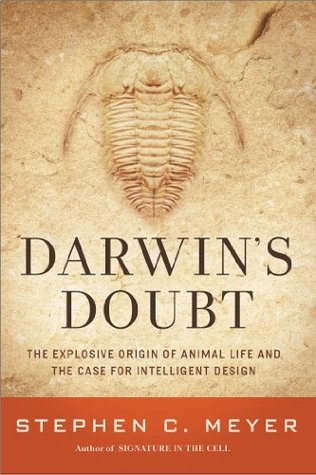
More on this book
Community


Kindle Notes & Highlights


Indeed, since the 1950s, when Watson and Crick first illuminated the chemical structure and information-bearing properties of DNA, biologists have come to understand that living things, as much as high-tech devices, depend upon digital information—information that, in the case of life, is stored in a four-character chemical code embedded within the twisting figure of a double helix.
Because of the importance of information to living things, it has now become apparent that many distinct “information revolutions” have occurred in the history of life—not revolutions of human discovery or invention, but revolutions involving dramatic increases in the information present within the living world itself. Scientists now know that building a living organism requires information, and building a fundamentally new form of life from a simpler form of life requires an immense amount of new information. Thus, wherever the fossil record testifies to the origin of a completely new form of
...more
Scientists attempting to explain the origin of life must explain how both information-rich molecules and the cell’s information-processing system arose.
The type of information present in living cells—that is, “specified” information in which the sequence of characters matters to the function of the sequence as a whole—has generated an acute mystery. No undirected physical or chemical process has demonstrated the capacity to produce specified information starting “from purely physical or chemical” precursors.
For this reason, chemical evolutionary theories have failed to solve the mystery of the origin of first life—a claim that few mainstre...
This highlight has been truncated due to consecutive passage length restrictions.
In Signature in the Cell, I not only reported the well-known impasse in origin-of-life studies; I also made an affirmative case for the theory of intelligent design. Although we don’t know of a material cause that generates functioning digital code from physical or chemical precursors, we do know—based upon our uniform and repeated experience—of one type of cause that has ...
This highlight has been truncated due to consecutive passage length restrictions.
information theorist Henry Quastl...
This highlight has been truncated due to consecutive passage length restrictions.
“The creation of information is habitually associated with c...
This highlight has been truncated due to consecutive passage length restrictions.
designing intelligence at work in the origin of the first life.
intelligent design provides the best explanation for the origin of the information necessary to produce the first life.
In other words, these critics cited an undirected process that acts on preexistent information-rich DNA to refute my argument about the failure of undirected material processes to produce information in DNA in the first place.2
refute Signature by arguing that evidence from the DNA of humans and lower primates showed that the genomes of these organisms had arisen as the result of an unguided, rather than intelligently designed, process—
even though my book did not address the question of human evolution or attempt to explain the origin of the human genome, and even though the process to which Ayala alluded clearly presupposed the existence of another information-rich genome in some hypothetical lower primate.3
the mammalian immune system can only perform the marvels it does because its mammalian hosts are already alive, and even though the mammalian immune system depends upon an elaborately preprogrammed form of adaptive capacity rich in genetic information—one that arose long after the origin of the first life. Another critic steadfastly maintained that “Meyer’s main argument” concerns “the inability of random mutation and selection to add information to [preexisting] DNA”4 and attempted to refute the book’s presumed critique of the neo-Darwinian mechanism of biological evolution accordingly.
After all, if natural selection and random mutations can generate new information in living organisms, why can it also not do so in a prebiotic environment? But the distinction between a biological and prebiotic context was crucially important to my argument. Natural selection assumes the existence of living organisms with a capacity to reproduce. Yet self-replication in all extant cells depends upon information-rich proteins and nucleic acids (DNA and RNA), and the origin of such information-rich molecules is precisely what origin-of-life research needs to explain. That’s
Because despite the widespread impression to the contrary—conveyed by textbooks, the popular media, and spokespersons for official science—the orthodox neo-Darwinian theory of biological evolution has reached an impasse nearly as acute as the one faced by chemical evolutionary theory.
Since 1980, when Harvard paleontologist Stephen Jay Gould declared that neo-Darwinism “is effectively dead, despite its persistence as textbook orthodoxy,”7 the weight of critical opinion in biology has grown steadily with each passing year.
Indeed, the problem of the origin of information lies at the root of a host of other acknowledged problems in contemporary Darwinian theory—from the origin of new body plans to the origin of complex structures and systems such as wings, feathers, eyes, echolocation, blood clotting, molecular machines, the amniotic egg, skin, nervous systems, and multicellularity, to name just a few.
As an increasing number of evolutionary biologists have noted, natural selection explains “only the survival of the fittest, not the arrival of the fittest.”12 The technical literature in biology is now replete with world-class biologists13 routinely expressing doubts about various aspects of neo-Darwinian theory, and especially about its central tenet, namely, the alleged creative power of the natural selection and mutation mechanism.
Today modern neo-Darwinism seems to enjoy almost universal acclaim among science journalists and bloggers, biology textbook writers, and other popular spokespersons for science as the great unifying theory of all biology. High-school and college textbooks present its tenets without qualification and do not acknowledge the existence of any significant scientific criticism
came home to me with particular poignancy as I was preparing to testify before the Texas State Board
Eugenie Scott,
At the same time, I was preparing a binder of one hundred peer-reviewed scientific articles in which biologists described significant problems with the theory—a binder later presented to the board during my testimony. So I knew—unequivocally—
Part One, “The Mystery of the Missing Fossils,” describes the problem that first generated Darwin’s doubt—the missing ancestors of the Cambrian animals in the earlier Precambrian fossil record—and then tells the story of the successive, but unsuccessful, attempts that biologists and paleontologists have made to resolve that mystery.
Part Two examines the problem of explaining how the unguided mechanism of natural selection and random mutations could have produced the biological information necessary to build the Cambrian animal forms.
This group of chapters explains why so many leading biologists now doubt the creative power of the neo-Darwinian mechanism and it presents four rigorous critiques of the mechanism based on recent biological research.
Part Three, “After Darw...
This highlight has been truncated due to consecutive passage length restrictions.
Like a great Gothic cathedral,
explaining phenomena in fields as diverse as
comparative a...
This highlight has been truncated due to consecutive passage length restrictions.
Darwin’s Origin explained many classes of biological evidence with just two central organizing ideas. The twin pillars of his theory were the ideas of
natural selection.
universal common ...
This highlight has been truncated due to consecutive passage length restrictions.
In a famous passage at the end of the Origin, Darwin argued that “all the organic beings which have ever lived on this earth have descended from some one primordial form.”1 Darwin thought that this primordial form gradually developed into new forms of life, which in turn gradually developed into other forms of life, eventually producing, after many millions of generations, all the complex life we see in the present.
usually depict this idea just as Darwin did, with a great branching tree. The trunk of Darwin’s tree of life represents the first primordial organism. The limbs and branches of the tree represent the many new forms of life that developed from it (see Fig. 1.1).
The
This highlight has been truncated due to consecutive passage length restrictions.
horizontal axis represents...
This highlight has been truncated due to consecutive passage length restrictions.
biologica...
This highlight has been truncated due to consecutive passage length restrictions.
what biologis...
This highlight has been truncated due to consecutive passage length restrictions.
history of life
“universal common descent”
Darwin argued that this idea best explained a variety of biological evidences:
succession of fossil forms,
the geographical distribution of va...
This highlight has been truncated due to consecutive passage length restrictions.
among otherwise highly distinc...
This highlight has been truncated due to consecutive passage length restrictions.
second ...
This highlight has been truncated due to consecutive passage length restrictions.
(the branching tree)
natural selection
natural selection by analogy
“artificial selection”
