
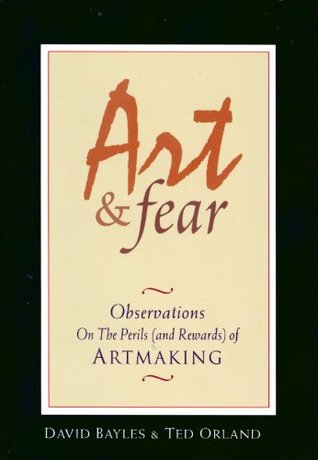
More on this book
Community


Kindle Notes & Highlights

by
David Bayles
Read between
January 25 - February 23, 2020

Writing is easy: all you do is sit staring at a blank sheet of paper until the drops of blood form on your forehead. — Gene Fowler
MAKING ART AND VIEWING ART ARE DIFFERENT AT THEIR CORE. The sane human being is satisfied that the best he / she can do at any given moment is the best he/she can do at any given moment.
Making art provides uncomfortably accurate feedback about the gap that inevitably exists between what you intended to do, and what you did. In fact, if artmaking did not tell you (the maker) so enormously much about yourself, then making art that matters to you would be impossible.
To all viewers but yourself, what matters is the product: the finished artwork. To you, and you alone, what matters is the process: the experience of shaping that artwork. The viewers’ concerns are not your concerns (although it’s dangerously easy to adopt their attitudes.) Their job is whatever it is: to be moved by art, to be entertained by it, to make a killing off it, whatever. Your job is to learn to work on your work.
Virtually all artists spend some of their time (and some artists spend virtually all of their time) producing work that no one else much cares about. It just seems to come with the territory.
Artists don’t get down to work until the pain of working is exceeded by the pain of not working. — Stephen DeStaebler
What separates artists from ex-artists is that those who challenge their fears, continue; those who don’t, quit.
After a few months’ practice, David lamented to his teacher, “But I can hear the music so much better in my head than I can get out of my fingers.” To which the Master replied, “What makes you think that ever changes?”
Lesson for the day: vision is always ahead of execution — and it should be. Vision, Uncertainty, and Knowledge of Materials are inevitabilities that all artists must acknowledge and learn from: vision is always ahead of execution, knowledge of materials is your contact with reality, and uncertainty is a virtue.
Uncertainty is the essential, inevitable and all-pervasive companion to your desire to make art. And tolerance for uncertainty is the prerequisite to succeeding.
Fears about artmaking fall into two families: fears about yourself, and fears about your reception by others. In a general way, fears about yourself prevent you from doing your best work, while fears about your reception by others prevent you from doing your own work.
The ceramics teacher announced on opening day that he was dividing the class into two groups. All those on the left side of the studio, he said, would be graded solely on the quantity of work they produced, all those on the right solely on its quality. His procedure was simple: on the final day of class he would bring in his bathroom scales and weigh the work of the “quantity” group: fifty pounds of pots rated an “A”, forty pounds a “B”, and so on. Those being graded on “quality”, however, needed to produce only one pot — albeit a perfect one — to get an “A”. Well, came grading time and a
...more
But the important point here is not that you have — or don’t have — what other artists have, but rather that it doesn’t matter. Whatever they have is something needed to do their work — it wouldn’t help you in your work even if you had it. Their magic is theirs. You don’t lack it. You don’t need it. It has nothing to do with you. Period.
The risk is fearsome: in making your real work you hand the audience the power to deny the understanding you seek; you hand them the power to say, “you’re not like us; you’re weird; you’re crazy.”
What is sometimes needed is simply an insulating period, a gap of pure time between the making of your art, and the time when you share it with outsiders.
Such respites also, perhaps, allow the finished work time to find its rightful place in the artist’s heart and mind — in short, a chance to be understood better by the maker.
Acceptance means having your work counted as the real thing; approval means having people like it. It’s not unusual to receive one without the other.
Your reach as a viewer is vastly greater than your reach as a maker. The art you can experience may have originated a thousand miles away or a thousand years ago, but the art you can make is irrevocably bound to the times and places of your life. Limited by the very ground on which you stand.
Decisive works of art participate directly in the fabric of history surrounding their maker. Simply put, you have to be there.
Only the maker (and then only with time) has a chance of knowing how important small conventions and rituals are in the practice of staying at work.
The hardest part of artmaking is living your life in such a way that your work gets done, over and over — and that means, among other things, finding a host of practices that are just plain useful.
Nonetheless the admonition stands: avoiding the unknown has considerable survival value.
“From the day I was hired I began cultivating a reputation within the Art Department of being sort of a flake. I found that after a year or so of losing track of my committee assignments, forgetting to answer memos and missing departmental meetings — well, after while they just stopped asking me to do all those things.”
Provocative art challenges not only the viewer, but also its maker. Art that falls short often does so not because the artist failed to meet the challenge, but because there was never a challenge there in the first place.
Artists who need ongoing reassurance that they’re on the right track routinely seek out challenges that offer the clear goals and measurable feedback — which is to say, technical challenges.
Simply put, art that deals with ideas is more interesting than art that deals with technique.
As the Zen proverb suggests, for the beginner there are many paths, for the advanced, few.
Science advances at the rate that technology provides tools of greater precision, while art advances at the pace that evolution provides minds with greater insight — a pace that is, for better or worse, glacially slow.
science is about classes of events, not particular instances.” Art is just the opposite.
Self-reference, repetition, parody, satire — art is nothing if not incestuous.
John Szarkowski once curated a show at the Museum of Modern Art titled Mirrors and Windows. His premise was that some artists view the world as if looking through a window at things happening “out there”, while others view the world as if looking in a mirror at a world inside themselves. Either way, the autobiographical vantage point is implicit.
Artmaking grants access to worlds that may be dangerous, sacred, forbidden, seductive, or all of the above. It grants access to worlds you may otherwise never fully engage. It may in fact be the engagement — not the art — that you seek.
When you start on a long journey, trees are trees, water is water, and mountains are mountains. After you have gone some distance, trees are no longer trees, water no longer water, mountains no longer mountains. But after you have travelled a great distance, trees are once again trees, water is once again water, mountains are once again mountains. — Zen teaching
The only work really worth doing — the only work you can do convincingly — is the work that focuses on the things you care about. To not focus on those issues is to deny the constants in your life.
To make art is to sing with the human voice. To do this you must first learn that the only voice you need is the voice you already have.
