
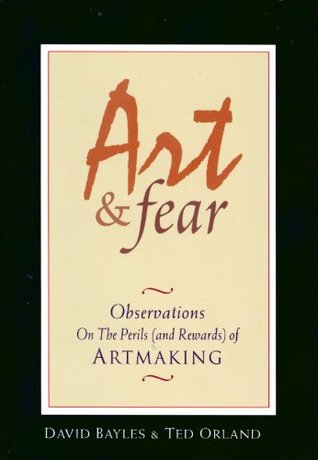
More on this book
Community


Kindle Notes & Highlights


To you, and you alone, what
matters is the process: the experience of shaping that artwork. The viewers’ concerns are not your concerns (although it’s dangerously easy to adopt their attitudes.) Their job is whatever it is: to be moved by art, to be entertained by it, to make a killing off it, whatever. Your job is to learn to work on your work.
The function of the overwhelming majority of your artwork is simply to teach you how to make the small fraction of your artwork that soars. One of the basic and difficult lessons every artist must learn is that even the failed pieces are essential. X-rays of famous paintings reveal that even master artists sometimes made basic mid-course corrections (or deleted really dumb mistakes) by overpainting the still-wet canvas.
moments when vision races ahead of execution.
And tolerance for uncertainty is the prerequisite to succeeding.
without a sense of direction or a goal to strive for, it won’t count for much. The world
You find reasons to procrastinate, since to not work is to not make mistakes.
But the important point here is not that you have — or don’t have — what other artists have, but rather that it doesn’t matter.
Worse yet, expectations drift into fantasies all too easily. At a recent writers’ workshop, the instructor labored heroically to keep the discussion centered upon issues of craft (as yet unlearned), while the writers (as yet unpublished) labored equally to divert the focus with questions about royalties, movie rights and sequels.
Conversely, expectations based on the work itself are the most useful tool the artist possesses.
What you need to know about the next piece is contained in the last piece. The place to learn about your materials is in the last use of your materials. The place to learn about your execution is in your execution. The best information about what you love is in your last contact with what you love. Put simply, your work is your guide: a complete, comprehensive, limitless reference book on your work.
There is no other such book, and it is yours alone. It functions this way for no one else. Your fingerprints are all over your work, ...
This highlight has been truncated due to consecutive passage length restrictions.
Ask your work what it needs, not what you need.
artists from Atget to Weegee were ignored through most of their careers because the work they produced didn’t fit within the established definition of
they were left making images of experiences they never quite had. If you find yourself caught in similar circumstances, we modestly offer this bit of cowboy wisdom: When your horse dies, get off.
There’s a difference between meaning that is embodied and meaning that is referenced. As someone once said, no one should wear a Greek fisherman’s hat except a Greek fisherman.
If you were working smoothly and now you are stuck, chances are you unnecessarily altered some approach that was already working perfectly well.
When things go haywire, your best opening strategy might be to return — very carefully and consciously — to the habits and practices in play the last time you felt good about the work. Return
while the veteran artist tends to employ a small and specific set. In time, as an artist’s gestures become more assured, the chosen tools become almost an extension of the artist’s own spirit. In time, exploration gives way to expression.
It can even be argued that you have an obligation to explore the possible variations, given that a single artistic question can yield many right answers. Productive times encourage you to build an extended body of work, one where all the pieces (even the flawed sketches that will never see the gallery wall) have a
the very best writings on art are not analytical or chronological; they are autobiographical. The artist, after all, was there.
the Master paints not the created thing, but the forces that created it.
have a way of taking on all the trappings of aesthetic standards. There is widespread agreement, for instance, that it’s a genuine challenge to impart rich blacks and subtle high values to a photographic print.
As this genre established itself, criteria for judging a print increasingly concentrated on the virtuoso technical performance needed to produce the desired tones. Subtlety of tone became, often quite literally, the primary content.
It’s all a matter of balance, and making art
helps achieve that balance. For the artist, a sketchpad or a notebook is a license to explore — it becomes entirely acceptable to stand there, for minutes on end, staring at a tree stump. Sometimes you need to scan the forest, sometimes you need to touch a single tree — if you can’t apprehend both, you’ll never entirely comprehend either. To see things is to enhance your sense of
wonder both for the singular pattern of your own experience, and for the meta-patterns that shape all experience. All this suggests a useful working approach to making art: notice the objects you notice. (e.g. Read that sentence again.) Or p...
This highlight has been truncated due to consecutive passage length restrictions.
Habits acquired from other artists are called — depending on the form they take — affectation, derivation, plagiarism or forgery.
Once developed, art habits are deep-seated, reliable, helpful, and convenient. Moreover, habits are stylistically important. In a sense, habits are style. The unconsidered gesture, the repeated phrasing, the automatic selection, the characteristic reaction to subject matter and materials — these are the very things we refer to as style.
Thus while the stone tools fashioned by cave dwellers an Ice Age ago are hopelessly primitive by current technological standards, their wall paintings remain as elegant and expressive as any modern art.
the answers you get depend upon the questions you ask. Where the scientist asks what equation would best describe the trajectory of an airborne rock, the artist asks what it would feel like to throw one.
Douglas Hofstadter noted, “is that science is about classes of events, not particular instances.” Art is just the opposite. Art deals in any one particular rock, with its welcome vagaries, its peculiarities of shape, its unevenness, its noise. The truths of life as we experience them — and as art expresses them — include random and distracting influences as essential parts of their nature. Theoretical rocks are the province of science; particular rocks are the province of art.
The world thus altered becomes a different world, with our alterations being part of it. The world we see today is the legacy of people noticing the world and commenting on it in forms that have been preserved. Of course it’s difficult to imagine that horses had no shape before someone painted their shape on the cave walls, but it is not difficult to see the world became a subtly larger, richer, more complex and meaningful place as a result.
autobiographical. John Szarkowski once curated a show at the Museum of Modern Art titled Mirrors and Windows. His premise was that some artists view the world as if looking through a window at things happening “out there”, while others view the world as if looking in a mirror at a world inside themselves.
us. Study French, for instance, and you’ll likely spend the first month painstakingly translating it word by word into English to make it understandable. Then one day — voilá! — you find yourself reading French without translating it, and a process that was previously enigmatic has become automatic. Or go mushroom hunting with someone who really knows mushrooms, and you’ll first endure some downright humiliating outings in which the expert finds all the mushrooms and you find none. But then at some point the world shifts, the woods magically fill — mushrooms
everywhere! — and a view that was previously opaque has become transparent.
For the artist, such lightning shifts are a central mechanism of change. They generate the purest form of metaphor: connections are made between unlike things, meanings from one enrich the meanings of the other, and the unlike things become inseparable. Before the leap there was light and shadow. Afterwards, objects float in a space where light and shadow are indistinguishable from the object they define.
When your only tool is a hammer, so the saying goes, everything looks like a nail.
Over the long run, the people with the interesting answers are those who ask the interesting questions.
The question that probably served as the seed crystal for this book was posed to the authors nearly twenty years earlier. The occasion was a friendly debate surrounding the formation of a small artists’ collective. The question was: Do artists have anything in common with each other? Like any good question, that one quickly generated a flurry of relatives: How do artists become artists? How do artists learn to work on their work? How can I make work that will satisfy me? For young artists filled with energy and idealism, the answers seemed just around the corner. Only as the years passed did
...more
share. The message across time from the painted bison and the carved ivory seal speaks not of the differences between the makers of that art and ourselves, but the similarities. Today those similarities lay hidden beneath urban complexity — audience, critics, economics, trivia — in a self-conscious world. Only in those moments when we are truly working on our own work do we recover the fundamental connection we share with all makers of art. The rest may be necessary, but it’s not art. Your job is to draw a line from your life to your art that is straight and clear.
