
More on this book
Community


Kindle Notes & Highlights

by
David Bayles
Read between
May 19 - May 21, 2018

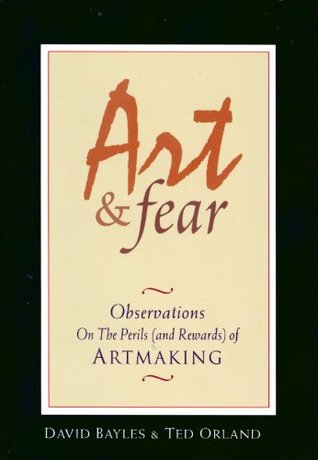
Making art now means working in the face of uncertainty ; it means living with doubt and contradiction, doing something no one much cares whether you do, and for which there may be neither audience nor reward. Making the work you want to make means setting aside these doubts so that you may see clearly what you have done, and thereby see where to go next. Making the work you want to make means finding nourishment within the work itself. This is not the Age of Faith, Truth and Certainty.
To all viewers but yourself, what matters is the product: the finished artwork. To you, and you alone, what matters is the process: the experience of shaping that artwork. The viewers’ concerns are not your concerns (although it’s dangerously easy to adopt their attitudes.) Their job is whatever it is: to be moved by art, to be entertained by it, to make a killing off it, whatever. Your job is to learn to work on your work.
Quitting is fundamentally different from stopping. The latter happens all the time. Quitting happens once. Quitting means not starting again — and art is all about starting again.
Joan Didion nailed this issue squarely (and with trademark pessimism) when she said, “What’s so hard about that first sentence is that you’re stuck with it. Everything else is going to flow out of that sentence. And by the time you’ve laid down the first two sentences, your options are all gone.”
The artist’s life is frustrating not because the passage is slow, but because he imagines it to be fast.
Art is like beginning a sentence before you know its ending. The risks are obvious: you may never get to the end of the sentence at all-or having gotten there, you may not have said anything. This is probably not a good idea in public speaking, but it’s an excellent idea in making art.
Talent is a snare and a delusion. In the end, the practical questions about talent come down to these: Who cares? Who would know? and What difference would it make? And the practical answers are: Nobody, Nobody, and None.
The ceramics teacher announced on opening day that he was dividing the class into two groups. All those on the left side of the studio, he said, would be graded solely on the quantity of work they produced, all those on the right solely on its quality. His procedure was simple: on the final day of class he would bring in his bathroom scales and weigh the work of the “quantity” group: fifty pounds of pots rated an “A”, forty pounds a “B”, and so on. Those being graded on “quality”, however, needed to produce only one pot — albeit a perfect one — to get an “A”. Well, came grading time and a
...more
to require perfection is to invite paralysis.
your work is your guide: a complete, comprehensive, limitless reference book on your work. There is no other such book, and it is yours alone. It functions this way for no one else. Your fingerprints are all over your work, and you alone know how they got there. Your work tells you about your working methods, your discipline, your strengths and weaknesses, your habitual gestures, your willingness to embrace.
the real question about acceptance is not whether your work will be viewed as art, but whether it will be viewed as your art.
in our artwork there is nothing but reaction. The breathtakingly wonderful thing about this reaction is its truthfulness. Look at your work and it tells you how it is when you hold back or when you embrace. When you are lazy, your art is lazy; when you hold back, it holds back; when you hesitate, it stands there staring, hands in its pockets. But when you commit, it comes on like blazes.
the progression of most artists’ work over time is a progression from art toward craft.
The difference between art and craft lies not in the tools you hold in your hands, but in the mental set that guides them. For the artisan, craft is an end in itself. For you, the artist, craft is the vehicle for expressing your vision. Craft is the visible edge of art.
Habits are the peripheral vision of the mind.
In a sense, habits are style.
