
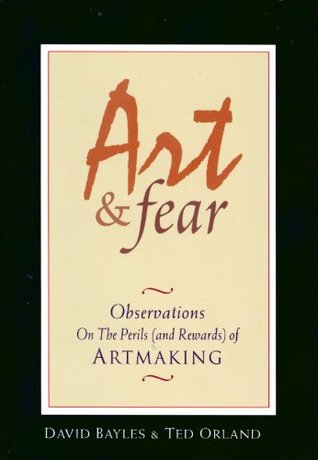
More on this book
Community


Kindle Notes & Highlights

by
David Bayles
Read between
September 7 - September 23, 2019

Making art is a common and intimately human activity, filled with all the perils (and rewards) that accompany any worthwhile effort. The difficulties artmakers face are not remote and heroic, but universal and familiar.
It’s easy to imagine that artists doubted their calling less when working in the service of God than when working in the service of self.
Making the work you want to make means finding nourishment within the work itself.
In large measure becoming an artist consists of learning to accept yourself, which makes your work personal, and in following your own voice, which makes your work distinctive.
To all viewers but yourself, what matters is the product: the finished artwork. To you, and you alone, what matters is the process: the experience of shaping that artwork. The viewers’ concerns are not your concerns (although it’s dangerously easy to adopt their attitudes.) Their job is whatever it is: to be moved by art, to be entertained by it, to make a killing off it, whatever. Your job is to learn to work on your work.
The function of the overwhelming majority of your artwork is simply to teach you how to make the small fraction of your artwork that soars. One of the basic and difficult lessons every artist must learn is that even the failed pieces are essential.
The best you can do is make art you care about — and lots of it!
Fear that your next work will fail is a normal, recurring and generally healthy part of the artmaking cycle.
Quitting is fundamentally different from stopping. The latter happens all the time. Quitting happens once. Quitting means not starting again — and art is all about starting again.
There’s a painful irony to stories like that, to discovering how frequently and easily success transmutes into depression. Avoiding this fate has something to do with not letting your current goal become your only goal.
What separates artists from ex-artists is that those who challenge their fears, continue; those who don’t, quit.
The development of an imagined piece into an actual piece is a progression of decreasing possibilities, as each step in execution reduces future options by converting one — and only one — possibility into a reality.
The artist’s life is frustrating not because the passage is slow, but because he imagines it to be fast.
while you may feel you’re just pretending that you’re an artist, there’s no way to pretend you’re making art.
Even at best talent remains a constant, and those who rely upon that gift alone, without developing further, peak quickly and soon fade to obscurity.
Art is human; error is human; ergo, art is error.
Such imperfections (or mistakes, if you’re feeling particularly depressed about them today) are your guides — valuable, reliable, objective, non-judgmental guides — to matters you need to reconsider or develop further.
Admittedly, artmaking probably does require something special, but just what that something might be has remained remarkably elusive — elusive enough to suggest that it may be something particular to each artist, rather than universal to them all.
Their magic is theirs. You don’t lack it. You don’t need it. It has nothing to do with you. Period.
it’s a delicate balance — lean too far one way and your head fills with unworkable fantasies, too far the other and you spend your life generating “To Do” lists.
What is sometimes needed is simply an insulating period, a gap of pure time between the making of your art, and the time when you share it with outsiders.
the far greater danger is not that the artist will fail to learn anything from the past, but will fail to teach anything new to the future.
When your horse dies, get off.
this security carries a price: risk-taking is discouraged, artistic development stunted, and personal style sublimated to fit a pre-existing mold.
heightened self-consciousness was rarely an issue in earlier times when it seemed self-evident that the artist (and everyone else, for that matter) had roots deeply intertwining their culture. Meanings and distinctions embodied within artworks were part of the fabric of everyday life, and the distance from art issues to all other issues was small.
Today, indeed, you can find urban white artists — people who could not reliably tell a coyote from a german shepherd at a hundred feet — casually incorporating the figure of Coyote the Trickster into their work.
If you were working smoothly and now you are stuck, chances are you unnecessarily altered some approach that was already working perfectly well.
A piece of art is the surface expression of a life lived within productive patterns.
There’s one hell of a lot more to art than just making it.
and no matter how benign this ready-made world may be, there will always be times when something is missing or doesn’t quite ring true. And so you make your place in the world by making part of it — by contributing some new part to the set. And surely one of the more astonishing rewards of artmaking comes when people make time to visit the world you have created.
if you chase two rabbits, you catch neither.
Learning is the natural reward of meetings with remarkable ideas, and remarkable people.
Training prepares you for a job; an education prepares you for life.
what we really gain from the artmaking of others is courage-by-association. Depth of contact grows as fears are shared — and thereby disarmed — and this comes from embracing art as process, and artists as kindred spirits. To the artist, art is a verb.
Zen proverb suggests, for the beginner there are many paths, for the advanced, few.
This is unavoidable : making any art piece inevitably engages the large themes and basic techniques that artists have used for centuries.
Once developed, art habits are deep-seated, reliable, helpful, and convenient. Moreover, habits are stylistically important. In a sense, habits are style.
an article of faith, among artists and scientists alike, that at some deep level their disciplines share a common ground. What science bears witness to experimentally, art has always known intuitively — that there is an innate rightness to the recurring forms of nature.
Your growth as the artist is a growth toward fully realizable works — works that become real in full illumination of all that you know. Including all you know about yourself.
