
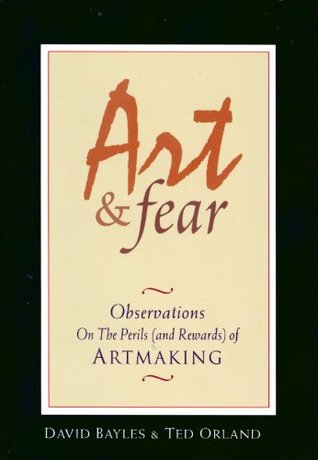
More on this book
Community


Kindle Notes & Highlights

by
David Bayles
Read between
January 24 - April 24, 2020

Consider that if artist equals self, then when (inevitably) you make flawed art, you are a flawed person, and when (worse yet) you make no art, you are no person at all! It seems far healthier to sidestep that vicious spiral by accepting many paths to successful artmaking — from reclusive to flamboyant, intuitive to intellectual, folk art to fine art. One of those paths is yours.
Life and Art, once entwined, can quickly become inseparable; at age ninety Frank Lloyd Wright was still designing, Imogen Cunning-ham still photographing, Stravinsky still composing, Picasso still painting.
Making art can feel dangerous and revealing. Making art is dangerous and revealing. Making art precipitates self-doubt, stirring deep waters that lay between what you know you should be, and what you fear you might be.
Lesson for the day: vision is always ahead of execution — and it should be.
All you can work on today is directly in front of you. Your job is to develop an imagination of the possible.
In the words of Ben Shahn, “The painter who stands before an empty canvas must think in terms of paint.”
For you, the seed for your next art work lies embedded in the imperfections of your current piece.
Put simply, your work is your guide: a complete, comprehensive, limitless reference book on your work. There is no other such book, and it is yours alone.
When my daughter was about seven years old, she asked me one day what I did at work. I told her I worked at the college — that my job was to teach people how to draw. She stared back at me, incredulous, and said, “You mean they forget?” — Howard Ikemoto
This is unavoidable : making any art piece inevitably engages the large themes and basic techniques that artists have used for centuries. Finding your own work is a process of distilling from each those
The artistic evidence for the constancy of interior issues is everywhere. It shows in the way most artists return to the same two or three stories again and again. It shows in the palette of Van Gogh, the characters of Hemingway, the orchestration of your favorite composer. We tell the stories we have to tell, stories of the things that draw us in — and why should any of us have more than a handful of those? The only work really worth doing — the only work you can do convincingly — is the work that focuses on the things you care about. To not focus on those issues is to deny the constants in
...more
