
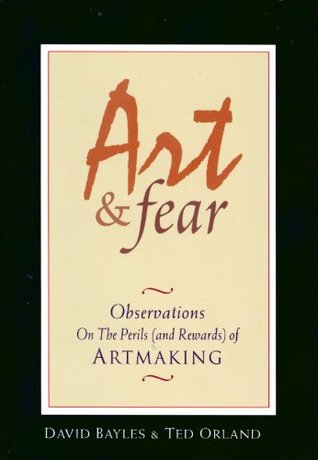
More on this book
Community


Kindle Notes & Highlights
by
David Bayles
Read between
November 20 - November 25, 2021

It is about committing your future to your own hands, placing Free Will above predestination, choice above chance. It is about finding your own work.
In large measure becoming an artist consists of learning to accept yourself, which makes your work personal, and in following your own voice, which makes your work distinctive.
The function of the overwhelming majority of your artwork is simply to teach you how to make the small fraction of your artwork that soars.
Yet however much they love you, it still remains as true for them as for the rest of the world: learning to make your work is not their problem.
If ninety-eight percent of our medical students were no longer practicing medicine five years after graduation, there would be a Senate investigation, yet that proportion of art majors are routinely consigned to an early professional death.
As Stanley Kunitz once commented, “The poem in the head is always perfect. Resistance begins when you try to convert it into language.”
most artists don’t daydream about making great art — they daydream about having made great art.
The materials of art, like the thumbnail sketch, seduce us with their potential.
Uncertainty is the essential, inevitable and all-pervasive companion to your desire to make art. And tolerance for uncertainty is the prerequisite to succeeding.
When you act out of fear, your fears come true.
Talent is a snare and a delusion.

Unless You have it .
Albert Einstein, even the seemingly perfect construct of mathematics yielded to his observation that “As far as the laws of mathematics refer to reality, they are not certain; and as far as they are certain, they do not refer to reality.”
if artists share any common view of magic, it is probably the fatalistic suspicion that when their own art turns out well, it’s a fluke-but when it turns out poorly, it’s an omen.
But the important point here is not that you have — or don’t have — what other artists have, but rather that it doesn’t matter. Whatever they have is something needed to do their work — it wouldn’t help you in your work even if you had it. Their magic is theirs. You don’t lack it. You don’t need it. It has nothing to do with you. Period.
When Columbus returned from the New World and proclaimed the earth was round, almost everyone else went right on believing the earth was flat. Then they died — and the next generation grew up believing the world was round. That’s how people change their minds.
Craft is the visible edge of art.
scientist asks what equation would best describe the trajectory of an airborne rock, the artist asks what it would feel like to throw one.
Or get hit by one. Or how it would effect the thrower to have thrown a rock that hit someone. Or how it would effect the throwee to have the thrower assault them like that.
In the end it all comes down to this: you have a choice (or more accurately a rolling tangle of choices) between giving your work your best shot and risking that it will not make you happy, or not giving it your best shot — and thereby guaranteeing that it will not make you happy. It becomes a choice between certainty and uncertainty. And curiously, uncertainty is the comforting choice.
