
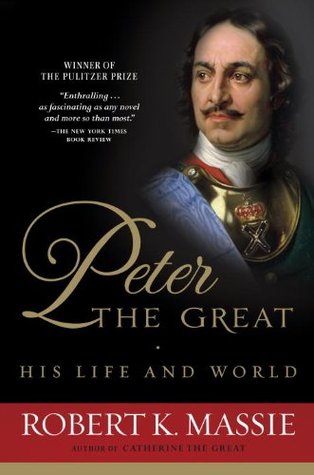
More on this book
Community


Kindle Notes & Highlights
Read between
October 9, 2020 - January 2, 2021

Sparrow Hills.

The Master and Margarita
Tsar Alexis, father of Peter the Great, and two of his sons, Fedor and Ivan VI, also both tsars, would lie in this small room, but they would be the last. Alexis’ third son, Peter, would build a new cathedral in a new city on the Baltic where he and all the Romanovs who followed would be entombed.*
Terem Palace
Alexis Mikhailovich,
Tsar Alexis was recognized in his own time as “tishaishy tsar,” the quietest, gentlest and most pious of all the tsars, and when he succeeded his father on the throne in 1645 at the age of sixteen, he was already known as “the Young Monk.”
Alexis’ favorite sport, falconry. Over the years, the enthusiastic huntsman built up an immense establishment of 200 falconers, 3,000 falcons and 100,000 pigeons.
Most of the time, however, Alexis prayed and worked.
Crimean Tatars, Islamic descendants of the old Mongol conquerors and vassals of the Ottoman sultan, who lived in villages along the slopes and among the crags of the mountainous Crimean peninsula.
twice, in 1382 and 1571, the Tatars had sacked and burned Moscow itself.
Russians are a communal people.
Few people in the world live in such harmony with nature as the Russians.
After 160 days of winter, spring lasts only for several weeks.
In Russia, the return of spring is greeted with a joy inconceivable in more temperate lands.
Orthodox faith.
fascinated by Western culture.
Natalya Naryshkina
Natalya Naryshkina
staff of dwarfs especially trained to act as servants and playmates to the royal children.
Peter’s favorite toys and his earliest games were military.
Intelligent, active and noisy, Peter grew rapidly. Most children walk at around one year; Peter walked at seven months.
on February 8, Tsar Alexis died.
Fedor was Tsar, and the great pendulum of power had swung back again from Naryshkin to Miloslavsky.
He was not a scholar, but he was unusually open and curious, and Zotov stimulated this curiosity;
Unfortunately, his scurvy-like disease frequently forced him to rule Russia lying on his back.
Fedor did carry out one great reform, the abolition of the medieval system of precedence, a crushing weight on public administration,
Fedor decreed that thereafter offices and power would be distributed on a basis of merit and not of birth, a principle which Peter would subsequently make the foundation of his own military and civilian administration.
Fedor’s death and the sudden elevation to the throne of her half-brother, Peter, rather than her full brother, Ivan, were terrible blows to Sophia.
the Streltsy, the shaggy, bearded pikemen and musketeers who guarded the Kremlin and were Russia’s first professional soldiers.
Thus, Sophia came to power. Now there was no opposition: Matveev was dead, Natalya was overwhelmed by the tragedy that had engulfed her family, Peter was a boy of ten. Yet Peter was still tsar.
Tsarevna Sophia become the regent.
Thus, Sophia assumed the leadership of the Russian state.
for the next seven years this extraordinary woman governed Russia.
The upheaval was over. In rapid and bewildering succession, a tsar had died; a ten-year-old boy, the minor child of a second wife, had been elected in his place; a savage military revolt had overthrown this election and spattered the young Tsar and his mother with the blood of their own family; and then, with all the jeweled panoply of state, the boy was crowned jointly with a frail and helpless older half-brother. Through all the horror, although he had been elected tsar, he was powerless to intervene. The Streltsy revolt marked Peter for life. The calm and security of his boyhood were
...more
Great Schism.
As Western Europe moved through the Reformation and the Renaissance and into the Enlightenment, Russia and her church remained pure—petrified in their medieval past.
Paul of Aleppo
For six years, Nikon acted as virtual ruler of Russia. He not only shared with the Tsar the title of “Great Sovereign,” but he often exercised purely political power over temporal affairs.
Nikon’s legacy was the opposite of that he had intended. Never again would a patriarch wield such power; thereafter the Russian church would be clearly subordinate to the state.
Thousands of people who refused to accept the reforms became known as Old Believers or Schismatics. Because the state was supporting the church reforms, revolt against the church widened into revolt against the state, and the Old Believers refused to obey either authority.
During a six-year period, from 1684 to 1690, 20,000 Old Believers voluntarily followed their leader into the flames, preferring martyrdom to accepting the religion of the Antichrist.
hunting lodge at Preobrazhenskoe on
obsession for the sea and his desire to learn from the West.
Eudoxia Lopukhina.
The eldest was the Tsarevich Alexis, whose tragic life would torment Peter. The second, an infant named Alexander, died after seven months.
Prince Vasily Vasilievich Golitsyn.
Golitsyn passionately admired France and Louis XIV;
Poles and Russians were traditional enemies.
Jan Sobieski,
It was not the Turks whom Sophia and Golitsyn were asked to attack, but their vassals, the Crimean Tatars.
In May 1687, a Russian army of 100,000 men began marching southward along the road to Orel and Poltava.
