
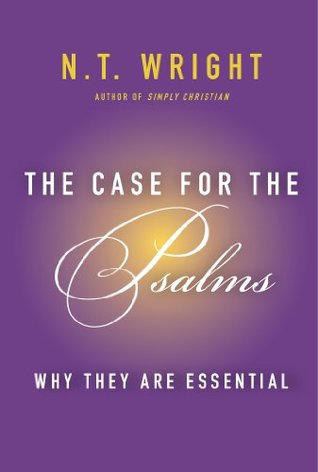
More on this book
Community


Kindle Notes & Highlights

by
N.T. Wright
Read between
August 6 - August 20, 2022

They are full of power and passion, horrendous misery and unrestrained jubilation, tender sensitivity and powerful hope. Anyone at all whose heart is open to new dimensions of human experience, anyone who loves good writing, anyone who wants a window into the bright lights and dark corners of the human soul—anyone open to the beautiful expression of a larger vision of reality should react to these poems like someone who hasn’t had a good meal for a week or two. It’s all here.
The Psalms offer us a way of joining in a chorus of praise and prayer that has been going on for millennia and across all cultures.
I propose in this book that the regular praying and singing of the Psalms is transformative.
This means, of course, that the Psalms were the hymnbook that Jesus and his first followers would have known by heart.
First, for me to think about the Psalms is like thinking about breathing.
Second, alongside that lifelong habit, I have been pondering the Psalms for a long time from the perspective of devout Jews in the second-Temple period.
The Psalms are enormously important in the New Testament, as a glance at any list of biblical quotations and allusions in the New Testament will reveal.
The philosophy of Epicurus, particularly in its developed exposition by the great Roman poet Lucretius (who lived about a century before Jesus), proposed that the world was not created by a god or the gods and that if such beings existed, they were remote from the world of humans. Our world and our own lives were simply part of an ongoing self-developing cosmos in which change, development, decay, and death itself operated entirely under their own steam.
At a popular level, the message was this: shrug your shoulders and enjoy life as best you can. Sounds familiar? This is the philosophy that our modern Western world has largely adopted as the norm.
Epicureanism, then, is of course an ancient worldview, but it has been retrieved in Western modernity as though it were a new thing.
they should equip us the better to live by and promote that alternative worldview. The biblical worldview, I will suggest, is both far more ancient than Epicureanism and also far more up-to-date.
The Psalms, I want to suggest here, are songs and poems that help us not just to understand this most ancient and relevant worldview but actually to inhabit and celebrate it—this worldview in which, contrary to most modern assumptions, God’s time and ours overlap and intersect, God’s space and ours overlap and interlock, and even (this is the really startling one, of course) the sheer material world of God’s creation is infused, suffused, and flooded with God’s own life and love and glory. The Psalms will indeed help us to understand all of this.
The Psalms are the steady, sustained subcurrent of healthy Christian living. They shaped the praying and vocation even of Jesus himself. They can and will do the same for us.
A poem (a good poem, at least) uses its poetic form to probe deeper into human experience than ordinary speech or writing is usually able to do, to pull back a veil and allow the hearer or reader to sense other dimensions.
The Psalms are there for every church to use in public worship, in creative and imaginative ways but also in ways that become familiar and traditional in the best sense, so that the worshipers can slip into them as one would into a comfortable suit of clothes.
This book, then, is an unashamed encouragement for all Christians to weave the Psalms into the very heart of their devotional life and to expect to find as they do this that the way they look out at the world will change bit by bit.
one of the basic spiritual laws is that you become like what you worship.
What’s more, people who learn the serious business of prayer often discover something that therapists in other traditions sometimes stumble upon as well: that prayer encourages a rhythm of breathing that facilitates a calmer and wiser bodily approach to life than might otherwise be the case.
All this points to the specifically Christian use of the Psalms. From the very beginning, the Christian church has seen the Psalms as containing, embodying, and expressing a thousand hints and forward pointers to Jesus himself.
am suggesting that the entire worldview that the Psalms are inculcating was to do with that intersection of our time, space, and matter with God’s, which Christians believe happened uniquely and dramatically in Jesus.
The Psalter forms the great epic poem of the creator and covenant God who will at the last visit redeem his people and, with them, his whole creation.
Scripture is, at its heart, the great story that we sing in order not just to learn it with our heads but to become part of it through and through, the story that in turn becomes part of us. And if that is true of scripture as a whole (and, in the New Testament, of the Gospels as a whole), we might say that the very heart of scripture, working properly like this, is the book of Psalms.
God gives us these poems, the Psalms, as a gift, in order that through our praying and singing of them he may give us as a gift to his world. We are called to be living, breathing, praying, singing poems.
Make us, in other words, to be people who know how to stand at the threshold of human time and God’s time, and there to learn both humility and hope.
This is the regular “now and not yet” of the people of God, with all the emotions raw and (as usual in these poems) on the surface. The celebration is wild and uninhibited; the misery is deep and horrible.
In the Bible, God not only called human beings to look after creation. He also called Israel to be the means of rescuing the world from the plight into which it had fallen.
Here is the ecstasy and the agony of the Old Testament: the rich, breathtaking vocation of Israel and the dark, tragic fact that this vocation, this rescue mission, was to be undertaken by a people who were themselves in sore need of the very same rescue.
All this is not simply a repeated assertion of national superiority, made in the teeth of the all-too-obvious national failures. It is a repeated assertion of the divine purpose, not only for Israel but through Israel. These psalms look beyond the present time to the coming time.
When we take the Psalms as a whole and learn to stand at their complex intersection of God’s time and ours, of the past Davidic kingdom with its flaws and failures and the coming kingdom of God, with Jesus at the middle of that sequence, we find that they themselves express the eschatological tension and invite us to stand exactly there.
It is a way of holding onto God in the darkness, even when—precisely when!—the problem is that God seems to have gone back on his word, to have abandoned his promises and his people, and particularly to have forgotten his specific promises to the king himself. The psalm offers a way of continuing to worship without pretense, eyes open to the terrible reality.
All this, it seems to me, apart from my sidelong reference to Jesus himself, would be readily understood by a second-Temple Jew used to hundreds of years of disappointed hopes and false dawns but with a memory as long as the covenant and a hope that refused to die.
We are given those psalms, I believe, so that we can pray them ourselves out of our own impatience. God in his wisdom knows that we shall want and need to express the pain of being caught in the crack of time.
We are called, then, to stretch out the arms of our minds and hearts, and to find ourselves, Christ shaped, cross shaped, at the intersection of the past, present, and future of God’s time and our own time. This is a place of intense pain and intense joy, the sort that perhaps only music and poetry can express or embody.
The living God establishes his throne in Zion so that from there his judgment will go out to all the nations:
This, of course, is why the pilgrim psalms, the Songs of Ascents, traditionally known as the songs to be sung by pilgrims on their way up to Jerusalem for the great festivals, are what they are. Jerusalem and the Temple itself are not just a convenient gathering point: they are the place of promise, the place of presence, the place out of all the earth where the living God has chosen to live:
Again and again the theme comes; it makes no sense, of course, in post-Enlightenment thought, but it fits perfectly within the creational and covenantal monotheism of ancient Israel. “May YHWH, maker of heaven and earth, bless you from Zion” (134.3).
Those who continued to sing and pray the Psalms throughout this period must, therefore, have been well used to living, as we saw in the previous chapter, in the tension between the past (when he had surely been there), the future (when he would surely return), and the puzzling present (when one might perhaps sense his presence but not yet in the full promised glory and rescuing power).
It is not, then, absolutely necessary to be in Jerusalem to know the presence of YHWH. We do not provide a dwelling place for him; he himself is our dwelling place. Psalm 141, another that speaks of YHWH as a “refuge” (141.8), sees personal and private prayer as the functional equivalent of being in the Temple—a necessity, of course, for the great majority of Jews even before the destruction of the Temple in AD 70, and for all of them thereafter:
But there are other psalms that pick up the prophetic warnings about casual or formalistic worship and take those warnings a stage further: YHWH does not actually want the kind of worship that goes on in the Temple half as much as he wants an obedient ear and heart.
Psalm 119 is a glorious extended meditation on the same theme, with the alphabetical backbone of the poem (each set of eight verses begins with the next letter of the Hebrew alphabet, a remarkable poetic feat in itself) making its own point about the word of God. The very script in which it is written can bring God’s order to human life.
The early Christians, wanting to explain their explosive sense of who Jesus really was, drew on the ancient theme of Israel’s God coming back at last to dwell in the midst of his people, to save them and bring his restorative and healing justice to the whole world.
Here is the challenge for those who take the New Testament seriously: try singing those psalms Christologically, thinking of Jesus as their ultimate fulfillment. See how they sound, what they do, where they take you.
But sing them also pneumatologically—that is, reflect, as you sing, on the New Testament’s vision of the church as the new Temple, indwelt by the Spirit of the living God. Watch how, without any complex theological or hermeneutical footwork, the early Christian vision of covenant renewal generates a fresh idea of sacred space. Or go back to Psalm 72 and see how those worldwide promises about David’s coming kingdom are fulfilled in the New Testament (as, for instance, in Matt. 28.16–20 or Rom. 15.7–13), up to and including the stunning concluding line: “Blessed be his glorious name forever; may
...more
The New Testament picks up all of these themes, so central to the Psalter, and sings them in a new key.
The early Christians did not imagine for a moment that they had “arrived” at the ultimate new creation. But with the resurrection of Jesus and the gift of the Spirit, that new creation had already broken into the world, and they were able to sing the ancient songs with, as it were, a whole new set of harmonies. Learning to sing them that way formed the heart of early Christian spirituality and the taproot of early Christian mission.
But this mention of God as the heart searcher is also taken from Psalm 44, in the verse (21) immediately before the one Paul quotes a bit later: God knows, says the psalmist, “the secrets of the heart.” The whole psalm, in fact, resonates with the whole of Romans 8,
We should not be surprised, then, that Paul finds in the Psalms both a map to see where he presently is (rejoicing in God’s victory while still surrounded by persecution and danger of every kind) and a means by which he can bring both his celebrations and his sorrows into the personal presence of the God who searches the hearts.
And at the heart of that new land, we see not a sacred building of bricks and mortar but a sacred people, whose very hearts have become the dwelling place of the living God by his Spirit, enabling them to be conformed to “the model of the image of his son,” the one in whom the Psalms’ greatest promises have found their fulfillment.
what looks to the flattened-out imagination of late Western modernity like “lifeless” matter is in fact a world throbbing with God-given life. That life is constantly praising its maker by being, particularly and peculiarly, what it is.
The old Anglican prayer book prescribes, to be prayed daily, Psalm 95 with its celebration of God’s creative power:
