
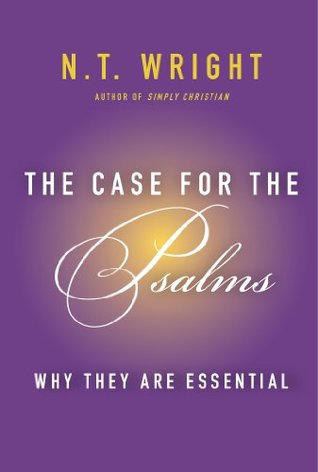
More on this book
Community


Kindle Notes & Highlights
by
N.T. Wright
Read between
January 15, 2020 - October 31, 2021

Actually, again and again it is we, muddled and puzzled and half-believing, who are the problem; and the question is more how we can find our way into their world, into the faith and hope that shine out in one psalm after another.
inhabit the great unceasing liturgy that is going on all the time in the heavenly realms.
In particular, I propose in this book that the regular praying and singing of the Psalms is transformative.
normal understandings of these for granted, it is my suggestion that the Psalms will gently but firmly transform our understandings of all of them.
This means, of course, that the Psalms were the hymnbook that Jesus and his first followers would have known by heart.
The main difference between the worldview of the first Christians and the worldview of most modern Western persons has nothing to do with “ancient” and “modern.” It has almost nothing to do, except at a tangent, with the development of modern science. The main difference is that the first Christians, being first-century Jews who believed that Israel’s God had fulfilled his ancient promises in Jesus of Nazareth, were what I and others call “creational monotheists”: that is, they believed that the one creator God, having made the world, remained in active and dynamic relation with it. What’s
...more
The problem we face when we read, pray, or sing parts of the Bible is not that it is “old” and our current philosophy is “new” (and therefore somehow better). The problem is that, out of many ancient worldviews, the Bible resolutely inhabits one, and much of the modern Western world has resolutely inhabited a different one.
Epicureanism, then, is of course an ancient worldview, but it has been retrieved in Western modernity as though it were a new thing.
Part of my reflection in this book is that when the Psalms do their work in us and through us, they should equip us the better to live by and promote that alternative worldview.
The Psalms invite their singers, as they always have, to live at the crossroads of time, space, and matter.
material world of God’s creation is infused, suffused, and flooded with God’s own life and love and glory.
That is why this book is not so much an invitation to study the Psalms—though that, too, is an immensely worthwhile exercise—but to pray and live the Psalms.
one of the basic spiritual laws is that you become like what you worship.
My point is deeper. I am suggesting that the entire worldview that the Psalms are inculcating was to do with that intersection of our time, space, and matter with God’s, which Christians believe happened uniquely and dramatically in Jesus.
It’s a matter of learning to live within the great complex narrative that, with hindsight, Christians have discerned as the story of Jesus himself.
The early Christians clearly continued to use the Psalms in their own worship and prayer and (not least) in their theology.

We still do! :D
In Luke’s Gospel, the risen Jesus explains to the puzzled and previously downcast disciples, “Everything written about me in the law of Moses, and in the prophets and the Psalms, had to be fulfilled” (Lk. 24.44).
Scripture is, at its heart, the great story that we sing in order not just to learn it with our heads but to become part of it through and through, the story that in turn becomes part of us.
One final word before we press on. Paul speaks at one point of Christians as “God’s poem,” God’s “artwork.” We are his “workmanship,” say some of the translations of Ephesians 2.10. The Greek word Paul uses there is poiēma, the very word from which the English word “poem” is derived.
The children of your servants shall live secure; their offspring shall be established in your presence. (102.23–28)
God created humans in the beginning to be his vice rulers over the world.
The real arrogance would be to refuse the vocation, imagining that we knew better than God the purpose for which we have been put here.
When the humans rebelled, he did not rescind that project. Instead, he called a human family in order that they might reflect not simply his wise ordering and stewardship into the world but now also his rescuing love into that same world, disastrously flawed as it now was.
Here is the ecstasy and the agony of the Old Testament: the rich, breathtaking vocation of Israel and the dark, tragic fact that this vocation, this rescue mission, was to be undertaken by a people who were themselves in sore need of the very same rescue.
