
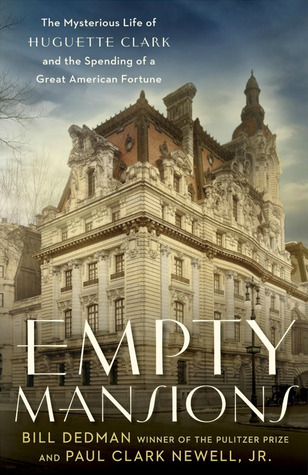
More on this book
Community


Kindle Notes & Highlights

by
Bill Dedman
Read between
October 23 - October 30, 2014

The length of history spanned by father and daughter is hard to comprehend. W. A. Clark was born in 1839, during the administration of the eighth president of the United States, Martin Van Buren. W.A. was twenty-two when the Civil War began. When Huguette was born in 1906, Theodore Roosevelt, the twenty-sixth president, was in the White House. Yet 170 years after W.A.’s birth, his youngest child was still alive at age 103 during the time of the forty-fourth president, Barack Obama.
Given Huguette’s shyness, in contrast to her outgoing father, it’s not surprising that there were Clark family stories claiming that W.A. wasn’t keen on her, even that he wasn’t actually her father, but these tales are belied by his warm mentions of her in his correspondence. In 1921, for example, W.A. wrote to a friend while he, Anna, and Huguette were on a Hawaiian vacation, describing with enthusiasm how mother and daughter sunned and rode surfboards at Waikiki Beach: “They take great delight in swimming and the beach at the Moana Hotel is very good. The board riding is particularly
...more
W.A.’s wife and children showed him great affection as well. A relative recalled Anna snuggling up to the old man and tugging on his whiskers playfully, with frolicsome affection.
Through the years, there was Clark family speculation that Huguette was in love with her handsome Cher Maître, or that he was in lust with her. Tadé Styka was mentioned occasionally in newspapers as a possible suitor of celebrities and the wealthy. In early 1923, when Huguette was just sixteen and Tadé was thirty-four, he was named as a rival to Charlie Chaplin for the affections of the sultry Polish actress Pola Negri, whom he had painted many times. But she moved on to the film heartthrob Rudolph Valentino, and Tadé wouldn’t marry until the 1940s.
Bill was a year older than Huguette, a tall, not unattractive man.
Then there was a frightening incident at the apartment. Huguette described a day in the late 1980s when a water delivery boy, or someone pretending to be a delivery boy, came to 8W. Huguette was up in 12W, getting something for one of her art projects. When she came back downstairs, she found the maid locked in the bathroom, with no sign of the delivery boy. As Huguette described it much later, “It was spooky.”
They had discovered something their 102-year-old aunt didn’t know: Her accountant was a felon.
It was at this reunion the relatives learned about criminal charges against Huguette’s accountant.
Kamsler was indicted on six felony counts of attempting to disseminate indecent material to minors and nine misdemeanor counts of attempting to endanger the welfare of a child.
Kamsler reached a plea deal with the prosecutor, pleading guilty in January 2009 to a single felony: attempting to disseminate indecent material to minors. He got no jail time, five years of probation, a $5,000 fine, one hundred hours of community service, and a listing on the state’s registry of sex offenders. The felon was allowed to continue working as a certified public accountant.
Kamsler’s full statement to the court, when his time came to show remorse, was simply this: “I just want to apologize to the Court, to my wife, to my family for what I have done, and the aggravation, and thank the court very much for their consideration and assistance in this.”
Kamsler, in line for more than $3 million in fees when this elderly client died, had waited a year and five months to tell her about his arrest on sex charges, and even then his letter didn’t disclose that he had explicit sex talk with people who had told him they were underage girls, or that he’d talked with them about meeting him, or that he was charged with multiple offenses over several years, or that he was undergoing sex therapy, or that he would remain a registered sex offender.
The godchildren said they were called in to a meeting in 1997, where Kamsler and Bock told them brusquely that only the country house would go to them, while the city apartment would go to Bock and Kamsler.
In Connecticut, a buyer emerged in 2014 for Huguette’s spare mansion, Le Beau Château, which had unraveled her privacy.
Eccentricity is not a psychiatric disorder.
For a recluse, Huguette had a lot of pen pals, her lifelong friends, most of them unknown to one another. She was a recluse in that she locked herself away from travel and sunsets and cafés, but a woman who leaves twenty thousand pages of affectionate correspondence is also a world traveler.
